

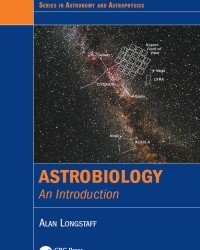
Alan Longstaff – Astrobiology. An Introduction (2015)
1.880 ₽
Автор: Alan Longstaff
Название книги: Astrobiology. An Introduction (2015)
Формат: PDF
Жанр: Биология
Страницы: 454
Качество: Изначально компьютерное, E-book
Astrobiology is a multidisciplinary pursuit that in various guises encompasses astronomy, chemistry, planetary and Earth sciences, and biology. It relies on mathematical, statistical, and computer modeling for theory, and space science, engineering, and computing to implement observational and experimental work. Consequently, when studying astrobiology, a broad scientific canvas is needed. For example, it is now clear that the Earth operates as a system; it is no longer appropriate to think in terms of geology, oceans, atmosphere, and life as being separate.
The idea that there is life on other worlds has a long history that stretches back at least
as far as the Greek philosophers’ writing in 400 BCE. More recently, Giordano Bruno
(1548–1600 CE) formulated a cosmology that was remarkably ahead of his time. He
subscribed to the Copernican heliocentric description of the solar system, considered
that the stars were other suns, and would be orbited by planets just as the sun is.
Moreover, he reasoned that there would be an infinite number of inhabited worlds. We
had to wait almost 400 years after Bruno’s dreadful execution for the first exoplanet
to be discovered. In the meantime, we have seen some fantastic claims, including
life on the moon, and even the sun! For the first half of the twentieth century, the
notion that Mars was inhabited was widely entertained; a view encouraged by illusory
canals, surface features that darken and lighten with the Martian seasons attributed
to the growth of vegetation and even, in 1956, the apparent detection of spectroscopic
evidence for plant life.
As a research enterprise, astrobiology—the study of the origin, nature, distribution,
and future of life in the universe—is young. The term exobiology, the study of
life elsewhere than on Earth, was first coined by the Nobel Prize-winning molecular
biologist Joshua Lederberg, who became a powerful advocate for the new field. It
emerged in the 1950s and 1960s from a convergence of planetary science, the search
for exoplanets, origin of life studies, and the Search for Extraterrestrial Intelligence
(SETI), four disciplines that use very different research methods and techniques and
started out with very different goals. Unlike exobiology, described disparagingly in
1964 by an evolutionary biologist as a science without a subject, astrobiology—its
successor—encompasses life on Earth. NASA has become its most important patron,
spending $1 billion on the 1977 Viking missions to search for life on Mars, and funding
much else, including biology programs.
Astrobiology is a multidisciplinary pursuit that in various guises encompasses
astronomy, chemistry, planetary and Earth sciences, and biology. It relies on mathematical,
statistical, and computer modeling for theory, and space science, engineering,
and computing to implement observational and experimental work. Consequently,
when studying astrobiology we need a broad scientific canvas. For example, it is now
clear that the Earth operates as a system; it is no longer appropriate to think in terms
of geology, oceans, atmosphere, and life as being separate. This textbook reflects this
multiscience approach, so if you are an astronomy major, there is some planetary science
and biology to get to grips with, if you are a biologist, be prepared to learn some
planetary science and astronomy, and if you are doing primarily Earth sciences—
well, you get the picture.
This book is introductory in the sense that there is no calculus or curly arrow chemistry,
nor details of modeling, and I have been sparing in areas that experience shows
students find hard, such as isotope geochemistry and molecular spectroscopy. Also I
provide reminders at appropriate places so that your study will not be compromised
by lack of a bit of physics, chemistry, or whatever. Despite that, some of the material is
not straightforward because there are uncertainties and controversies which is sometimes
instructive to follow.
Inevitably, it is not possible to cover everything. The astonishingly rapid rate of exoplanet
discoveries means that I have not included statistical data on exoplanets, since
anything I include now will be out-of-date within a few months. There are several
websites and computer applications that will allow you to mine the exoplanet database
and construct any number of graphical representations using the latest exoplanet
count if you wish. My choice of material has been dictated to some extent by the
emphasis of recent conferences and by ideas that seem as if they have a future. Thus,
my coverage of how life might have originated on Earth has focused (some might say
too much) on alkaline vents. My future defense will be that it seemed like a good idea
at the time! I have also taken the traditional line that life everywhere will be carbonand
water-based (for good reasons). There is often considerable speculation in the
media on matters astrobiological; just a “sniff” of water is seemingly enough to populate
a world. Yet NASA’s mantra, “follow the water,” has to be interpreted carefully:
water is the second most common molecule in the universe (after molecular hydrogen)
and most of the places where it is found would be inimical to life. Nonetheless, some
astrobiologists do consider not just whether worlds such as Mars, Titan, or Europa are
habitable, but what sort of organisms might make a living there—that is their job after
all—and although this is entirely speculative, where it is more plausible than fanciful
I have included it. But this material comes with a warning: we must surely demand
extraordinary evidence for any extraordinary claim of extraterrestrial life.
No textbook author is likely to have an unbiased opinion, especially on something as
exciting as astrobiology. I have tried not to let my biases get too much of an upper hand,
but just so that you know: the number of planets out there makes me pretty sure that
there is life elsewhere in the universe, so Earth is not unique. But my feeling is that it is
rare, and that complex life is extremely rare indeed. Overall, I remain to be convinced
by arguments about the habitability of Mars or Europa, but I would be delighted to be
proved wrong. What I am convinced about is that we must continue the quest
Описание
Только зарегистрированные клиенты, купившие данный товар, могут публиковать отзывы.


Отзывы
Отзывов пока нет.