50% Off

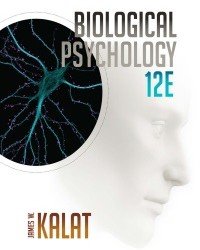
J. Kalat – Biological Psychology (12th edition)
Первоначальная цена составляла 2.840 ₽.1.420 ₽Текущая цена: 1.420 ₽.
Автор: J. Kalat
Название книги: Biological Psychology (12th edition)
Формат: PDF
Жанр: Психология
Страницы: 627
Качество: Изначально компьютерное, E-book
In the first edition of this text, published in 1981, I remarked,
“I almost wish I could get parts of this text . . . printed in
disappearing ink, programmed to fade within ten years of
publication, so that I will not be embarrassed by statements
that will look primitive from some future perspective.” I would
say the same thing today, except that I would like for the ink
to fade faster. Biological psychology progresses rapidly, and
much that we thought we knew becomes obsolete.
Biological psychology is the most interesting topic in
the world. No doubt many people in other fields think
their topic is the most interesting, but they are wrong. This
really is the most interesting. Unfortunately, it is easy to get
so bogged down in memorizing facts that one loses the big
picture. The big picture here is fascinating and profound:
Your brain activity is your mind. I hope that readers of this
book will remember that message even after they forget
some of the details.
Each chapter is divided into modules; each module begins
with an introduction and finishes with a summary. This organization
makes it easy for instructors to assign part of a chapter
per day instead of a whole chapter per week. Modules can
also be covered in a different order. Indeed, of course, whole
chapters can be taken in different orders.
I assume that readers have a basic background in psychology
and biology and understand such terms as classical conditioning,
reinforcement, vertebrate, mammal, gene, chromosome,
cell, and mitochondrion. I also assume a high school
chemistry course. Those with a weak background in chemistry
or a fading memory of it may consult Appendix A.
MindTap for Biological
Psychology, 12th edition
MindTap for Biological Psychology, 12th Edition, engages and
empowers students to produce their best work—consistently.
By seamlessly integrating course material with videos, activities,
apps, and much more, MindTap creates a unique learning
path that fosters increased comprehension and efficiency.
For students:
■ MindTap delivers real-world relevance with activities and
assignments that help students build critical thinking and
analytic skills that will transfer to other courses and their
professional lives.
■ MindTap helps students stay organized and efficient
with a single destination that reflects what’s important
to the instructor, along with the tools students need to
master the content.
■ MindTap empowers and motivates students with information
that shows where they stand at all times—both
individually and compared to the highest performers
in class.
Additionally, for instructors, MindTap allows you to:
■ Control what content students see and when they see it
with a learning path that can be used as-is or matched to
your syllabus exactly.
■ Create a unique learning path of relevant readings
and multimedia and activities that move students
up the learning taxonomy from basic knowledge and
comprehension to analysis, application, and critical
thinking.
■ Integrate your own content into the MindTap Reader
using your own documents or pulling from sources like
RSS feeds, YouTube videos, websites, Googledocs, and
more.
■ Use powerful analytics and reports that provide a
snapshot of class progress, time in course, engagement,
and completion.
Changes in this edition
One new feature in this edition is a set of multiple-choice review
questions at the end of each module. This edition also
includes several changes in organization and many changes in
content, to reflect the rapid progress in biological psychology.
It includes well over 600 new references, more than 85 percent
of them from 2011 or later, and many new or revised illustrations.
Here are a few noteworthy items:
The module on genetics and evolution of behavior has been
moved from the first chapter to the chapter on development
(Chapter 4). The remainder of the first chapter
(introduction to the field, concept of mind–body monism,
job opportunities, ethics of animal research, etc.) is now
labeled “Introduction.” The introduction is brief, but I
believe important. Note especially the section “Three Main
Points to Remember from this Book.”
The discussion of addictions, previously in the Synapses
chapter, is now a module in the chapter on Psychological
Disorders (Chapter 14). Material about how drugs exert
their effects is integrated into the second module of the
Synapses chapter (Chapter 2).
Chapter 3 (Anatomy and Research Methods) has an expanded
treatment of optogenetics, rapidly becoming a more important
method in neuroscience. The discussion of fMRI has
new examples and a clearer emphasis that we need to be
cautious about the conclusions we draw from fMRI studies.
Chapter 4 (Genetics, Evolution, Development and Plasticity)
now includes a short section on brain evolution. The
discussion of behavioral evolution now acknowledges
that group selection is sometimes plausible. Important
updates are added to the discussions of new neurons in
the adult brain, fetal alcohol syndrome, and brain changes
in adulthood.
Chapter 5 (Vision) is rearranged at the start to emphasize a
fundamental point that a third of college students miss,
sometimes even after taking courses in physics, perception,
and biological psychology: We see because light enters the
eyes, not because we send out sight rays! This chapter also
has a revised description of the distinction between the
ventral and dorsal pathways.
Chapter 6 (Other Sensory Systems) has a new section on the
role of attention in hearing loss, and a new study showing
that some people developed synesthesia by playing with
colored refrigerator magnets during childhood.
Chapter 7 (Movement) has a substantial revision of the section
about the basal ganglia, stressing their role in motivating
movements.
Chapter 10 (Reproductive Behaviors) has a new section on
how sex hormones affect nonsexual behaviors. The section
on activating effects of hormones is reorganized in terms
of males versus females instead of rodents versus humans.
Chapter 11 (Emotional Behavior) begins with a reorganized
and reconsidered discussion of the relationship between
emotion and autonomic arousal. A new section is titled,
“Do People Have a Limited Number of Basic Emotions?”
An expanded treatment of reconsolidation relates it to the
possibility of alleviating learned fears.
Chapter 12 (The Biology of Learning and Memory) has some
reorganization, and a more thorough explanation of the
role of the basal ganglia in probabilistic learning.
Chapter 13 (Cognitive Functions) has a new short module on
social neuroscience. It also has a new discussion of what
Michael Gazzaniga calls “the interpreter,” the tendency of
the left hemisphere to invent explanations, correct or not,
for unconsciously influenced behaviors. The discussion of
consciousness is reorganized.
Chapter 14 (Psychological Disorders) has a new module on
addictions and a new short module on autism spectrum
disorders. The modules on depression and schizophrenia
have been updated in many ways.
A Comprehensive Teaching
and learning Package
Biological Psychology, 12th edition, is accompanied by an
array of supplements developed to facilitate both instructors’
and students’ best experience inside as well as outside
the classroom. All of the supplements continuing from the
11th edition have been thoroughly revised and updated;
other supplements are new to this edition. Cengage Learning
invites you to take full advantage of the teaching and learning
tools available to you and has prepared the following descriptions
of each.
online Instructor’s Resource Manual
This manual, updated and expanded for the 12th edition, is
designed to help streamline and maximize the effectiveness
of your course preparation. It provides chapter outlines and
learning objectives; class demonstrations and projects, including
lecture tips and activities, with handouts; a list of video
resources, additional suggested readings and related websites,
discussion questions designed to work both in class and on
message boards for online classes; key terms from the text;
and James Kalat’s answers to the “Thought Questions” that
conclude each module.
Cengage learning Testing, powered
by Cognero for Biological Psychology,
12th edition
Cognero is a flexible, online system that allows you to author,
edit, and manage test bank content as well as create multiple
test versions in an instant. You can deliver tests from your
school’s learning management system, your classroom, or
wherever you want.
Описание
Только зарегистрированные клиенты, купившие данный товар, могут публиковать отзывы.




Отзывы
Отзывов пока нет.