
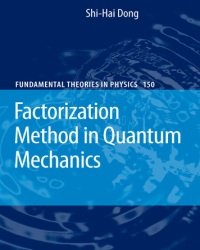
Shi-Hai Dong – Factorization Method in Quantum Mechanics (2007)
1.460 ₽
Автор: Shi-Hai Dong
Название книги: Factorization method in quantum mechanics
Формат: PDF
Жанр: Физика
Страницы: 308
Качество: Изначально компьютерное, E-book
This book introduces the factorization method in quantum mechanics at an advanced level, with the aim of putting mathematical and physical concepts and techniques like the factorization method, Lie algebras, matrix elements and quantum control at the reader’s disposal. For this purpose, the text provides a comprehensive description of the factorization method and its wide applications in quantum mechanics which complements the traditional coverage found in quantum mechanics textbooks.
This work introduces the factorization method in quantum mechanics at an
advanced level addressing students of physics, mathematics, chemistry and electrical
engineering. The aim is to put the mathematical and physical concepts
and techniques like the factorization method, Lie algebras, matrix elements and
quantum control at the reader’s disposal. For this purpose, we attempt to provide
a comprehensive description of the factorization method and its wide applications
in quantum mechanics which complements the traditional coverage found
in the existing quantum mechanics textbooks. Related to this classic method are
the supersymmetric quantum mechanics, shape invariant potentials and group
theoretical approaches. It is no exaggeration to say that this method has become
the milestone of these approaches. In fact, the author’s driving force has been
his desire to provide a comprehensive review volume that includes some new
and significant results about the factorization method in quantum mechanics
since the literature is inundated with scattered articles in this field and to pave
the reader’s way into this territory as rapidly as possible. We have made the
effort to present the clear and understandable derivations and include the necessary
mathematical steps so that the intelligent and diligent reader should be
able to follow the text with relative ease, in particular, when mathematically
difficult material is presented. The author also embraces enthusiastically the
potential of the LaTeX typesetting language to enrich the presentation of the
formulas as to make the logical pattern behind the mathematics more transparent.
Additionally, any suggestions and criticism to improve the text are most
welcome since this is the first version. It should be addressed that the main
effort to follow the text and master the material is left to the reader even though
this book makes an effort to serve the reader as much as was possible for the
author.
This book starts out in Chapter 1 with a comprehensive review for the traditional
factorization method and builds on this to introduce in Chapter 2 a new
approach to this method and to reviewin Chapter 3 the basic properties of the Lie algebras su(2) and su(1, 1) to be used in the successive Chapters. As important
applications in non-relativistic quantum mechanics, from Chapter 4 to Chapter
13, we shall apply our new approach to the factorization method to study
some important quantum systems such as the harmonic oscillator, infinitely
deep square well, Morse, P¨oschl-Teller, pseudoharmonic oscillator, noncentral
ring-shaped potential quantum systems and others. One of the advantages of
this new approach is to easily obtain the matrix elements for some related physical
functions except for constructing a suitable Lie algebra from the ladder
operators. In Chapter 14 we are going to study the position-dependent mass
Schr¨odinger equation for a singular oscillator based on the algebraic approach.
We shall carry out the applications of the factorization method in relativistic
Dirac and Klein-Gordon equations with the Coulomb and hyperbolic potentials
from Chapter 15 to Chapter 18. As an important generalized application of this
method related to the group theory in control theory, we shall study the quantum
control in Chapters 19 and 20, in which we briefly introduce the development
of the quantum control and some well known theorems on control theory and
then apply the knowledge of the Lie algebra generated by the system’s quantum
Hamiltonian to investigate the controllabilities of the quantum systems for
the Morse, P¨oschl-Teller (PT) and PT-like potentials. Some conclusions and
outlooks are given in Chapter 21.
This book is in a stage of continuing development, various chapters, e.g.,
on the group theory, on the supersymmetric quantum mechanics, on the shape
invariance, on the higher order factorization method will be added to the extent
that the respective topics expand. At the present stage, however, the work
presented for such topics should be complete enough to serve the reader.
This book shall give the theoretical physicists and chemists a fresh outlook
and new ways of handling the important quantum systems for some potentials
of interest in all branches of physics and chemistry and of studying quantum
control. The primary audience of this book shall be the graduate students and
young researchers in physics, theoretical chemistry and electric engineering
Описание
Книга Shi-Hai Dong — Factorization Method in Quantum Mechanics (2007) представляет собой систематическое изложение одного из наиболее эффективных подходов к решению задач квантовой механики. Автор подробно разбирает метод факторизации, позволяющий находить точные решения уравнения Шрёдингера для широкого класса потенциалов без прямого решения дифференциальных уравнений.
В работе рассмотрены как классические системы (гармонический осциллятор, водородоподобные атомы), так и более сложные модели: потенциалы Морса, Пёшль-Теллера, Халмилтона, экзотические потенциалы и суперсимметричные квантовомеханические системы. Особое внимание уделено связи метода факторизации с теорией суперсимметрии и алгебраическими методами в квантовой механике.
- студентам и аспирантам, изучающим квантовую механику на продвинутом уровне
- исследователям, работающим в области математической физики и квантовой теории
- специалистам, интересующимся точными решениями уравнения Шрёдингера
- преподавателям, готовящим курсы по современным методам квантовой механики
Только зарегистрированные клиенты, купившие данный товар, могут публиковать отзывы.
Похожие


Другие книги раздела «Физика»
- Gert Strobl – The Physics of Polymers
- Himadri B. Bohidar – Fundamentals of Polymer Physics and Molecular Biophysics
- James E. Mark – Physical Properties of Polymers Handbook
- L. Utracki – Polymer Physics
- Maarten Ambaum – Thermal Physics of the Atmosphere
- P. Sundararajan – Physical Aspects of Polymer Self‐Assembly
- Wenbing Hu – Polymer Physics
- Jan Toporski – Confocal Raman Microscopy
- Peter M. Martin – Handbook of Deposition Technologies for Films and Coatings
- Dmitri Kharzeev – Strongly Interacting Matter in Magnetic Fields
- Eric Poisson – Gravity
- Г. Готтштайн – Физико-химические основы материаловедения
- Wolfgang Demtroder – Experimentalphysik (Немецкий язык)
- David L. Andrews – Photonics (4 Volume set)
- Bob D. Guenther – Encyclopedia of Modern Optics (Second edition, 2018)
- Dieter Meschede – Gerthsen Physik (Немецкий язык)
Смежные разделы: Авиация и космонавтика · Астрономия · Геология и Геодезия · Железнодорожное дело · Журналистика · Математика · Машиностроение · Нанотехнологии · Научно-популярная литература · Химия · Экология · Энергетика
Рекомендуем также
- F. Pugnaire – Functional Plant Ecology (Second edition)
- J. Aldy – Post-Kyoto International Climate Policy
- M. Hamilton – Handbook of Bleeding and Coagulation for Neurosurgery (2014)
- C. Bonnelle – Rare-Earths and Actinides in High Energy Spectroscopy (2015)
- H. Luth – Quantum Physics in the Nanoworld. Schrodinger’s Cat and the Dwarfs (Second edition, 2013)
- T. Matsushita – Flux Pinning in Superconductors (Second edition, 2014)
- G. Bruinsma – Encyclopedia of Criminology and Criminal Justice (2014)
- G. Robbers – Encyclopedia of World Constitutions (2006)

Отзывы
Отзывов пока нет.