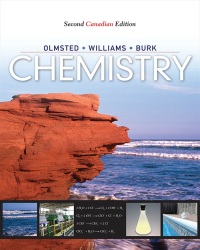
John Olmsted – Chemistry (Second Canadian edition, 2013)
988 ₽
Автор: John Olmsted
Название книги: Chemistry (Second edition)
Формат: PDF
Жанр: Химия
Страницы: 1224
Качество: Изначально компьютерное, E-book
The subject of this book is obvious from its title, and the general plan is clear from the
table of contents. The goal of this preface is to explain our purpose and clarify the plan.
We want to help our potential readers discover how the second Canadian edition of
Chemistry can guide students to a confident mastery of the fundamentals of chemistry.
THE MOLECULAR PERSPECTIVE:
INFORMING QUANTITATIVE REASONING
The purpose of our book is to describe the fundamentals of chemistry as a chemist thinks
about the subject. Matter is composed of atoms and molecules, and chemists explain the
behaviour of matter by describing how atoms and molecules behave and interact. We believe
that students will master chemistry more quickly and thoroughly when they grasp this molecular
perspective; hence our general theme: “Think molecules.”
When the first US edition of Chemistry, the Molecular Science was published, no
major general chemistry textbook emphasized the molecular approach. Now almost
every textbook shows some molecular pictures. Our text, which is based on the first
Canadian edition of this book, maintains the uniqueness in reinforcing each chemical
topic with molecular-level explanations. Our molecular approach to concepts appears
throughout the book, but it can be seen most clearly in the following chapters:
• Chapter 1, where we emphasize the molecular underpinnings of stoichiometry and
other fundamental aspects of chemistry
• Chapter 2, where we introduce the ideal gas equation by describing how molecular
kinetic behaviour varies with macroscopic variables
• Chapters 6 and 7, where the theories of chemical bonding in the molecules themselves
are described using copious diagrams
• Chapter 13, where we develop chemical kinetics starting with reaction
mechanisms
• Chapters 14 and 15, where we emphasize the importance of identifying the
species in solution as the first step in understanding aqueous chemical
equilibria
• Chapter 17, where we present molecular descriptions of electrode surfaces to support
the chemical basis of electrochemical cells
Because chemists work quantitatively just as frequently as they think molecularly, we
use the molecular approach to facilitate successful quantitative reasoning, not to replace
it. To see one example of this approach, explore our presentation (Section 14.6) of the
species in aqueous solution as an essential prologue to stoichiometric and equilibrium calculations
involving solution phase reactions. Look, too, at how we introduce the ideal gas
equation (Section 2.2): we use a qualitative description of how gaseous molecules behave
to develop the quantitative statement.
EMPHASIS ON PROBLEM SOLVING
Students usually attempt to solve problems using easy algorithms. Instructors want their
students to reason through problems rather than relying mindlessly on algorithms. We
believe there is validity to both views, because whereas reasoning is at the heart of any
science, every experienced scientist regularly employs algorithms as “shortcuts.”
Reflecting this view, we have developed stepwise approaches to problem solving that blend
sound reasoning with the efficient application of algorithms. We use a seven-step problem-
solving template consistently for quantitative problems, including a version designed
specifically for attacking equilibrium problems. We also provide step-by-step procedures
for the construction of Lewis structures and for the balancing of redox reactions. Beyond
this, for each Example problem, we provide a “strategy” of attack, designed to encourage
students to reason their way to solutions rather than search aimlessly for algorithms.
Furthermore, “Common Pitfalls” are presented in many problems where students often
make the same error, and a reality check is provided in the form of “Does the Result Make
Sense?” where students are encouraged to think critically about their answer. And finally,
each Example problem is paired with a Practice Exercise of the same type.
HIGHLIGHTS OF THE SECOND CANADIAN EDITION
Although chemistry is, in many ways, a mature science, our understanding of how best
to teach chemistry continues to evolve. The challenge to authors of general chemistry textbooks
is to incorporate contemporary teaching and learning strategies while maintaining
the established core of subject matter.
As was the case in the first Canadian edition, general material (typically high-school
level material) has been organized into Chapter 1. A more detailed version of this material
is available on the companion website.
The organic chemistry content is now organized into two chapters. Chapter 10 deals
with nomenclature and structure (including stereochemistry). Chapter 11 deals with reactions,
including substitution, elimination, and addition reactions. Some elementary ideas
of mechanisms are presented and students are encouraged to think in terms of flow of
electrons.
Canadian Content
The second Canadian edition has been produced specifically for Canadian students. There
is a long history of chemical research in Canada, and the Canadian chemical industry is
vibrant. We therefore have included many examples of Canadian successes in the laboratory
that have resulted in significant advancement of the science. Nobel Prize winners such
as Dr. John Polayni at the University of Toronto are featured, as is the work of current
researchers such as Dr. R.W. Gillham at the University of Waterloo. Canadian production
figures are included wherever possible to give the student a sense of the magnitude of the
chemical industry in this country.
Another significant feature of this Canadian edition is the exclusive use of SI units
and constants. This simplifies calculations and makes many unit conversions unnecessary.
Furthermore, all symbols, values of constants, and even organic nomenclature are done
in accordance with the guidelines of the International Union of Pure and Applied
Chemistry (IUPAC). This standardizes the presentation throughout the book, and teaches
students to communicate in the same fashion as most chemical researchers.
Coverage of Energy
Material on energy and its conservation appears in Chapter 3 in order to emphasize the
importance of energy to chemistry. This chapter has sections on Properties of Energy,
Energy Transfers, Energy Changes in Chemical Processes, Measuring Energy Changes:
Calorimetry, Enthalpy, and Energy Sources.
Having this material early in the book has two advantages. First, an early chapter that
focuses explicitly on energy emphasizes to students the centrality of energy to chemistry.
Second, an early description of calorimetry makes it possible to include calorimetry experiments
early in the laboratory portion of the course. To accommodate those who prefer a
more integrated approach, we have organized Chapter 3 so that it is possible to defer
calorimetry and enthalpy until later in the course.
Molecular Structure
Chapter 6, Fundamentals of Chemical Bonding, concentrates on more concrete, readily
grasped features of molecules. We use Lewis structures to organize the facts of molecular properties:
molecular shapes (VSEPR) and bond lengths, strengths, and polarities. Chapter 7, Theories of Chemical Bonding, introduces the more abstract concepts of quantum chemistry:
orbital overlap, hybridization, molecular orbitals, delocalization, and band theory.
The presentation of facts before theory allows students to become comfortable with tangible
features of Lewis structures and molecular shapes before confronting the abstractions
inherent in bonding theory.
Organic Chemistry
The first Canadian edition of this book had only one chapter on organic chemistry. We
have expanded the coverage of this material considerably by adding a second chapter
(Chapter 11). Chapter 10 introduces the concepts of nomenclature, functional groups, and
stereochemistry. The new Chapter 11 extends the discussion into reactions, including substitution,
addition, and elimination reactions. Students are introduced to basic reaction
mechanisms and electron flow. The coverage is thus more than extensive enough for
courses where organic chemistry is one of many topics covered. SN1 and SN2 reactions
are covered in some detail and can be used as an introduction to reaction mechanisms,
which are covered in more detail in Chapter 13, Kinetics: Mechanisms and Rates of Reactions.
Problems
Problem solving is a strong feature of this book, as it was in the first Canadian edition.
Specifically, the book incorporates the following:
• A Practice Exercise accompanies and reinforces every Example done in the text.
• Examples illustrate how to calculate yields in limiting reactant problems (Chapter 1),
how to determine reaction orders using the initial rate method (Chapter 13), how to
treat polyprotic acid titrations (Chapter 15), and how to analyze the common-ion effect
on solubility (Chapter 16).
• Our supporting materials include a greatly expanded electronic homework
feature and additional Interactive Learning Ware problem-solving tutorials.
• The number of integrative and advanced problems has been increased.
• Qualitative and visualization problems encourage the development of conceptual
and visual skills.
OTHER UNIQUE FEATURES
Previous editions introduced features that were not present in other general chemistry textbooks
but that the original authors felt reflected how contemporary chemistry should be
taught. These resonated well with our users, so we have retained them: molecular
approaches to traditional topics (described above), use of organic and biochemical examples
equally with inorganic ones, a “rational” approach to Lewis structures, and a separate
chapter on macromolecules.
Organic and Biochemical Examples
Whereas most other general chemistry textbooks restrict their use of organic and biochemical
molecules to a separate chapter, we feel that general chemistry is just that—a general
introduction to principles that apply equally well to all categories of chemical compounds.
Chapters 10 and 11 present an in-depth treatment of organic chemistry on their own, but
students encounter many organic and biochemical substances in their daily lives, so the
use of organic examples in other chapters can help excite student interest. We introduce
organic line structures in Chapter 1, allowing us to use interesting molecules as we introduce
basic chemical concepts.
Macromolecules
Macromolecules, both natural and synthetic, are everywhere in the contemporary world.
In recognition of their importance, we devote Chapter 18 to describing macromolecule
formation and structure. The chapter builds on the structure and bonding information of
earlier chapters, but it can be omitted without loss of continuity. We place this chapter
with three other chapters that can be covered at the will of the instructor: The Transition
Metals, The Main Group Elements, and Nuclear Chemistry and Radiochemistry.
PROVIDING WHAT STUDENTS NEED
Our discussions with students and colleagues, over the many years that we have taught general
chemistry, have convinced us that relevance, timeliness, readability, and problemsolving
strategies all are important for student success.
Most students who take general chemistry do not intend to major in chemistry. They
are pursuing careers in the health sciences, biology, agriculture, engineering, geology,
physics, or even non-science-related disciplines. Many of these students need to be convinced
that a sound understanding of chemical principles is essential to their field of interest.
Our chapter introductions offer short descriptions of topics that have “real-world”
importance and are related to material that appears in the chapter. Focussed material provides
further examples under five general themes: Chemistry and Life, Chemistry and the
Environment, Chemistry and Technology, Chemical Milestones, and Tools for Discovery. In
addition, some chapters end with sections that may interest a particular group of students
but can be omitted without loss of continuity. For examples, see Sections 3.6, Energy
Sources; 12.6, Bioenergetics; 16.5, Complexation Equilibria; and 19.4, Transition Metals
in Biology. Parts of Chapters 10 and 11, Organic Chemistry, can be incorporated into a
course or not, as described above.
LEARNING RESOURCES
Learners have a variety of styles, which are best served by supplements to textual and oral
explanations. The supplementary resources that accompany this second Canadian edition
can be divided into three categories: features in the textbook, tools designed for the student,
and ancillaries addressed to the instructor.
Описание
Только зарегистрированные клиенты, купившие данный товар, могут публиковать отзывы.



Отзывы
Отзывов пока нет.