

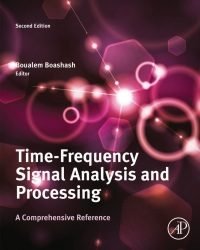
B. Boashash – Time-Frequency Signal Analysis and Processing (Second edition, 2016)
988 ₽
Автор: B. Boashash
Название книги: Time-Frequency Signal Analysis and Processing
Формат: PDF
Жанр: Электроника и Радио
Страницы: 1070
Качество: Изначально компьютерное, E-book
In the decade after the publication of the first edition of this book, advances in the field of timefrequency
signal analysis and processing accumulated to an extent that called for an expanded and
updated edition. This second edition contains:
1. over 30 new sections by leading experts in their respective fields; covering new time-frequency
(t, f ) methods, techniques, algorithms, and applications;
2. new tutorial sections on AM/FM decomposition of signals (Section 1.4), time-scale and wavelet
transforms (Section 2.7.6), time-frequency distributions (TFDs) vs. time-scale methods
(Section 2.7.7), high-resolution TFDs (Section 3.3.4), positivity of (t, f ) distributions (Section 3.4),
Ambiguity function and Radar (Section 3.5); thus making Chapter 3 the most important;
3. a new chapter on “Getting Started” in (t, f ) computation using the original (t, f ) toolbox updated
for this second Edition (Chapter 17);
4. a new introductory chapter (numbered I to minimize numbering changes), written at a more
intuitive level, making the book accessible to a wider readership reflecting the widening use of the
(t, f ) approach; and
5. a new chapter on (t, f ) methods in neuroscience. This emerging field of (t, f ) application is the
subject of the new Chapter 16, containing six new sections; these concern the assessment of brain
EEG and ECG abnormalities (Section 16.1), (t, f ) modeling of EEG signals (Section 16.2), EEG
(t, f ) features for classification (Section 16.3), brain networks analysis (Section 16.4), EEG (t, f )
analysis using empirical mode decomposition (Section 16.5), and perspectives for further
advances (Section 16.6).
Among the new sections, four relate (t, f ) methods to time-scale methods (Section 4.1), systems
(Section 4.9), energy (Section 4.10) and the EMD with the Hilbert spectrum (Section 4.12); four
concern directional kernels (Section 5.9), adaptive directional kernels (Section 5.10), the modified
S-transform (Section 5.11) and TFDs positivity (Section 5.12). Other new topics include memoryefficient
computation of TFDs (Section 6.6), compressive sensing (Section 7.6), signal complexity
(Section 7.7), neural networks for (t, f ) localization (Section 7.8), the improvement of (t, f ) representations
using (t, f ) post-processing (Section 7.5), introducing multichannel/multisensor (t, f )
processing (Section 8.1), audio source separation (Section 8.6), cyclostationary signals (Section 9.6),
extraction of signal components (Section 10.6), polynomial-phase parameter estimation (Section 10.7),
IF sequential Bayesian estimation (Section 10.8), subspace noise filtering (Section 11.5), speech
enhancement (Section 11.6), generalizing one-dimensional concepts in matched filtering (Section 12.5),
(t, f ) feature definition (Section 12.6), modulation parameter estimation (Section 13.5), sparse TFDs in
geophysics (Section 14.6), audio signals’ (t, f ) characteristics (Section 14.7), using (t, f ) features to
improve medical diagnosis (Section 15.5), and structural condition monitoring (Section 15.7).
More information on the scope of new and existing chapter/sections appears in the table of contents
and chapter overviews.
The (t, f ) toolbox package (available at the Elsevier website) complements the other chapters of this
book. It describes in a simple way the most important algorithms presented in the book and makes them
ready for use via an easy practical graphical user interface (GUI).With the aid of Chapter 17, new users
can start using the algorithms on simulated and real examples, compare with the results presented in the
book, and insert the algorithms in their own applications. Source code will be made available. Readers
can use the package as an introduction to the field (in combination with the tutorial in Chapter 17), or as
a set of Matlab™-compatible commands that can be accessed from the command line or called from
other programs, or as source code that can be adapted for particular applications.
The (t,f ) toolbox TFSAP is a recent upgrade to the package formerly known as TFSA, the first
package in its field, which was released publicly in 1987 at the inaugural ISSPA conference in
Brisbane, Australia, and frequently upgraded thereafter. It was originally purchased by several hundred
universities and research institutions throughout the world, and also made available free of charge as
part of evaluation agreements.
In addition to new material, this second edition also updates the text and references of existing
sections, ensures more consistent use of common terminology and notations, and enriches the crossreferencing
between the various parts of the book. The result is a comprehensive and connected
presentation of standard and novel topics in (t, f ) signal analysis and processing. My hope is that it
achieves the best possible outcome, within the constraints of a single volume, in equipping modern
researchers and engineers with the information and tools necessary to undertake any study, research, or
development project in this important scientific field.
ACKNOWLEDGMENTS
I thank several colleagues, postdocs, and research assistants who provided much needed help to complete this
project. First, Dr Gavin Putland and Ms Ayat Salim assisted with LATEX editing of the sections in the book and all
related tasks. In addition, several other colleagues contributed to the technical reviews of individual chapters or
sections; they include: S. Ouelha, N. A. Khan, E. Sejdic, S. Touati, S. Ali, A. Aïssa-El-Bey, G. Azemi, J. O’Toole,
S. Aviyente, B. Jawad, N. Stevenson, H. Hassanpour, A. Saleem, S. Dong, A. Zuri-Sha’ameri, M. A. Awal,
A. Ouahabi and M. Alsad. In addition, all individual sections of this book were technically reviewed by at least
two experts in the field, as shown in the first page of each section.
Publication of this second edition was facilitated by several grants from Qatar Foundation. In
particular, the work in the contributions in Sections 4.1, 11.6, 13.5, 14.7, and 15.6 and the updates
to Sections 7.1, 7.9, 14.4, and 14.5, was funded by Qatar National Research Fund, grant number
NPRP 6-680-2-282. The work in Sections 5.11, 6.6, 7.7, 10.6, 11.5, 12.5, 15.5, 16.2, 16.3, 16.4,
and 16.6, and the updates to Chapters 1 and 2 and Sections 4.6, 4.12, 5.4, 5.5, 5.7, 5.12, 6.1, 6.5,
7.4, 8.1, 10.3, 10.4, 10.5, 11.2, 11.4, 15.4 and 16.1 was funded by Qatar National Research Fund, grant
number NPRP 6-885-2-364. The work in Chapter 17, Sections 5.9, 5.10, 7.5, and 12.6, and the updates
to Chapter 3, was funded by Qatar National Research Fund, grant number NPRP 4-1303-2-517. The
work reported in Section 16.6 was funded by the Australian Research Council and the National Health
& Medical Research Council, Australia.
Boualem Boashash, Editor
Описание
Только зарегистрированные клиенты, купившие данный товар, могут публиковать отзывы.


Отзывы
Отзывов пока нет.