
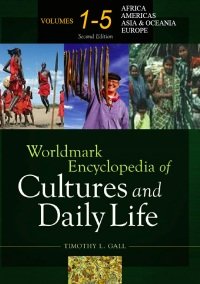
Timothy Gall – Worldmark Encyclopedia of Cultures and Daily Life (5 Volume Set, 2009)
1.885 ₽
Автор: Timothy Gall
Название книги: Worldmark Encyclopedia of Cultures and Daily Life (5 Volume Set)
Формат: PDF
Жанр: Культура и Искусство
Качество: Изначально компьютерное, E-book
For this new edition, more than 175 contributors—including university professors, researchers, writers, members of the press, and consulate staff—wrote (or revised) more than 500 articles exploring the ways of life and peoples of the world. Originally published in 1998 as a four-volume set, the encyclopedia has been expanded to five volumes with cultures grouped by geographical regions: Africa, Americas, Asia and Oceania (two volumes), and Europe. The volumes are organized in the same manner as the first edition, each containing lists of contents and contributors, a country index, a preface and volume introduction, articles, a glossary, and a comprehensive index. The 2- to 11-page articles generally follow a standard format, including an introduction, location and description of the group’s homeland, and 18 other topics that help shape cultural identity, such as “Language,” “Folklore,” and “Gender Issues.” Each article includes a map, bibliography, and an author/editor credit. Black-and-white photos, examples of language phrases, and recipes enhance many entries. The 26 new entries in this edition include Sudanese Americans as well as 8 new groups in Africa, 6 in Asia and Oceania, and 7 in Europe. The closest comparable resource is The Encyclopedia of World Cultures (1994), which contains information on 1,500 cultures and is written for the academic community. Students as well as any researcher seeking general information on a particular culture will find Worldmark Encyclopedia of Cultures and Daily Life useful. Recommended for high-school, academic, and public libraries
Th e Worldmark Encyclopedia of Cultures and Daily Life, Second
Edition, contains over 500 articles exploring the ways of life of
peoples of the world. Arranged in fi ve volumes by geographic
regions—Africa, Americas, Asia & Oceania (two volumes), and
Europe—the volumes of this encyclopedia parallel the organization
of its sister set, the Worldmark Encyclopedia of the Nations.
Whereas the primary purpose of Nations is to provide
information on the world’s nation states, this encyclopedia
focuses on the traditions, living conditions, and personalities
of many of the world’s culture groups. Entries emphasize how
people live today, rather than how they lived in the past.
Defi ning groups for inclusion was not an easy task. Cultural
identity can be shaped by such factors as geography, nationality,
ethnicity, race, language, and religion. Many people, in fact,
legitimately belong in two or more classifi cations, each as valid
as the other. For example, the citizens of the United States all
share traits that make them distinctly American. However, few
would deny the need for separate articles on Native Americans
or African Americans. Even the category Native American denies
the individuality of separate tribes like the Navajo and Paiute.
Consequently, this encyclopedia contains an article on the
Americans as well as separate articles on the Native Americans
and the Navajo. Closely related articles such as these are crossreferenced
to each other to help provide a more complete picture
of the group being profi led. Included in this encyclopedia
are articles on groups as large as the Han of China, with over
one billion members, and as small as the Jews of Cochin, with
only a few dozen members. Unfortunately, although the vast
majority of the world’s peoples are represented in this encyclopedia,
time and space constraints prevented many important
groups from being included in the fi rst edition. Twenty-three
new groups have been added to this second edition, and the
editors look forward to including many more culture groups in
future editions of this work.
New entries include in Americas: Sudanese Americans
(“Lost Boys”); in Africa: Afar, Berbers, Ewe, Guineas of Guinea
Bissau, Jola, Maldivians, San (Bushmen), Sao Tomeans, and
Twa; in Asia and Oceania: Brunei, Coptic Christians, Kashmiris,
Moro, Rajasthanis, and Timorese; and in Europe: Alsatians,
Kosovars, Maltese, Montenegrins, Serbs, Tyrolese, and
Vlachs.
Over 175 contributors and reviewers participated in the creation
of this encyclopedia. Drawn from universities, consulates,
and the press, their in-depth knowledge and fi rst-hand
experience of the profi led groups added signifi cantly to the
content of the articles. A complete listing of the contributors
and reviewers together with their affi liations appears in the
front of each volume.
ORGANIZATION
Each volume begins with an introduction that traces the cultural
developments of the region from prehistoric times to the
present. Following the introduction are articles devoted to the
peoples of the region. Within each volume the articles are arranged
alphabetically. A comprehensive table cross referencing
the articles by country follows the table of contents to each
volume.
Th e individual articles are of two types. Th e vast majority
follow a standard 20-heading outline explained in more detail
below. Th is structure allows for easy comparison of the articles
and enhances the accessibility of the information. A smaller
number do not follow the 20-heading format, but rather present
simply an overview of the group. Th is structure is used
when the primary purpose of an article is to supplement a fully
rubriced article appearing elsewhere in the set.
Whenever appropriate, articles begin with the pronunciation
of the group’s name, a listing of alternate names by which
the group is known, the group’s location in the world, its population,
the languages spoken, the religions practiced, and a
listing of related articles in the fi ve volumes of this encyclopedia.
Most articles are illustrated with a map showing the
primary location of the group and photographs of the people
being profi led. Th e twenty standard headings by which most
articles are organized are presented below.
INTRODUCTION: A description of the group’s historical
origins provides a useful background for understanding its
contemporary aff airs. Information relating to migration helps
explain how the group arrived at its present location. Political
conditions and governmental structure(s) that typically aff ect
members of the profi led ethnic group are also discussed.
LOCATION AND HOMELAND: Th e population size of
the group is listed. Th is information may include offi cial census
data from various countries and/or estimates. Information
on the size of a group’s population located outside the traditional
homeland may also be included, especially for certain
groups with large diaspora populations. A description of the
homeland includes information on location, topography, and
climate.
LANGUAGE: Each article lists the name(s) of the primary
language(s) spoken by members. Descriptions of linguistic origins,
grammar, and similarities to other languages may also be
included. Examples of common words, phrases, and proverbs
are listed for many of the profi led groups, and some include
examples of common personal names and forms of address.
FOLKLORE: Common themes, settings, and characters in
the profi led group’s traditional oral and/or literary mythology
are highlighted. Many entries include a short excerpt or synopsis
of one of the group’s most noteworthy myths, fables, or
legends. Some entries describe the accomplishments of famous
heroes and heroines or other prominent historical fi gures.
RELIGION: Th e origins of traditional religious beliefs are
profi led. Contemporary religious beliefs, customs, and practices
are also discussed. Some groups may be closely associated
with one particular faith (especially if religious and ethnic
identifi cation are interlinked), while others may have members
of diverse faiths.
MAJOR HOLIDAYS: Celebrations and commemorations
typically recognized by the group’s members are described.
Th ese holidays commonly fall into two categories: secular and
religious. Secular holidays oft en include an independence day
and/or other days of observance recognizing important dates
in history that aff ected the group as a whole. Religious holidays
are typically the same as those honored by other peoples of the
same faith. Some secular and religious holidays are linked to
the lunar cycle or to the change of seasons. Some articles describe
unique customs practiced by members of the group on
certain holidays.
RITES OF PASSAGE: Formal and informal episodic events
that mark an individual’s procession through the stages of life
are profi led. Th ese events typically involve rituals, ceremonies,
observances, and procedures associated with birth, childhood,
the coming of age, adulthood, and death. Th e impact of twenty-
fi rst century communications and global media on customs
are addressed here.
INTERPERSONAL RELATIONS: Information on greetings,
body language, gestures, visiting customs, and dating
practices is included. Th e extent of formality to which members
of a certain ethnic group treat others is also addressed, as
some groups may adhere to customs governing interpersonal
relationships more/less strictly than others.
LIVING CONDITIONS: General health conditions typical
of the group’s members are cited. Such information includes
life expectancy, the prevalence of various diseases, and access
to medical care. Information on urbanization, housing, and
access to utilities is also included. Transportation methods
typically utilized by the group’s members are also discussed.
FAMILY LIFE: Th e size and composition of the family unit
is profi led. Gender roles common to the group are also discussed,
including the division of rights and responsibilities
relegated to male and female group members. Th e roles that
children, adults, and the elderly have within the group as a
whole may also be addressed.
CLOTHING: Many entries include descriptive information
(size, shape, color, fabric, etc.) regarding traditional clothing
(or a national costume), and indicate the frequency of its use
in contemporary life. A description of clothing typically worn
in the present is also provided, especially if traditional clothing
is no longer the usual form of dress. Distinctions between
formal, informal, and work clothes are made in many articles,
along with clothing diff erences between men, women, and
children.
FOOD: Descriptions of items commonly consumed by
members of the group are listed. Th e frequency and occasion
for meals is also described, as are any unique customs regarding
eating and drinking, special utensils and furniture, and the
role of food and beverages in ritual ceremonies. Many entries
include a sample recipe for a favorite dish.
EDUCATION: Th e structure of formal education in the
country or countries of residence is discussed, including information
on primary, secondary, and higher education. For
some groups, the role of informal education is also highlighted.
Some articles may include information regarding the relevance
and importance of education among the group as a
whole, along with parental expectations for children. In addition,
literacy levels are described where appropriate.
CULTURAL HERITAGE: Since many groups express their
sense of identity through art, music, literature, and dance, a
description of prominent styles is included. Some articles also
cite the contributions of famous individual artists, writers, and
musicians.
WORK: Th e type of labor that typically engages members
of the profi led group is discussed. For some groups, the formal
wage economy is the primary source of earnings, but for other
groups, informal agriculture or trade may be the usual way to
earn a living. Working conditions are also highlighted.
SPORTS: Popular sports that children and adults play are
listed, as are typical spectator sports. Some articles include a
description and/or rules to a unique type of sport or game.
ENTERTAINMENT AND RECREATION: Listed activities
that people enjoy in their spare time may include carrying out
either structured pastimes (such as public musical and dance
performances) or informal get-togethers (such as meeting for
conversation). Th e role of popular culture, movies, theater, and
television in everyday life is also discussed.
FOLK ARTS, CRAFTS, AND HOBBIES: Entries describe
arts and craft s commonly fabricated according to traditional
methods, materials, and style. Such objects may oft en have a
functional utility for everyday tasks.
SOCIAL PROBLEMS: Internal and external issues that confront
members of the profi led group are described. Such concerns
oft en deal with fundamental problems like war, famine,
disease, and poverty. A lack of human rights, civil rights, and
political freedom may also adversely aff ect a group as a whole.
Other problems may include crime, unemployment, substance
abuse, and domestic violence.
GENDER ISSUES: New to this edition is a section focusing
on women’s issues including cultural attitudes, discrimination,
status, health, sexual issues, education, and work and employment.
Some discussion on the group’s attitudes toward homosexuality
may be included in this section, where relevant.
BIBLIOGRAPHY: References cited include works used to
compile the article, as well as benchmark publications oft en
recognized as authoritative by scholars. Citations for materials
published in foreign languages are frequently listed when there
are few existing sources available in English.
A glossary of terms and a comprehensive index appears at the
end of each volume.
Описание
Worldmark Encyclopedia of Cultures and Daily Life — это фундаментальная многотомная энциклопедия, которая подробно рассказывает о более чем 500 культурах и народах мира. В пяти томах собраны актуальные на 2009 год сведения о повседневной жизни, традициях, обычаях, языке, религии, праздниках и особенностях быта разных этнических групп.
Издание помогает понять культурное разнообразие планеты: от коренных народов Африки, Азии и Латинской Америки до современных сообществ Европы и Северной Америки. Каждый раздел структурирован по единой схеме, что позволяет быстро сравнивать культуры по ключевым параметрам — от семейного уклада и питания до искусства, образования и отношения к окружающей среде.
- Студентам, изучающим культурологию, антропологию, социологию и международные отношения
- Специалистам в сфере туризма, межкультурной коммуникации и дипломатии
- Преподавателям и всем, кто интересуется мировым разнообразием
- Читателям, которые хотят глубже понимать глобальные процессы и миграцию
Только зарегистрированные клиенты, купившие данный товар, могут публиковать отзывы.
Похожие


Другие книги раздела «Культура и Искусство»
- Э. Макаревич – Глобальная культура коммуникаций
- Е. Селезнева – Культурология русского мира. Духовные основы менталитета
- U. Zarins – Anatomy for Sculptors
Все книги раздела «Культура и Искусство» →
Смежные разделы: Архитектура · Живопись и Графический дизайн · Музыка · Мода и Дизайн · Театр и Кино · Фотография · Декоративно-прикладное искусство
Рекомендуем также
- В. Болотов – Лекции по истории Древней Церкви (4 Тома)
- Святитель Игнатий Брянчанинов – Полное собрание творений (8 Томов)
- Святитель Иоанн Златоуст – Полное собрание творений (12 Томов)
- Иар Эльтеррус – Сочинения (32 книги)
- Альфред Бестер – Миры Альфреда Бестера (4 Тома)
- Ashish Tewari – Advanced Control of Aircraft Spacecraft and Rockets
- C. Venkatesan – Fundamentals of Helicopter Dynamics
- Ethirajan Rathakrishnan – Theoretical Aerodynamics

Отзывы
Отзывов пока нет.