
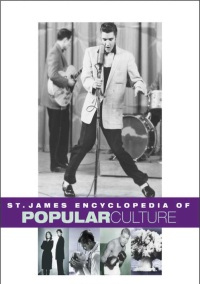
Tom Pendergast – St. James Encyclopedia of Popular Culture (5 Volume set)
1.488 ₽
Автор: Tom Pendergast
Название книги: St. James Encyclopedia of Popular Culture (5 Volume set)
Формат: PDF
Жанр: Культура и Искусство
Качество: Изначально компьютерное, E-book
This alphabetically arranged, 2,700-entry encyclopedia treats aspects of U.S. popular culture, defined as “all the experiences in life shared by people in common, generally though not necessarily disseminated by the mass media.” In the process of winnowing the 4,000 or so potential topics that were suggested by an advisory group to a manageable number of entries, the editors sought balance, though not necessarily equal coverage. Content breaks down into articles that address social life (23 percent of the articles), music (16 percent), print culture (16 percent), film (15 percent), television and radio (14 percent), sports (10 percent), and art and performance (6 percent). A few entries, such as Currier and Ives and Dime novels, relate to the culture of the nineteenth century, but treatment is purposely slanted toward the twentieth century, and the latter half of the twentieth at that.
Articles range from 75-to 150-word introductions to 3,000-word analyses. Each of the 450 contributors, mostly college or university professors and freelance writers, was asked to describe his or her topic and analyze its relevance to American popular culture, a charge successfully carried out in uniformly zesty and interesting prose, accompanied by numerous clear black-and-white illustrations. There are entries covering broad topics (Advertising, Jazz, Radio) and specific activities, comic strips, companies and consumer products, films, foods, individuals, musical groups, publications, social issues, sports teams, television and radio programs, and various other trends and phenomena, such as Advice columns, AARP, Aerobics, Air travel, and Astrology. Reflecting pop culture's inherent inclusiveness, there seems to be almost nothing missing, and an examination of the impact of Sigmund Freud keeps company with entries on Frederick's of Hollywood, Frosty the Snowman, and frozen food.
This is one of those rare encyclopedias that is good not only for research but for casual browsing, and readers will find much that is fascinating. Each entry, laid out in an easy-to-read typeface in double-column format, concludes with a list of further readings that includes references to both standard print and online sources. The introduction, list of contributors, and alphabetical list of entries are repeated in each volume. The indexing in volume five is superlative and broad, consisting of three different indexes–one general, one organized by subject, and one organized by decade, creating linkages and widening access to the information available on any given topic. Cross-referencing is limited to see references that refer readers to appropriate headings. The indexing helps make up for the lack of see also references, although these would more easily guide readers between entries for Orson Welles and War of the Worlds, to take one example.
Thirty some years ago Ray Browne and several of his colleagues provided a forum for the academic study of popular culture by
forming first the Journal of Popular Culture and later the Popular Culture Association and the Center for the Study of Popular
Culture at Bowling Green State University. Twenty some years ago Thomas Inge thought the field of popular culture studies well
enough established to put together the first edition of his Handbook of Popular Culture. In the years since, scholars and educators
from many disciplines have published enough books, gathered enough conferences, and gained enough institutional clout to make
popular culture studies one of the richest fields of academic study at the close of the twentieth century. Thirty, twenty, in some places
even ten years ago, to study popular culture was to be something of a pariah; today, the study of popular culture is accepted and even
respected in departments of history, literature, communications, sociology, film studies, etc. throughout the United States and
throughout the world, and not only in universities, but in increasing numbers of high schools. Thomas Inge wrote in the introduction
to the second edition of his Handbook: “The serious and systematic study of popular culture may be the most significant and
potentially useful of the trends in academic research and teaching in the last half of this century in the United States.”2 It is to this
thriving field of study that we hope to contribute with the St. James Encyclopedia of Popular Culture.
The St. James Encyclopedia of Popular Culture includes over 2,700 essays on all elements of popular culture in the United States in
the twentieth century. But what is “popular culture?” Academics have offered a number of answers over the years. Historians
Norman F. Cantor and Michael S. Werthman suggested that “popular culture may be seen as all those things man does and all those
artifacts he creates for their own sake, all that diverts his mind and body from the sad business of life.”1 Michael Bell argues that:
At its simplest popular culture is the culture of mass appeal. A creation is popular when it is created to respond to the experiences and
values of the majority, when it is produced in such a way that the majority have easy access to it, and when it can be understood and
interpreted by that majority without the aid of special knowledge or experience.3
While tremendously useful, both of these definitions tend to exclude more than they embrace. Was the hot dog created for its own
sake, as a diversion? Probably not, but we’ve included an essay on it in this collection. Were the works of Sigmund Freud in any way
shaped for the majority? No, but Freud’s ideas—borrowed, twisted, and reinterpreted—have shaped novels, films, and common
speech in ways too diffuse to ignore. Thus we have included an essay on Freud’s impact on popular culture. Our desire to bring
together the greatest number of cultural phenomena impacting American culture in this century has led us to prefer Ray Browne’s
rather broader early definition of popular culture as “all the experiences in life shared by people in common, generally though not
necessarily disseminated by the mass media.”4
Coverage
In order to amass a list of those cultural phenomena that were widely disseminated and experienced by people in relatively
unmediated form we asked a number of scholars, teachers, librarians, and archivists to serve as advisors. Each of our 20 advisors
provided us with a list of over 200 topics from their field of specialty that they considered important enough to merit an essay;
several of our advisors provided us with lists much longer than that. Their collective lists numbered nearly 4,000 potential essay
topics, and we winnowed this list down to the number that is now gathered in this collection. We sought balance (but not equal
coverage) between the major areas of popular culture: film; music; print culture; social life; sports; television and radio; and art and
perfomance (which includes theatre, dance, stand-up comedy, and other live performance). For those interested, the breakdown of
coverage is as follows: social life, 23 percent (a category which covers everything from foodways to fashion, holidays to hairstyles);
music, 16 percent; print culture, 16 percent; film, 15 percent; television and radio, 14 percent; sports, 10 percent; and art and
performance, 6 percent. A variety of considerations led us to skew the coverage of the book in favor of the second half of the century.
The massive popularity of television and recorded music, the mass-marketing of popular fiction, and the national attention given to
professional sports are historical factors contributing to the emphasis on post-World War II culture, but we have also considered the
needs of high school and undergraduate users in distributing entries in this way.
The Art of Everyday Life
Sometimes, when I’m wandering in an art museum looking at the relics of an ancient civilization, I find myself wondering how a
future society would represent a defunct American culture. What objects would be chosen—or would survive—to be placed on
display? Would I agree with a curator’s choices? Were I to choose the items that some future American Museum of Art should
exhibit to represent twentieth-century American culture, here are some I would name: an Elvis Presley record; a Currier & Ives
print; a movie still from Casablanca. To put it a different way, my priority would not be to exhibit fragments of an urban cathedral, a
painted landscape, or a formal costume. I wouldn’t deny such objects could be important artifacts of American culture, or that they
belong in a gallery. But in my avowedly biased opinion, the most vivid documents of American life—the documents that embody its
possibilities and limits—are typically found in its popular culture.
Popular culture, of course, is not an American invention, and it has a vibrant life in many contemporary societies. But in few, if any,
of those societies has it been as central to a notion of national character at home as well as abroad. For better or worse, it is through
icons like McDonald’s (the quintessential American cuisine), the Western (a uniquely American narrative genre), and Oprah
Winfrey (a classic late-twentieth century embodiment of the American Dream) that this society is known—and is likely to be
remembered.
It has sometimes been remarked that unlike nations whose identities are rooted in geography, religion, language, blood, or history,
the United States was founded on a democratic ideal—a notion of life, liberty, and the pursuit of happiness elaborated in the
Declaration of Independence. That ideal has been notoriously difficult to realize, and one need only take a cursory look at many
aspects of American life—its justice system, electoral politics, residential patterns, labor force, et. al.—to see how far short it
has fallen.
American popular culture is a special case. To be sure, it evinces plenty of the defects apparent in other areas of our national life,
among them blatant racism and crass commercialism. If nothing else, such flaws can be taken as evidence of just how truly
representative it is. There is nevertheless an openness and vitality about pop culture—its appeal across demographic lines; its
interplay of individual voices and shared communal experience; the relatively low access barriers for people otherwise marginalized
in U.S. society—that give it real legitimacy as the art of democracy. Like it or hate it, few dispute its centrality.
This sense of openness and inclusion—as well as the affection and scorn it generated—has been apparent from the very beginning.
In the prologue of the 1787 play The Contrast (whose title referred to the disparity between sturdy republican ideals and effete
monarchical dissipation), American playwright Royall Tyler invoked a cultural sensibility where ‘‘proud titles of ‘My Lord! Your
Grace/To the humble ‘Mr.’ and plain ‘Sir’ give place.’’ Tyler, a Harvard graduate, Revolutionary War officer, and Chief Justice of
the Vermont Supreme Court, was in some sense an unlikely prophet of popular culture. But the sensibility he voiced—notably in his
beloved character Jonathon, a prototype for characters from Davy Crockett to John Wayne—proved durable for centuries to come.
For much of early American history, however, artists and critics continued to define aesthetic success on European terms, typically
invoking elite ideals of order, balance, and civilization. It was largely taken for granted that the most talented practitioners of fine
arts, such as painters Benjamin West and John Singleton Copley, would have to go abroad to train, produce, and exhibit their most
important work. To the extent that newer cultural forms—like the novel, whose very name suggests its place in late eighteenth- and
early nineteenth-century western civilization—were noted at all, it was usually in disparaging terms. This was especially true of
novels written and read by women, such as Susanna Rowson’s widely read Charlotte Temple (1791). Sermons against novels were
common; Harvard devoted its principal commencement address in 1803 to the dangers of fiction.
The industrialization of the United States has long been considered a watershed development in many realms of American life, and
popular culture is no exception. Indeed, its importance is suggested in the very definition of popular culture coined by cultural
historian Lawrence Levine: ‘‘the folklore of industrial society.’’ Industrialization allowed the mass-reproduction and dissemination
of formerly local traditions, stories, and art forms across the continent, greatly intensifying the spread—and development—of
culture by, for, and of the people. At a time when North America remained geographically and politically fragmented, magazines,
sheet music, dime novels, lithographs, and other print media stitched it together
This culture had a characteristic pattern. Alexis de Tocqueville devoted 11 chapters of his classic 1835-40 masterpiece Democracy
in America to the art, literature, and language of the United States, arguing that they reflected a democratic ethos that required new
standards of evaluation. ‘‘The inhabitants of the United States have, at present, properly speaking, no literature,’’ he wrote. This
judgment, he made clear, arose from a definition of literature that came from aristocratic societies like his own. In its stead, he
explained, Americans sought books ‘‘which may be easily procured, quickly read, and which require no learned researches to be
understood. They ask for beauties self-proffered and easily enjoyed; above all they must have what is unexpected and new.’’ As in so
many other ways, this description of American literature, which paralleled what Tocqueville saw in other arts, proved not only vivid
but prophetic.
The paradox of American democracy, of course, is that the freedom Euro-Americans endlessly celebrated co-existed with—some
might say depended on—the enslavement of African Americans. It is therefore one of the great ironies of popular culture that the
contributions of black culture (a term here meant to encompass African, American, and amalgamations between the two) proved so
decisive. In another sense, however, it seems entirely appropriate that popular culture, which has always skewed its orientation
toward the lower end of a demographic spectrum, would draw on the most marginalized groups in American society. It is, in any
event, difficult to imagine that U.S. popular culture would have had anywhere near the vitality and influence it has without slave
stories, song, and dance. To cite merely one example: every American musical idiom from country music to rap has drawn on, if not
actually rested upon, African-American cultural foundations, whether in its use of the banjo (originally an African instrument) or its
emphasis on the beat (drumming was an important form of slave communication). This heritage has often been overlooked,
disparaged, and even satirized. The most notable example of such racism was the minstrel show, a wildly popular nineteenth century
form of theater in which white actors blackened their faces with burnt cork and mocked slave life. Yet even the most savage parodies
could not help but reveal an engagement with, and even a secret admiration for, the cultural world the African Americans made in
conditions of severe adversity, whether on plantations, tenant farms, or in ghettoes.
Meanwhile, the accelerating pace of technological innovation began having a dramatic impact on the form as well as the content of
popular culture. The first major landmark was the development of photography in the mid-nineteenth century. At first a
mechanically complex and thus inaccessible medium, it quickly captured American imaginations, particularly by capturing the
drama and horror of the Civil War. The subsequent proliferation of family portraits, postcards, and pictures in metropolitan
newspapers began a process of orienting popular culture around visual imagery that continues unabated to this day.
In the closing decades of the nineteenth century, sound recording, radio transmission, and motion pictures were all developed in
rapid succession. But it would not be until well after 1900 that their potential as popular cultural media would be fully exploited and
recognizable in a modern sense (radio, for example, was originally developed and valued for its nautical and military applications).
Still, even if it was not entirely clear how, many people at the time believed these new media would have a tremendous impact on
American life, and they were embraced with unusual ardor by those Americans, particularly immigrants, who were able to
appreciate the pleasures and possibilities afforded by movies, records, and radio.
Many of the patterns established during the advent of these media repeated themselves as new ones evolved. The Internet, for
example, was also first developed for its military applications, and for all the rapidity of its development in the 1990s, it remains
unclear just how its use will be structured. Though the World Wide Web has shown tremendous promise as a commercial enterprise,
it still lacks the kind of programming—like Amos ’n’ Andy in radio, or I Love Lucy in television—that transformed both into truly
mass media of art and entertainment. Television, for its part, has long been the medium of a rising middle class of immigrants and
their children, in terms of the figures who have exploited its possibilities (from RCA executive David Sarnoff to stars like Jackie
Gleason); the new genres it created (from the miniseries to the situation-comedy); and the audiences (from urban Jews to suburban
Irish Catholics) who adopted them with enthusiasm.
For much of this century, the mass appeal of popular culture has been viewed as a problem. ‘‘What is the jass [sic] music, and
therefore the jass band?’’ asked an irritated New Orleans writer in 1918. ‘‘As well as ask why the dime novel or the grease-dripping
doughnut. All are manifestations of a low stream in man’s taste that has not come out in civilization’s wash.’’ However one may feel
about this contemptuous dismissal of jazz, now viewed as one of the great achievements of American civilization, this writer was
clearly correct to suggest the demographic, technological, and cultural links between the ‘‘lower’’ sorts of people in American life,
the media they used, and forms of expression that were often presumed guilty until proven innocent.
Описание
St. James Encyclopedia of Popular Culture (5 Volume set) — это фундаментальная многотомная энциклопедия, в которой собраны и систематизированы ключевые явления, имена, тренды и артефакты американской и мировой поп-культуры XX–XXI веков. Издание охватывает кино, телевидение, музыку, моду, литературу, спорт, рекламу, интернет-феномены и повседневные привычки миллионов людей.
Каждый том содержит тысячи статей, написанных специалистами. Здесь подробно разбирается, как формировались и менялись культурные коды общества: от появления рок-н-ролла и расцвета Голливуда до мемов, стриминга и социальных сетей. Энциклопедия помогает понять контекст, в котором создавались и воспринимались произведения искусства, знаменитости и массовые увлечения.
- студентам, преподавателям и исследователям культурологии, медиа и социологии
- специалистам в сфере маркетинга, PR и медиа-индустрии
- журналистам, сценаристам и всем, кто работает с трендами
- любителям поп-культуры, желающим глубже разобраться в её механизмах
Только зарегистрированные клиенты, купившие данный товар, могут публиковать отзывы.
Похожие



Другие книги раздела «Музыка»
- Дуглас Рашкофф – Медиавирус
- Жан Абитболь – Власть голоса
- Игорь Стравинский – Хроника моей жизни
- Менеджмент и звукорежиссура музыкальных проектов
- Ник Кейв – Король Чернило (2 Тома)
- Роман Масленников – СуперДиджей
- С. Васенина – Музыкальная звукорежиссура
- Елена Ерофеева-Литвинская – Майя Плисецкая
- Монетизация и продвижение музпроектов и диджеев
- История западноевропейской музыки до 1789 года
- Тревор Кокс – Книга звука
- Филип Норман – Пол Маккартни
- Dik J. Hermes – The Perceptual Structure of Sound
- Rolf Bader – Computational Phonogram Archiving
- Springer Handbook of Systematic Musicology
- Tim Ziemer – Psychoacoustic Music Sound Field Synthesis
Смежные разделы: Архитектура · Живопись и Графический дизайн · Мода и Дизайн · Театр и Кино · Фотография · Культура и Искусство · Декоративно-прикладное искусство
Рекомендуем также
- M. Dick – Clinical Cardiac Electrophysiology in the Young (2015)
- N. Schneiderman – Psychosocial Stress and Cardiovascular Disease in Women
- P. Ghosh – Introduction to Protein Mass Spectrometry (2016)
- M. Abzalov – Applied Mining Geology (2016)
- M. Ullah – Critical Dietary Factors in Cancer Chemoprevention (2016)
- S. Ranjan – Nanoscience in Food and Agriculture (5 Volume set)
- W. Lyons – Standard Handbook of Petroleum and Natural Gas Engineering
- M. Katz – Multimodality Management of Borderline Resectable Pancreatic Cancer

Отзывы
Отзывов пока нет.