


J. Udale, J. Hopkins – Basics Fashion Design (5 Volume set + Basics Graphic Design)
1.880 ₽
Автор: Anette Fischer, Elinor Renfrew, Jenny Udale, John Hopkins, Juliana Sissons, Neil Leonard
Название книги: Basics Fashion Design (6 Volume set)
Формат: PDF
Страницы: 1130
Жанр: Мода и дизайн
Качество: Изначально компьютерное, E-book
1. Anette Fischer – Basics Fashion Design. Construction
The Basics Fashion Design series from AVA Publishing’s Academia imprint comprises a collection of titles that, together, cover the key elements of fashion design: Research and Design, Textiles and Fashion, Construction, Developing a Collection, Fashion Drawing and Knitwear. The series provides an essential introduction to the subject and forms a comprehensive reference tool for students and anyone interested in the art of fashion design.
Introduction.
How to get the most out of this book.
Getting started.
Pattern cutting.
Garment construction.
Surface-specific techniques.
Haute couture and tailoring.
Draping on the mannequin.
Support and structure.
Finishes.
Conclusion.
Glossary.
Bibliography.
Useful resources.
Canon.
Acknowledgements and picture credits.
2. Elinor Renfrew – Basics Fashion Design. Developing. A Collection
The Basics Fashion Design series together, cover the key elements of fashion design: Research and Design, Textiles and Fashion, Construction, Developing a Collection and Fashion Drawing.
The series provides an essential introduction to the subject and forms a comprehensive reference tool for students and anyone interested in the art of fashion design.
Fashion collections vary depending on market level, product type, season, customer and retailer. Developing a Collection examines all of these in more detail and follows the development process from initial design ideas through to the final outcome: a collection’s exhibition and sale. Developing a Collection is divided into five chapters that cover everything the fashion student needs to know about developing a collection, including an overview of the development process; the common themes used by designers; different market levels, from haute couture to the high street; specialist.
collections and finally, approaches to designing the student collection. Underpinning each chapter are interviews with designers from all over the fashion industry.
Introduction.
How to get the most out of this book.
What is a collection?
How to start a collection.
Research and development.
The team.
Showing the collection.
Interviews Giles Deacon.
Shelley Fox.
Richard Nicoll.
Markus Lupfer.
William Tempest.
Colin McNair.
Louis Armadola.
Collections and their influences
Background.
Conceptual influences.
Form and function.
Futuristic influences.
Global influences.
Political influences.
Archivism.
Interviews James New.
Kenneth Mackenzie.
Sophie Hulme.
Will Broome.
Collections designed for different markets
Haute couture.
Ready-to-wear.
Mass market.
Home shopping.
Interviews Ian Garlant.
Jens Laugesen.
Ohne Titel.
Emily Craig.
James Spreckley.
Simon Kneen.
Gordon Richardson.
Specialist collections
Children’s wear.
Footwear and accessories.
Knitwear.
Fashion jewellery.
Corporate collections.
Interviews Mark Eley.
Sibling.
Katie Greenyer.
Holly Berry.
Bill Amberg.
Nicholas Kirkwood.
The student collection
The brief.
Your portfolio.
Research and development.
Presentation.
3. Jenny Udale – Basics Fashion Design. Textiles and Fashion
The textile sample
Researching textiles.
Designing textiles.
Textiles into production.
Future fabrics.
Fibres.
Natural.
Man-made.
Yarn.
Dyeing.
Finishing processes.
Fabric construction.
Weave.
Knit.
Other forms of construction.
Surface treatments
Print.
Embroidery and fabric manipulation.
Embellishment.
Textiles used in fashion design.
Choosing fabrics for fashion design.
Designing with textiles.
Garment construction.
How will you work?
Conclusion.
Glossary.
Bibliography.
Useful resources and Canon.
Acknowledgements and picture credits.
4. John Hopkins – Basics Fashion Design. Fashion Drawing
Basics Fashion Design: Fashion Drawing presents a fresh perspective on the basic principles and practices of contemporary drawing styles, applied to a fashion context. The title takes a practical approach in describing the process of fashion drawing, offering advice on the selection of materials and media, through to their different uses and applications. It also considers the theory and history of fashion drawing, and the range of styles used by contemporary designers; from quick sketches to sophisticated digital pieces. This discussion is accompanied by interviews with designers and illustrators, a glossary, resources directory and templates.
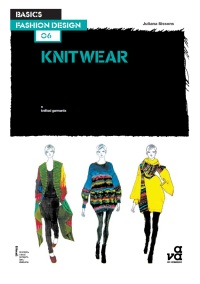
5. Juliana Sissons – Basics Fashion Design. Knitwear
Basics Fashion Design: Fashion Knitwear is an introduction to the use of creative knitwear in fashion design. Thanks to recent developments in technology, knitwear is a revived industry. This book is a practical guide to its use in the creation of original and experimental outcomes. Fully supported by contemporary examples and easy-to-follow diagrams, it introduces the key materials, equipment, and processes involved. It also discusses knitwear as an industry and offers useful career information, with further insight provided by interviews with international designers.
6. Neil Leonard – Basics Graphic Design. Design Research
A graphic design project can be viewed as a series
of choices – the more informed these choices are,
the stronger the outcome will be. Research is the tool
that, above all others, can help you gain the in-depth
knowledge needed to inform your choices and make
the most appropriate and educated decisions.
Research is an ongoing process, beginning with initial
fact-fi nding as you respond to a brief, and progressing
through audience research, to the development and
synthesis of ideas, and the fi nal testing of materials,
processes and resolutions.
The processes you undertake may be structured or intuitive,
but all research should be approached with an open mind.
You may start with a very clear methodology that allows you
to move from one step to another in a structured way, or you
may prefer to engage in a series of experiments and allow
the outcome of these to dictate your next step. In either
case, you should be open to what your research tells you.
This book will act as a guide, introducing you to relevant
concepts and terminology, and helping you make the most
of your investigative work. The chapters help you discover
appropriate research methods, identify and question your
target market and make appropriate and targeted design
choices. The book will help you make the best of your
creative ideas, formulate plans and structure your work in
a way that will benefi t your fi nal ideas and open fresh
avenues of creativity.
Описание
Перед вами полный комплект из 5 книг серии Basics Fashion Design от Jenny Udale и John Hopkins — фундаментальное введение в мир моды и графического дизайна. Этот набор охватывает ключевые аспекты создания одежды: от исследования идей и разработки концепций до работы с тканями, кроем, силуэтами и финальной презентацией коллекции.
Авторы последовательно раскрывают процесс создания модной одежды, объясняя, как формируется тренд, как дизайнеры работают с цветом, фактурами и формами. Отдельные тома посвящены конструктивным особенностям, текстилю, иллюстрации и графическому представлению идей — всё то, что необходимо знать начинающему модельеру или стилисту.
- студентам и преподавателям профильных вузов по специальностям «Дизайн одежды» и «Мода»
- начинающим дизайнерам, желающим выстроить системное понимание профессии
- стилистам и байерам, которые хотят глубже понимать процесс создания коллекций
- всем, кто интересуется fashion-дизайном и хочет читать профессиональную литературу на английском языке
Только зарегистрированные клиенты, купившие данный товар, могут публиковать отзывы.
Похожие


Другие книги раздела «Мода и Дизайн»
- Kendra Stanton – 500 Eye Makeup Design
- Федор Коммиссаржевский – История костюма
- Энн Холландер – Пол и костюм. Эволюция современной одежды
- Информационные технологии проектирования швейных изделий
- История китайской одежды
- История текстильного искусства и костюма. Древний мир
- Мишель Пастуро – История цвета
- Виктория Лунина – Парижский гардероб
- Автоматизированные методы проектирования ремизных и жаккардовых тканей
- Виды декорирования текстильных материалов и готовых изделий
- Элизабет Гуслан – Жан-Поль Готье
- Информационно-технические и технологические аспекты проектирования костюма
- Марианна Дроздова – Авторский курс интерьерного дизайна
- Елена Ледней – Таро Уэйта
- Ксения Меньшикова, Полный курс Таро
- Евгения Марк, Таро Консультирование
Все книги раздела «Мода и Дизайн» →
Смежные разделы: Архитектура · Живопись и Графический дизайн · Музыка · Театр и Кино · Фотография · Культура и Искусство · Декоративно-прикладное искусство
Рекомендуем также
- C. Bailly – Turbulence (2015)
- D. Pfaff – Neuroscience in the 21st Century (Second edition, 2016)
- J. Ohm – Multimedia Signal Coding and Transmission (2015)
- N. Perez – Fracture Mechanics (2017)
- J. Hu – Active Coatings for Smart Textiles (2016)
- M. Matsumoto – Sustainability Through Innovation in Product Life Cycle Design
- J. Wang – Multiferroic Materials (2017)
- N. Berger – Epigenetics, Energy Balance and Cancer (2016)

Отзывы
Отзывов пока нет.