
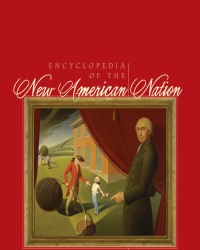
Paul Finkelman – Encyclopedia of the New American Nation (3 Volumes)
984 ₽
Автор: Paul Finkelman
Название книги: Encyclopedia of the New American Nation (3 Volumes)
Формат: PDF
Жанр: История Америки, Австралии, Океании
Страницы: 525+579+501
Качество: Изначально компьютерное, E-book
Traces the development of the ideas, customs, and institutions that constitute the American cultural identity through 670 articles by specialists in history, law, religion, literature, art, music, African American studies, women's studies, and science and technology.
The Encyclopedia of the New American Nation is the last in a series of four encyclopedias
that provide a detailed understanding of American history from the first
European exploration of the New World to the beginning of the twenty-first century.
The series—which also includes The Encyclopedia of the North American
Colonies (1993), edited by Jacob E. Cooke, The Encyclopedia of the United States in
the Nineteenth Century (2001), edited by Paul Finkelman, and The Encyclopedia of
the United States in the Twentieth Century (1995), edited by Stanley I. Kutler—
provides comprehensive access to the history and development of the events,
trends, movements, technologies, cultural and social changes, political ideas and
systems, and intellectual trends that have shaped America. This encyclopedia completes
this multivolume series by providing detailed information about the founding
period of the United States—the era of the new nation. The bibliographies following
each entry lead both students and specialists to the central literature surrounding
the 667 entries in the three volumes that make up this encyclopedia.
In 1754 the United States did not exist. There was no new American nation, or
any American nation. Along the east coast of what is today the United States were
thirteen British colonies and one Spanish colony. The Gulf Coast was divided
between the Spanish and the French. The interior of the continent, from the
foothills of the Appalachians to the Mississippi and beyond, was mostly inhabited
by Indians, with a few settlements and scattered traders and trading posts. England
claimed the lands east of the Mississippi and north of the Gulf of Mexico, but
France challenged British interests in the Ohio River valley and on the eastern
shores of the Mississippi River. France claimed and controlled most of the land
north of the St. Lawrence River. West of the Mississippi most of the continent
belonged to Spain and France. The largest city in British North America was
Philadelphia, with about 13,000 people in 1740 and about 25,000 by 1760. Only
three other cities—New York, Boston, and Charleston—had populations that
exceeded 5,000. The thirteen colonies had a non-Indian population of about
1,200,000, of whom about 240,000 were slaves.
By 1829 this world had been turned upside down. In 1763 England defeated
France in the French and Indian War. The conflict was what might be considered
the first “world war” in history, as it was fought in Europe, Asia, the Pacific, and
the Americas. The peace treaty redrew the map of America. With the exception of
Florida and the Gulf Coast, everything east of the Mississippi became British, and
the rest of the continent went to Spain. France was defeated and expelled from the
continent, and Indians who had sided with France were also weakened. Even those
who fought for the British were hurt beyond repair. The American colonists, however,
emerged strong and self-confident. In 1775, the thirteen colonies revolted
against Great Britain, the most powerful nation on earth. After eight years of warfare,
Britain gave up in her attempt to subdue these rebels. A new nation was born,
proclaiming itself a self-governing republic. The row of tiny colonies was no longer
ruled by a king and his parliament on a distant island. It was indeed the beginning
of new era, not just in America, but in western Europe as well.
In the next half century the new nation grew rapidly. Its population more than
tripled, reaching 13,000,000 by 1830. The thirteen colonies of 1775 had grown to
twenty-four states. By 1775 slavery was legal in all of the colonies, and by 1830
twelve states had either abolished it or were in the process of doing so. About 3,000
slaves remained in those states, almost all of them in New Jersey, which was the
last state to begin gradual abolition. Twelve southern states, on the other hand, had
more than 2,000,000 slaves. Slavery was the most obvious marker of the differences
between the sections, but it was not the only one.
Industrial production had begun in the North, and some parts of New England,
and the Middle Atlantic states were, for the first time in the nation’s history, more
urban and industrial than agrarian. In 1790 no American city exceeded 35,000
people and only about 160,000 Americans lived in a town or city of more than
5,000 people. By 1830 New York City’s population exceeded 200,000, and more
than a million Americans lived in towns and cities. Baltimore, a city in a slave state
that straddled the North and the South had grown from 13,000 in 1790 to more
than 80,000 people, but it was the only southern city of any great size. In 1790
Charlestown was the South’s biggest city, with about 16,000 people. By 1830 the
city had only grown to about 30,000 people. New Orleans, which had about
20,000 people when Louisiana became a state in 1812 had grown to 46,000 by
1830. Meanwhile Boston, which had 18,000 people in 1790, had more than tripled
to over 60,000 by 1830, while in the same period Philadelphia had grown from
28,000 in 1790 to over 80,000.
The geography of the nation had also changed. At the end of the Revolution the
thirteen new American states were hugging the Atlantic seaboard; the nation itself
extended to the Mississippi River in the West and the Great Lakes to the North, but
not to the Gulf Coast. The southern portions of Mississippi and Alabama, called
West Florida at the time, were still under Spanish control. By 1830 the nation was
vastly larger. Florida and West Florida were now safely in American hands. The
Gulf port of New Orleans was an American city; the nation stretched west from
the Mississippi to the Rocky Mountains and beyond. Both the United States and
Britain now claimed the Pacific Northwest, and eventually they would peacefully
divide it. The Great Plains were populated by Indians, but by 1830 few Indians lived
in the East. Tens of thousands of Indians had already been pushed west, into what
later became Oklahoma and Arkansas, while others had been pushed north into
New York, Michigan, and what would become Wisconsin. The stage was set for
the final removal in the next decade—through Black Hawk’s War and the Trail of
Tears—of most of the Indians in the Southeast and the Midwest. While the nation grew physically and prospered economically, it matured even
more rapidly politically. The nation began with no political system at all. Each
colony managed to create a system of self-government almost as soon as the
Revolution began. Constitutions appeared in all but two of the new states; Rhode
Island and Connecticut simply recycled their old charters. All the states experimented
with the details of government, but all accepted basic principles: democratically
elected representatives serving for defined terms of office. New states all had a governor,
although the executive’s power varied from place to place, as did terms of
office and voting rights. Massachusetts allowed almost universal male suffrage,
without regard to property or race; South Carolina limited voting to propertyowning
white men. Most other states were somewhere in the middle. About half
of all states allowed free blacks to vote, and New Jersey initially allowed women
to vote, but had taken that right away by 1812.
At the national level the Americans at first had a weak central government
with few powers and little ability to control the actions of the individual states.
After 1787 the national government grew stronger, under a constitution that was,
as John Marshall put it, “intended to endure for ages to come, and, consequently,
to be adapted to the various crises of human affairs.” And so it did, at least for
another three decades, until finally the pressure of slavery undermined the compromises
at the Constitutional Convention and brought the nation to civil war.
The ability of the nation, thirty years later, to survive the Civil War was in
part due to the political structures created in the early national period. No one
planned to have political parties, for example. In fact, the founders thought they
were a bad idea. But they emerged quickly. More significantly, only a few of them
emerged. The nation was not saddled with a plethora of parties, each holding a tiny
slice of the political pie, collectively preventing a government from functioning.
This lack of political options may have fostered a false sense of unity, as a majority
of Americans denied class division and ignored racial oppression, but it had the
advantage of creating a political system that worked. When Thomas Jefferson proclaimed
in his inaugural address, “We are all Republicans—we are all Federalists,”
he was fundamentally right. He called a hard-fought and vicious presidential campaign
a “contest of opinion,” and noted that all Americans accepted the fundamental
principles of self-government, freedom of expression, and the “sacred principle,
that though the will of the majority is in all cases to prevail, that will to be rightful
must be reasonable; that the minority possess their equal rights, which equal
law must protect, and to violate would be oppression.”
Citizens, and especially public figures, of the new nation were not always able
to follow these principles. Jefferson himself relished the persecution and prosecution
of some of his critics. More important, Jefferson could not imagine any of his
two hundred slaves or the million other blacks in the nation being entitled to the
rights of the majority. Nor would he have wanted Indians—the first Americans—
to be the beneficiaries of his ideology. But, others in the nation could imagine those
things and more. The legacy of the new nation was one of democratic self-government
and the belief that ideas could be turned into practical solutions to make the
nation a better place.
This encyclopedia is designed to explore these issues, and others, and to illuminate
our understanding of how thirteen tiny colonies clinging to the Atlantic coast,
evolved into a single nation spanning a continent.
The completion of these three volumes would not have been possible without
the participation of the many scholars who have contributed their time and expertise
to write for this project. Without their cooperation and willingness to share
their knowledge and understanding of American history it would simply be impossible
to create a reference tool like this one. My editorial board was also essential to this project. Jan Lewis, Peter Onuf, Jeff Pasley, John Stagg, and Michael
Zuckerman are all superb historians, important scholars, and as I learned when
they read the entries I wrote, first-rate editors in their own right. They are also
good friends and colleagues. I am honored that they agreed to work on this project
and help create these volumes. Rita Langford, my own administrative assistant
at the University of Tulsa College of Law was invaluable in the management of this
project, and in so many others that I have worked on. Similarly, I thank John
Wright, who claims to be my agent, but is really a friend and advisor. My editors
at Scribners/Gale, John Fitzpatrick, and the project managers I worked with,
Roberta Klarreich, Lisa Vecchione, and especially Erin Bealmear, were enormously
helpful, as were Linda Hubbard and her entire production team. Most of all, I owe
a special thanks to Frank Menchaca, who changed job titles, office, and even the
city he lived in during the project, but was always available for consultation. One
of the great bonuses of this project was the opportunity to spend time with Frank,
and learn from him.
Paul Finkelman
Описание
Paul Finkelman – Encyclopedia of the New American Nation (3 Volumes) представляет собой фундаментальный справочник, посвященный истории США с момента обретения независимости до начала Гражданской войны (1776–1860 годы). Издание охватывает ключевые события, идеи, институты и персоналии, сформировавшие молодую американскую республику.
В трех томах подробно рассмотрены политические процессы, экономическое развитие, социальные изменения, вопросы рабства и аболиционизма, экспансия на Запад, культурная жизнь, внешняя политика и формирование американской идентичности. Энциклопедия содержит сотни статей, написанных ведущими историками, с акцентом на взаимосвязь между различными аспектами жизни ранней Америки.
- студентам и преподавателям истории США, политологии и культурологии
- исследователям, работающим с периодом Early Republic и Antebellum America
- читателям, интересующимся формированием американской демократии, правами человека и социальной историей
- специалистам библиотек и всем, кто ищет авторитетный источник по американской истории XVIII–XIX веков
Только зарегистрированные клиенты, купившие данный товар, могут публиковать отзывы.
Похожие


Другие книги раздела «История Америки, Австралии, Океании»
- Jennifer D. Keene – Visions of America. A History of the United States (2nd edition)
- John M. Herrick – Encyclopedia of Social Welfare History in North America
- L. Levy – Encyclopedia of the American Constitution (Second edition)
- M. Grossberg – The Cambridge History of Law in America (3 Volumes)
- M. Keller – Americas Three Regimes. A New Political History (2009)
- Marc Wortman – Bonfire. The Siege and Burning of Atlanta
- Marie Gottschalk – The Politics of Mass Incarceration in America
- Michael J. Bennett – Union Jacks. Yankee Sailors in the Civil War
- Michael Kazin – The Princeton Encyclopedia of American Political History
- C. Meadows – Encyclopedia of Oceania
- G. Nash – Encyclopedia of American History (11 Volume set)
- N. Guyatt – Providence and the Invention of the United States 1607-1876
- R. Farley – Wall Street Wars. The Epic Battles with Washington
- R. Harrison – Congress Progressive Reform and the New American State
- R. Remini – A Short History of the United States of America
- R. Samuels – Encyclopedia of United States National Security (2006)
Рекомендуем также
- S. Ranjan – Nanoscience in Food and Agriculture (5 Volume set)
- W. Lyons – Standard Handbook of Petroleum and Natural Gas Engineering
- M. Katz – Multimodality Management of Borderline Resectable Pancreatic Cancer
- S. Paul – Clinical Cases in Skin Cancer Surgery and Treatment (2016)
- Y. Sakai – Laparoscopic Surgery for Colorectal Cancer (2016)
- V. Stearns – Novel Biomarkers in the Continuum of Breast Cancer (2016)
- A. Mathur – Nanotechnology in Cancer (2017)
- P. Rennert – Novel Immunotherapeutic Approaches to the Treatment of Cancer

Отзывы
Отзывов пока нет.