
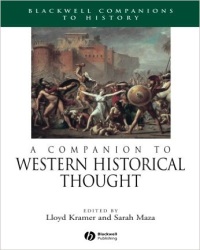
Lloyd Kramer – A Companion to Western Historical Thought
984 ₽
Автор: Lloyd Kramer
Название книги: A Companion to Western Historical Thought
Формат: PDF
Жанр: Прочая историческая литература
Страницы: 533
Качество: Изначально компьютерное, E-book
This broad survey introduces readers to the major themes, figures, traditions and theories in Western historical thought, tracing its evolution from biblical times to the present.
Surveys the evolution of historical thought in the Western World from biblical times to the present day.
Provides students with the background to contemporary historical debates and approaches.
Serves as a useful reference for researchers and teachers.
Includes chapters by 24 leading historians.
This volume provides an overview of the many forms of historical thought
which have flourished in Europe and North America from biblical times and
classical antiquity down to the contemporary era of the Internet, television,
and the global film industry. In essays that cover more than two thousand years
of Western cultural history, the twenty-four contributors to this book examine
the evolving theories, methods, and conceptual categories that men and
women have used to explain and write about the past. Over the long development
of Western historical writing, historians have come from an extraordinary
range of social and cultural positions – monks, courtiers and royal
scribes, army generals and wealthy aristocrats, prosperous merchants and poor
workers, political leaders and statesmen, philosophers, poets, teachers, university
professors, artists, and filmmakers. Thinking and writing about history, as
the authors of the following essays show, has always been shaped by a host of
different and often conflicting ideals, aspirations, and practical objectives,
including religious beliefs, political ideologies, propaganda for ruling elites (or
for their opponents), literary expression, popular entertainment, academic
careerism, and the search for personal or collective identities.
The chapters in this book refer in various ways to all of these historical practices,
and they describe specific historians as well as wider historical movements
that have influenced both their own era and the historical thought of later generations.
The story of historical thought begins in times so remote that their
histories survive only in fragments written by nameless chroniclers, but it continues
into a twenty-first century whose technologies and mass media are
rapidly transforming the oldest traditions of historical work. Previously obscure
documents and historical records have become instantly available through the
world-wide web of the computer age, yet the readership of academic historywriting
is dwindling, and historians are anxiously searching for new ways to
communicate with a culture that gives far more value to “speed” and “the present” than to slow-moving commentaries on the people and events of the
past.
A survey of historical thought must therefore recognize the ways in which
historical understanding both changes and stays the same in the different eras
of human history. We asked each of the authors in this book to discuss the
origin and legacy of a specific period or form of historical thought and thereby
provide a concise summary of often diverse historical texts or historiographical
traditions. When and where did a particular style or method of historical
thought appear and what were its most distinctive traits? What were its guiding
assumptions and what impact did this kind of history have on historical conceptions
of human events or human societies? What were its limitations or
historical blind spots? Did this form of historical thought produce an enduring
legacy that remains relevant or influential in the historical writing and
thought of our own era? We asked all of the authors to address such questions
in essays that would be accessible to readers who have an interest in history
but little or no specialist knowledge of historical thought and philosophies of
history.
The following chapters thus emphasize the main themes of different eras
and forms of historical thought, but they are also organized roughly in chronological
fashion to suggest the development of historical thought across time.
We decided to use this mostly linear organization – though the chronology
flattens out in later sections that discuss the concurrent themes of contemporary
historical thought – in order to show how various aspects of historiography
have reappeared in different historical eras or remained influential or
changed amid evolving historical contexts. Many of the assumptions we take
for granted when we think about history today have origins that can in fact
be traced far back into the history of pre-modern Western thought. The idea
of a “people” or “nation” as the fundamental unit of historical thought, for
example, emerged in some of the earliest biblical narratives and in ancient
Greek histories of early Greek wars. Cultural history had its practitioners in
ancient Greece, in Renaissance Italy, and in eighteenth-century France long
before it took on new philosophical themes in nineteenth-century Germany.
Some Renaissance historians were the first to point out that history written
from the vantage point of women would look much different from the usual
male-centered story. Eighteenth-century thinkers began to divide the sweep
of Western history into “stages” whose dominant characteristics were forms
of economic activity or social organization. In some periods – the Renaissance
and early nineteenth century, for instance – historians focused attention on the
importance of original, written documents, while at other times the sources
became almost invisible behind the writer’s own voice. Such traditions and
many others described in this book remain influential in historical thought to
this day, though they have also been challenged, criticized, and redefined in
the historical debates of almost every generation. Like other forms of human culture, historical thought draws on models or antecedents from the past, but
it also transforms, revises, and recreates all the traditions that it uses.
The essays in this volume draw attention not only to the assumptions that
have shaped historical thought in a succession of times and places, but also to
the different social, political, and cultural contexts in which accounts of the
past have been produced. What we see today as the “normal” context for
writing history – advanced degrees, university departments, professional meetings,
journals, and monographs – took shape little more than a century ago.
The professional environment in which most historians now work developed
in the new universities, libraries, archives, and publishing systems of the
modern nation-state, but these institutions (and the nation-states that supported
them) are now undergoing rapid and unpredictable changes. It is difficult
to imagine what “doing history” will look like a century from now,
though it seems likely that this future world will be increasingly dominated by
the visual media, by cyberspace and by the global cultural exchanges that are
emerging in this new technological context. Historical thought is shaped by
the historian’s religious, political, and intellectual commitments, but also by
more immediate social and institutional factors such as the need to provide
historical legitimacy for powerful persons, to flatter a monarch, to defend the
privileges of an institution, to complete an encyclopedic European-style thesis,
or to gain the security of a tenured academic job. As these shaping institutional
structures change in the coming century, the nature of historical work
is bound to change too.
This volume’s survey of the leading ideas and influential contexts that have
shaped previous centuries and patterns of historical thought deals essentially
with developments in what is usually called the “Western World”: the ancient
Mediterranean, Europe, and modern North America. It does not cover the
independent evolution of historical thought in other important civilizations
and cultural traditions in Asia, Africa, and Latin America. The book’s final
section, however, suggests that current intellectual exchanges are making such
clearly demarcated cultural distinctions increasingly untenable. Thinkers from
other parts of the world have challenged Western historians to recast their histories
of both the Western world and the large, diverse world outside the West.
The rapid growth of new global and post-colonial histories shows how
complex, cross-cultural exchanges have long influenced all parts of the world
(including of course the West). One of the main themes of post-colonial
history, for instance, stresses the ambiguous, often vexed nature of national
identities among the inhabitants of Europe’s former colonies. The work of
post-colonial historians has in turn influenced historians of Europe and
America, leading them to examine the multicultural characteristics of modern
nations and to question the very concept of nationhood as it applies to
countries like France, Britain or the United States. Historical thought in the
contemporary world is therefore becoming global and encouraging new cross- cultural themes that will surely be as influential as new technologies, new media
and new social institutions in shaping the future development of historical
thought.
The study of historical thought thus could and should move far beyond the
Western tradition, but even within the Western tradition itself it would be possible
to explore many themes that are not examined in this volume. We could
have included more analysis of how social and cultural assumptions about
gender affect historical writing, or a survey of how historical novels influence
historical understanding, or a detailed discussion of how historical thought
appears and disappears in contemporary popular culture. Given the inevitable
limits of a single book, however, we have chosen to focus mostly on the long
intellectual history of Western historiography.
This overview of the distant and more recent past summarizes what earlier
historians have thought and written about the meaning of history, but it is
also designed to encourage new critical thinking about contemporary and
future historical work. Placing recent historical practice in a wider cultural and
temporal context shows both the contingency and the cultural origins of our
own historical assumptions. It also provokes questions about the new directions
that historical thought could take in the twenty-first century. How long
will we continue to think of history as unfolding within the boundaries
of nation-states? Will the traditional distinctions between Western and non-
Western societies remain important in historical thought? Will we arrive at
new understandings of individuals and “selfhood” in history, or grasp the
nature of emotions in societies and eras that are far removed from our own
culture? Will our longstanding assumptions about the purposes of historical
narratives crumble as future generations produce computerized hypertexts
instead of bound books and dissertations? Facing such questions about the
changes and discontinuities in the theory and practice of historical studies, we
need to think again about the enduring characteristics and continuities that
have long made historical thought one of the decisive influences in Western
intellectual life. But what are the distinctive beliefs and themes of Western
historical thought?
Описание
A Companion to Western Historical Thought Ллойда Крамера — это фундаментальный сборник, который знакомит читателей с эволюцией исторической мысли на Западе от античности до наших дней. Книга анализирует, как менялось понимание прошлого, роли историка и методов исследования на протяжении столетий.
В сборнике рассматриваются ключевые философские, культурные и методологические повороты в историографии: от Геродота и Фукидида до влияния Просвещения, романтизма, марксизма, постмодернизма и современных подходов, включая гендерные и постколониальные исследования. Авторы статей разбирают, как историческое знание формировалось под влиянием политики, науки и общества.
- студентам и преподавателям истории, философии и культурологии
- исследователям, интересующимся теорией и методологией исторической науки
- всем, кто хочет глубже понять, почему и как мы изучаем прошлое
- специалистам, работающим с историческими текстами и нарративами
Только зарегистрированные клиенты, купившие данный товар, могут публиковать отзывы.
Похожие


Другие книги раздела «Прочая историческая литература»
- Бруно Латур – Нового Времени не было. Эссе по симметричной антропологии
- Н. Курчанов – Антропология и концепции биологии
- Ричард Линн – Расы. Народы. Интеллект
- В. Ламин – Историческая Энциклопедия Сибири (3 Тома, 2009)
- С. Лурье – Историческая этнология
- А. Зданович – Органы государственной безопасности и Красная армия
- Тим Вейнер – ФБР. Правдивая история
- И. Гладков – История социалистической экономики СССР (5 Томов)
Рекомендуем также
- R. Larson – Algebra and Trigonometry (2016)
- R. Singh – Principles and Applications of Environmental Biotechnology for a Sustainable Future (2017)
- M. Gulrajani – Colour Measurement
- C. Prestigiacomo – Surgical Endovascular Neuroradiology (2015)
- R. Eklund – Encyclopedia of Sport and Exercise Psychology (2014)
- C. Batt – Encyclopedia of Food Microbiology (2nd edition, 2014)
- A. Bosserhoff – Melanoma Development (2017)
- S. Kountakis – Encyclopedia of Otolaryngology Head and Neck Surgery

Отзывы
Отзывов пока нет.