
50% Off 

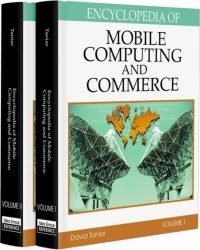
David Taniar – Encyclopedia of Mobile Computing and Commerce (2007)
Первоначальная цена составляла 2.960 ₽.1.480 ₽Текущая цена: 1.480 ₽.
Автор: David Taniar
Название книги: Encyclopedia of Mobile Computing and Commerce
Формат: PDF
Жанр: Компьютеры
Страницы: 1116
Качество: Изначально компьютерное, E-book
The Encyclopedia of Mobile Computing and Commerce is the leading reference source for innovative research on mobile applications and commerce. This two-volume encyclopedia set presents current trends in mobile computing and their potential use in business and commerce. Hundreds of internationally renowned scholars and practitioners have written comprehensive articles exploring the latest concepts, technologies, and innovations in this rapidly expanding field. Thousands of definitions and references to additional literature have been included to stimulate further research. The Encyclopedia of Mobile Computing and Commerce is an indispensable reference work for every academic, public, and private library.
Nowadays, mobile communication, mobile devices, and mobile computing are widely available. Everywhere people are
carrying mobile devices, such as mobile phones. The availability of mobile communication networks has made a huge impact
to various applications, including commerce. Consequently, there is a strong relationship between mobile computing
and commerce. The Encyclopedia of Mobile Computing and Commerce brings to readers articles covering a wide range of
mobile technologies and their applications.
Mobile commerce (m-commerce) is expanding, and consequently the impact to the overall economy is considerable.
However, there are still many issues and challenges to be addressed, such as mobile marketing, mobile advertising, mobile
payment, mobile authorization using voice, and so on. Providing users with more intelligent product catalogues for browsing
on mobile devices and product brokering also plays an important role in m-commerce. Furthermore, the impact mobile
devices give to the supply chain must be carefully considered. This includes the use of emerging mobile technology, such
as RFID, sensor network, and so forth.
A wide range of mobile technology is available for m-commerce. Mobile phones are an obvious choice. Additionally,
there are many different kinds of mobile phones sold in the market, some of which are labelled as smartphones. There is
much research conducted in conjunction with the use of mobile phones. Mobile phone text messaging and SMS are common
among mobile users. Subsequently, the use of text messaging and SMS enriches m-commerce, including the ability
to support multilingual text messaging. Mobile phone supporting disability has also been a focus lately, which focuses on
text messaging to disabled people. More advanced applications now require additional services, such as chatting using
Bluetooth, mobile querying, and voice recognition. Mobile privacy issues are also still an important topic.
Apart from mobile phones, there is a wide variety of mobile technology, some of which are mobile robots, RFID, penbased
mobile computing, and so forth. Many advanced applications have been developed utilizing these technologies. Current
research has been focusing on man-machine interfaces and sensory systems, particularly for mobile robots, biometric
and voice based authentication, traffic infractions, and so forth. The context of smart spaces also gives a new dimension
to mobile technology.
The use of mobile technology in entertainment is growing rapidly. Some examples include mobile phone gambling,
mobile collaborative games, mobile television, mobile sport videos, and mobile hunting incorporating location-based information.
The list is expanding as the technology is advancing. Understanding the success factors for mobile gaming and
other entertainment is equally important as the technical aspects of the technology itself.
Videos and multimedia undoubted play an important role in mobile entertainment. Video technologies, such as mobile
video sequencing, mobile video transcoding, and mobile video communications, have been studied extensively. One of the
main limitations of mobile devices is the limited memory capacity, which has to be carefully addressed, especially in the
context of mobile multimedia, because these kinds of applications generally require large amount of spaces. Beside videos,
radio technology should not be neglected either.
There are many other applications of mobile technology. For example, the use of mobile technology in health, called
m-health, is expanding. Mobile medical imaging is made possible thru the use of 3G wireless network. Another example is
the use of mobile technology in learning, called m-learning, such as the use of SMS and text messaging, although some still
argue whether m-learning is the way to go in learning, while others are still looking at how to combine the infrastructures
and tools with pedagogy.
Developing mobile applications requires a novel software engineering approach. The design for mobile information
systems is still maturing. Some researchers are still formulating design patterns for mobile applications, while others are
focusing on the user interface aspects. Programming for handheld devices is quite common to use various programming
languages and tools, including Java micro edition, J2ME, Corba, and Extreme programming. Since the device generally has
a small screen, content transformation and content personalization need to be examined. Other forms of interfaces, including brain computing interfacing, are also interesting. Mobile databases and XML-based mobile technology have received
some degree of attention as well.
Other issues that have been incorporated into mobile technologies include mobile agents, service-oriented computing,
and various forms of caching, such as peer-to-peer, cooperative, and semantic caching. Service delivery and resource discovery
are gaining their popularities too. Security—especially in a mobile environment—should not be neglected. Some
work on mobile PKI and limited key generations has been carried out by a number of researchers in order to contribute to
advancing m-commerce.
The impact of mobile technology in commerce needs to be evaluated, including its socio-psychological influence and
technological adoption and diffusion, as well as readiness and transformation. We need to understand the adoption, barrier,
and influencing factors of m-commerce. Some gender issues have been pointed out by some researchers.
All of the abovementioned applications will not be made possible without addressing the advancement of mobile networks.
Most of the articles in this encyclopedia may be categorized into the mobile network and communication category.
3G architectures have made their entries lately. Mobile ad-hoc network, IPv6 and P2P are also maturing. Some new work
in wireless sensor network is presented.
Last but not least, mobile technology and its applications will not be complete without mentioning location-aware and
context-aware. New technologies in positioning; either indoor or outdoor, as well as tracking of moving objects, are presented.
Some applications of location-aware include ad-hoc mobile querying, use of iPod as a tourist guide, location-based
multimedia for monitoring purposes, and location-based multimedia for tourists. Some notable context-aware applications
are notification services, context-aware mobile GIS, and semantic mobile agents for context-aware applications.
As a final note, the Encyclopedia of Mobile Computing and Commerce covers a broad range of aspects pertaining to
mobile computing, mobile communication, mobile devices, and various mobile applications. These technologies and applications
will shape mobile computing and commerce into a new era of the 21st century whereby mobile devices are not
only pervasive and ubiquitous, but also widely accepted as the main tool in commerce.
David Taniar
Melbourne, Australia
January 2007
Описание
Только зарегистрированные клиенты, купившие данный товар, могут публиковать отзывы.





Отзывы
Отзывов пока нет.