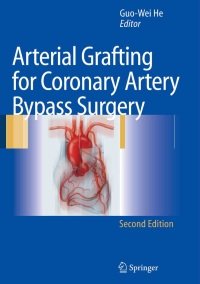
Guo-Wei He – Arterial-Grafting for Coronery Artery Bypass Surgery (Second edition)
1.860 ₽
Автор: Guo-Wei He
Название книги: Arterial-Grafting for Coronery Artery Bypass Surgery (Second edition)
Формат: PDF
Жанр: Медицина
Страницы: 349
Качество: Изначально компьютерное, E-book
This updated edition examines the biological characteristics and clinical use of arterial grafts for coronary artery bypass surgery. It contains first-hand information on arterial grafts, as well as vein grafts with regard to biological characteristics, clinical use including off-pump coronary bypass grafting surgery, results, and future developments. The book is a practical guide and as a stimulus for further improvement of arterial grafting techniques.
Coronary artery disease remains the major cause of mortality worldwide. Despite
aggressive application of percutaneous coronary interventions, the surgical approach,
namely coronary artery bypass grafting (CABG), remains a major approach
for the treatment of coronary artery disease. Usage of arterial grafting has been well
accepted as the main approach to increasing the long-term patency of the graft and
long-termsurvival.However, the use of arterial grafts is not a simple issue. This is reflected
by the diversity in practice amongmost experienced cardiac surgeons around
the world as to the choice of conduit, the combined use of various arterial grafts,
pedicle versus free grafting, etc. The issue is further complicated by the usage of
these grafts during conventional cardiopulmonary bypass or on beating hearts, the
usage of minimally invasive surgery in CABG, and, moreover, by the fact that most
surgeons are still using vein grafts in combination with arterial grafts.With all these
concerns, a comprehensive book on CABG using arterial grafts has become essential
for cardiac surgeons and related professionals such as cardiologists, cardiac anesthesiologists,
nurses, and other allied professionals for daily reference.
The first edition of this book was published in 1999 by Springer-Verlag. Since then,
much experience has been obtained regarding arterial grafting in CABG. The principal
role of the left internal mammary artery (IMA) as the first choice of arterial graft
stands without argument and the use of alternative arterial grafts has become more
mature in the hands of most cardiac surgeons. However, various methods of using the
left IMA in combinationwith alternative grafts are being used since the role of the latter
is defined differently among even most experienced cardiac surgeons. For example,
use of the radial artery is routine practice by some surgeons but is ignored by others.
A similar attitude is held by surgeons as to the use of the gastroepiploic artery and inferior
epigastric artery. This issue exists in the use of the second IMA, namely the right
IMA. In addition, the use of complex arterial grafts remains subject to diverse opinions.
Furthermore, much attention has been paid to the logical use of the minimally
invasive technique. For example, the roles of minimally invasive direct coronary artery
bypass (MIDCAB) and port-access technology have been redefined.
This second edition is an effort to provide the reader with the most advanced
knowledge regarding the issues such as those mentioned above fromworld-renowned
experts. To best reflect the current status of arterial grafting worldwide, new contributors
have been invited to write in their areas of expertise. I would particularly mention
the contribution by these new authors and their colleagues in the second edition: Dr.
Bruce Lytle and Joseph Sabik from the Cleveland Clinic; Dr. Hendrick Barner from St.
Louis; Dr. Hartzell Schaff fromtheMayo Clinic; Dr. Alfred Tector fromMilwaukee; Dr.
Matthew Slater from Portland; Dr. Piet Boonstra from The Netherlands; Professor
Gianni Angelini, Professor David Taggart, and Dr. Jamie Jeremy from the UK; and
Professors Masashi Komeda, Masami Ochi, and Tohru Asai from Japan. I would also
acknowledge the contribution ofmy colleagues Professor Anthony Yim, Dr. SongWan,
and Dr. Qin Yang at the Chinese University of Hong Kong. In addition to all the contributors
for the first edition, they have made the book more complete.
The successful use of arterial grafts, i.e., the arterial conduit with a diameter of
around 2 mm, is largely related to the method of overcoming the vasospasm of the
graft in the perioperative period.With a more advanced understanding of the basic
physiology and pharmacology of the arteries and veins used for grafting, this edition
provides the newest information on the endothelial function and the method of
overcoming vasospasm in the arterial grafts. The advancement of our basic knowledge
of myocardial protection is also reflected in this edition.
There are a few chapters for which the original contributors are not contactable
due to retirement or other reasons. In these cases where no new contributors could
be identified, I did the relevant literature searches and updated the chapter myself.
These chapters are „Histology and Comparison of Arterial GraftsUsed for Coronary
Surgery,“ „Splenic Artery Grafting,“ and „Use of Subscapular-Thoracodorsal Artery
for CABG.“ There is no new literature about inferior mesenteric artery grafting and
I therefore wrote an update note for the chapter.
For the chapter on the comparison of unilateral and bilateral IMA grafting, after
discussion with the original author, I rewrote the chapter with updated information
to better reflect the current view.
On the other hand, to best reflect the use of vein grafts in combinationwith arterial
grafts in most surgeons’ practice, this edition also includes a chapter on the role of
vein grafts in CABG by myself, a chapter on gene therapy for vein graft disease, and
a chapter on the prevention of vein graft failure. The use of arterial grafting in reoperative
CABG is included by presenting the large experience fromthe Cleveland Clinic.
In the minimally invasive technique of arterial grafting, Dr. Michael Mack has
combined his three chapters in the first edition into a new concise one with updated
information. Two chapters on port access of CABG have been reduced to one in order
to reflect the new trend in this area.
As one of the most pressing and controversial issues in coronary surgery today,
the indications and results of coronary intervention and CABG are attracting the attention
of all cardiac surgeons and cardiologists. The second edition therefore includes
a new chapter on the comparison between coronary intervention and CABG.
This edition also has an added section on quality control of arterial grafting by
presenting the method of measuring the blood flow in the arterial graft. Furthermore,
to better reflect the American experience at large in arterial grafting, in addition
to the new chapter from Cleveland mentioned above on the use of arterial grafts
in reoperative CABG, the experience on T-graft and internal thoracic artery-radial
artery-T-graft from other centers is described in detail.
I would like to extend my great gratitude to the original contributors of the first
edition who remain so in the second. These authors have made great efforts to provide
updates to their experience and have kept the book in step with the advancement
of science andmedicine. They have made the book a valuable addition to the
reference library of cardiac surgeons, cardiologists, anesthesiologists, and all other
professionals and scientists working in cardiovascular science and medicine.
As I mentioned above, our aim with the second edition is to make this book one
of the fewto be chewed and digested, as Francis Bacon said, and tomake it a pleasure
to study and be helpful in practice, as indicated by Confucius. It is up to the reader to
judge whether this goal has been fulfilled.
Finally, I am deeply indebted to Dr. Albert Starr for his continual support and encouragement
tomy work, not tomention that I have been the Director of Cardiovascular
Research since 1994 at the Albert Starr Academic Center for Cardiac Surgery,
the Providence Heart Institute, Portland, Oregon. I am also extremely grateful to
Dr. Denton Cooley for the useful personal communications and for the foreword he
warmly wrote for this edition. The secretarial assistance of Miss Ching-Yan Ng is
greatly appreciated.
Portland, Oregon, USA Professor Guo-Wei He
Wuhan and Hong Kong SAR, China
Описание
Arterial Grafting for Coronary Artery Bypass Surgery (второе издание) — фундаментальное руководство по использованию артериальных кондуитов в коронарной хирургии. Книга подробно разбирает, почему артериальные графты обеспечивают значительно лучшие отдалённые результаты по сравнению с венозными, и как правильно выбирать и формировать шунты для максимальной долгосрочной проходимости.
Второе издание обновлено с учётом последних данных крупных исследований, новых хирургических техник и современных стратегий полной артериальной реваскуляризации. Рассматриваются анатомия, физиология, биологические свойства различных артерий (внутренняя грудная, лучевая, желудочно-сальниковая, нижняя надчревная), техника забора и анастомозирования, а также вопросы послеоперационного ведения и оценки результатов.
- кардиохирургам, выполняющим операции КШС
- врачам-кардиологам, занимающимся отбором пациентов на реваскуляризацию
- интервенционным кардиологам и специалистам по лучевой диагностике
- ординаторам и студентам старших курсов, интересующимся сердечно-сосудистой хирургией
Только зарегистрированные клиенты, купившие данный товар, могут публиковать отзывы.
Похожие




Другие книги раздела «Кардиология»
- Andreas Helfen – Kursbuch Kontrastechokardiografie (+ Видеокурс, Немецкий язык, 2018)
- D. Hahn – Handbuch Diagnostische Radiologie. Kardiovaskulares System (Немецкий язык)
- Erland Erdmann – Klinische Kardiologie (Немецкий язык)
- Gebhard Schumacher – Klinische Kinderkardiologie (Немецкий язык)
- Ulrike Blum – Kompendium angeborene Herzfehler bei Kindern (Немецкий язык)
- Josef Niebauer – Sportkardiologie (2015, Немецкий язык)
- Marek Naruszewicz – Kardiologia Zapobiegawcza (Польский язык)
- Kewal Goswami – Cardiology Update 2018
- Paul A. Iaizzo – Handbook of Cardiac Anatomy, Physiology, and Devices (Plus Video Content)
- Ziad F. Issa – Clinical Arrhythmology and Electrophysiology (2019)
- Ross M. Ungerleider – Critical Heart Disease in Infants and Children (2019)
- Simcha Yagel – Fetal Cardiology (2019)
- Mohammad Shenasa – Cardiac Mapping (2019)
- Salim Yusuf – Evidence-Based Cardiology
- Harald Becher – Contrast Echocardiography (2019)
- In Sook Park – An Illustrated Guide to Congenital Heart Disease (2019)
Все книги раздела «Кардиология» →
Смежные разделы: Медицина на испанском языке · Медицина на немецком языке · Медицина на французском языке · Анестезиология и Реаниматология · Акушерство и Гинекология · Ветеринария · Гастроэнтерология и Гепатология · Дерматология и косметология · Диетология и нутрициология · Иммунология и Аллергология · Лапароскопия и Эндоскопия · Лабораторная диагностика (Гематология и Биохимия)
Рекомендуем также
- C. Bailly – Turbulence (2015)
- D. Pfaff – Neuroscience in the 21st Century (Second edition, 2016)
- J. Ohm – Multimedia Signal Coding and Transmission (2015)
- N. Perez – Fracture Mechanics (2017)
- J. Hu – Active Coatings for Smart Textiles (2016)
- M. Matsumoto – Sustainability Through Innovation in Product Life Cycle Design
- J. Wang – Multiferroic Materials (2017)
- N. Berger – Epigenetics, Energy Balance and Cancer (2016)
Отзывы
Отзывов пока нет.