
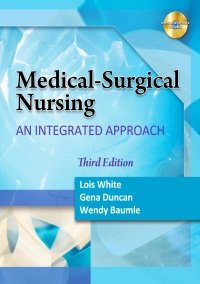
Lois White – Medical Surgical Nursing. An Integrated Approach (Third edition)
1.365 ₽
Автор: Lois White
Название книги: Medical Surgical Nursing. An Integrated Approach (Third edition)
Формат: PDF
Жанр: Медицина
Страницы: 1518
Качество: Изначально компьютерное, E-book
MEDICAL-SURGICAL NURSING: AN INTEGRATED APPROACH 3E is a comprehensive, reader friendly resource for the practical/vocational nurse. The Third Edition has been completely reinvisioned and thoroughly updated in all aspects of its coverage, with content now broken out into smaller, more manageable portions. In addition to rich coverage of all body systems with anatomy & physiology, data collection, disease information, and a strong focus on the nursing process, exciting new chapters on family processes and issues, psychobiological issues, bioterrorism and more have been added. Engaging features including case studies, critical thinking exercises, evidence-based practice boxes, informatics boxes, memory tricks, and more support learning and retention throughout the book. NCLEX style questions and Theory to Practice activities provide opportunities to test understanding and apply concepts.
Medical-Surgical Nursing: An Integrated Approach, Third
Edition, is a comprehensive examination of medicalsurgical
nursing. Critical thinking skills, real-life client case
studies, and practical clinical activities help integrate nursing
theory into professional licensed practical nursing (LPN)
licensed vocational nursing (LVN) practice. Providing thoroughly
researched, in-depth information on medical conditions
and best nursing practice, this new edition addresses
current health care topics in an easy-to-read, engaging
format.
The LPN/LVN plays an essential role on the health
care team. An LPN/LVN education lays the ground work to
competently care for clients or to move on to an advanced
nursing education degree while working as a nurse. The learning
opportunities in Medical-Surgical Nursing, Third Edition,
facilitate critical thinking, which prepares students to solve
nursing problems and make competent, accurate, time-saving
decisions. At the same time as it covers all of the medicalsurgical
nursing information needed by a student to become a
successful nurse, this text also highlights the many opportunities
that abound in different work settings and equips students
to be successful in the ever-changing health care arena.
CONCEPTUAL APPROACH
Medical-Surgical Nursing has a respected history of educating
and preparing students to be successful professional LPN/
LVN nurses. However, as is true for all textbooks, with time
the information needed thorough revision to reflect new
research and current practice. This became an exciting opportunity
for the authors to re-envision the text for today’s
nursing student. Recognizing that students have more to learn
at the same time that they have more demands on their time,
the authors listened to what students want. This new edition
has an innovative unit wrap-around presentation. Short
chapters are grouped together in units, either by body system
or related concepts. As students study the overview of these
systems, they can focus on conditions specific to one segment
of the body system. Shorter chapters are more easily grasped,
and can be fit into several shorter study sessions versus the
traditional single body system chapter presentation, which
can be overwhelming to read all at once. In this new edition,
the concepts are all brought back together in the end-of-unit
wrap-up, which provides summaries of each individual chapter,
learning activities, comprehensive references and web
resources, and carefully constructed NCELX-style questions
to help the student synthesize all of the information covered
in the unit. Students have everything they need, tailored to
how they want to learn.
The authors also wanted to present cutting-edge information
on new equipment, technology, and practice based
on research, yet emphasize the importance of taking the
time to listen and provide warm, compassionate care to a
client. This text is balanced by presenting the latest information
and linking it with the psychosocial needs of medicalsurgical
clients.
Clients are usually not alone when they enter a health
care facility. They are part of a family and community. This
new edition discusses caring for the client in a family context
and includes chapters on assessing the family structure to provide
holistic care for the client. Medical-surgical conditions
are explored in depth with an emphasis on the older adult
and caring for clients in pain and those experiencing palliative
and end-of-life care. There is an emphasis on community and
home health care.
ORGANIZATION OF THE TEXT
As highlighted earlier, Medical-Surgical Nursing: An Integrated
Approach, Third Edition, takes an innovative approach
to the organization and presentation of information.
Units of related information present smaller, more easily
digestible chapters that are wrapped in unit-specific information,
such as NCLEX-style review questions, references,
and resources. Seventeen “wrap-around units” contain 71
total chapters. These smaller chapters each present focused
information about a main concept. Driven by student feedback,
this organization facilitates better understanding and
a sense of accomplishment in completing reading assignments.
Today’s student can mark progress in reading and
comprehending smaller sections of in-depth content and
then synthesize all of the unit information by completing the
end-of-unit activities.
An exciting new feature at the end of each unit, the Theory
to Practice activity, reinforces chapter content in a real-life
situation. Students are encouraged to reevaluate their learning
experiences through recall of concepts, introspection of clinical
learning opportunities, and application of theory concepts
when interacting with staff or clients. Additionally, students
are provided with NCLEX-style questions that pull concepts
from all the unit’s chapters together to challenge critical thinking
and understanding of the nursing process.
Each body system unit has an introductory chapter with
an anatomy and physiology review, recall of assessment techniques
pertinent to the body system, and an explanation of
diagnostic tests specific to the body system. The rest of the
chapters in the unit explain the disorders within the body
system. These chapters are designed to give an overview of
the disorder and then present the medical and surgical care,
pharmacological care, specific dietary needs, client activity
precautions, and the nursing management according to the
nursing process. The nursing process identifies subjective and
objective data with health history questions, possible nursing
diagnoses, outcomes, interventions, rationales, and evaluation.
A sample nursing care plan is found in each chapter in
these units.
Unit 1, Introduction to Medical-Surgical Nursing,
provides students with a solid understanding of the roles
and characteristics of the medical-surgical nurse, knowledge
of assessment of family processes and issues, discussion of
family diversity and culture, and effective communication
techniques frequently found in healthy functioning families.
This unit provides stimulating and thought-provoking opportunities
to learn how to become a knowledgeable, competent,
caring medical-surgical nurse.
Unit 2, Concepts Integral to Medical-Surgical Nursing,
provides a comprehensive presentation of various topics
integral to medical-surgical nursing. This unit discusses
complementary and alternative therapies, inflammation and
infection, shock, pain, cancer, and palliative and end-of-life
care as applied to a medical-surgical client.
Unit 3, Nursing Care of Clients with Fluid and Electrolyte
Needs, addresses the homeostatic mechanisms necessary
to maintain fluid, electrolyte, and acid–base balance and
discusses the care of clients undergoing IV therapy. Nursing
concepts related to safe IV administration are covered.
Unit 4, Perioperative Nursing Care, takes the student
through the preparation of a client for surgery, the surgical
experience, postanesthesia care and postoperative care in the
clinical setting, and preparing a client for discharge. The emphasis
is on the postoperative nursing care of a client.
Unit 5, Nursing Care of Clients with Respiratory Disorders,
provides a comprehensive presentation of concepts
integral to respiratory assessment, upper respiratory tract,
lower respiratory tract, and acute respiratory disorders.
Unit 6, Nursing Care of Clients with Cardiovascular
and Hematologic Disorders, has joined the cardiovascular
and hematologic body systems. This unit has two assessment
chapters and a thorough discussion of dysrhythmias, inflammatory
and infectious cardiac disorders, occlusive disorders
and heart failure, peripheral vascular disorders, hypertension,
and hematologic disorders.
Unit 7, Nursing Care of Clients with Renal and Urinary
Disorders, focuses on assessment and the disease processes
and medical and nursing management associated with
urinary and renal disorders.
Unit 8, Nursing Care of Clients with Endocrine Disorders,
addresses the medical and nursing care needed to
provide a comprehensive assessment of the endocrine system,
care for clients with endocrine disorders, and care for clients
with diabetes mellitus.
Unit 9, Nursing Care of Clients with Gastrointestinal
Disorders, features a detailed assessment of the gastrointestinal
system with explanation of disorders affecting the upper
gastrointestinal and lower gastrointestinal systems, hepatobiliary
disorders, and exocrine pancreatic disorders. The nutritional
needs of clients are explained with a review of the U.S.
government’s new MyPlate dietary guidelines. The eating disorders
of malnutrition, obesity with bariatric surgery, bulimia
nervosa, and anorexia nervosa are included in this discussion
of nutrition. Fecal diversions are discussed in depth.
Unit 10, Nursing Care of Clients with Neurosensory
Disorders, combines discussions of the neurological system
and sensory disorders. Brain, spinal cord, and neurological
disorders are covered in the neurological section and visual,
auditory, and balance disorders are covered in the sensory
section. Also included is a chapter on sensation, perception,
and cognition, and the interrelatedness of the neurological
and sensory systems.
Unit 11, Nursing Care of Clients with Musculoskeletal
Disorders, describes assessment techniques for the
musculoskeletal system and details trauma care, musculoskeletal
conditions, inflammatory disorders, and degenerative
disorders of this system.
Unit 12, Nursing Care of Clients with Lymph, Immune,
or Infectious Disorders, details assessment of lymph
and immune function, and discusses care of clients with lymphatic
and plasma cell disorders, immunodeficiency, AIDS,
hypersensitive allergic responses, and autoimmune diseases.
Unit 13, Nursing Care of Clients with Integumentary
Disorders, comprehensively covers assessment and the
nursing care of clients with integumentary system disorders
including burns.
Unit 14, Nursing Care of Clients with Reproductive
and Sexual Health Disorders, includes assessment and
nursing care for female and male clients with reproductive
disorders, and a detailed discussion of infertility, contraceptive
methods, characteristics of conditions and disorders that
commonly affect the breast, and common sexually transmitted
infections.
Unit 15, Mental Health, addresses the specific and
unique issues of mental illness, substance abuse, and psychobiological
conditions. The psychobiological chapter shows
how physical conditions can also manifest with psychological
symptoms. This chapter emphasizes the need for the competent
medical-surgical nurse to not only care for the client’s
physical problems, but his emotional needs as well.
Unit 16, Nursing Care of Older Adult Clients, explains
assessment and nursing care for the older adult. Physiological
changes of aging are presented for each body system.
Unit 17, Special Considerations in Medical-Surgical
Nursing, explains the community, hospital, medical, and
nursing response in the event of a bioterrorist attack. Biologic,
chemical, and nuclear agents are discussed in detail. A brief
overview of the nursing care provided to various body systems
in trauma situations is provided in the emergency chapter. The
last chapter is distinct in that it presents several case studies
that show how one disorder can affect multiple body systems.
The students have a unique opportunity to expand their critical
thinking skills and explore a holistic approach to client care
NEW TO THE THIRD EDITION
Those familiar with previous editions of Medical-Surgical
Nursing: An Integrated Approach will quickly see how thoroughly
the new edition has been updated and reorganized.
In addition to the exciting new wrap-around unit organization,
every line of the text has been reviewed and updated to
reflect the most current nursing information. Nursing and the
health care field are constantly evolving as new technologies,
treatments, drugs, and disorders change our understanding
of client care. To address these new concepts and technologies,
seven new chapters were added to the third edition of
Medical-Surgical Nursing: An Integrated Approach. The new
chapters are:
Chapter 1: Role of Medical-Surgical Nursing
Chapter 2: Assessing Family Processes and Issues
Chapter 3: Communicating with Clients with Personal
and Family Issues
Chapter 5: Inflammation and Infection
Chapter 6: Caring for Clients in Shock
Chapter 67: Caring for Clients with Psychobiological
Conditions
Chapter 69: Bioterrorism and Mass Casualty Care.
Additionally, a special online-only chapter, Genetics, Genomics,
and Nursing, provides a brief review of genetics and
explains how the Human Genome Project is affecting the
medical community, pharmacology, and nursing. This chapter
can be accessed at www.cengagebrain.com.
In addition many chapters have been significantly revised
and updated to reflect current knowledge, research, and practice.
Some of the major revisions include the following:
Chapter 8, Cancer, provides information on updated
treatment modalities such as external and internal radiation
therapy, biotherapy, photodynamic therapy, hormone therapy;
drugs commonly used in chemotherapy; and complications
of cancer treatment.
Chapter 11, Assessing and Caring for Clients with Acid–
Base Disturbances, has received a major overhaul with new
content added for respiratory acidosis, respiratory alkalosis,
and metabolic acidosis.
Chapter 12, IV Therapy, provides current content on
intravenous administration.
Chapter 15, Caring for Clients with Upper Respiratory
Tract Disorders, has all new content and headings for the following
disorders: deviated septum, allergic rhinitis, acute viral
rhinitis, influenza, tonsillitis, laryngitis, pharyngitis, polyps,
foreign bodies, and sleep apnea.
In Unit 6, Nursing Care of Clients with Cardiovascular
and Hematologic Disorders, all cardiovascular and hematologic
disorder sections were updated, and a section on acute coronary
syndrome was added. Minimally invasive surgery is also
covered.
Chapter 27, Caring for Clients with Urinary Disorders,
includes new content addressing functional incontinence,
client teaching for bladder retraining and prevention of UTIs,
critical thinking questions, dietary changes for urinary stones,
cultural considerations for bladder cancer, and client teaching
for the care of urinary diversions.
Unit 9, Nursing Care of Clients with Gastrointestinal Disorders,
was updated to provide detailed assessment data for a client
with a gastrointestinal disorder; new MyPlate dietary guidelines;
and added disorders including hiatal hernia, gastric cancer, liver
abscess, liver cancer, liver failure, liver transplant, and pancreatic
cancer. All gastrointestinal disorder sections were updated
with an extensive update to pancreatitis including a concept map
that explains the pathophysiology of the disorder.
Unit 10, Nursing Care of Clients with Neurosensory Disorders,
has added information on intrathecal chemotherapy,
chemotherapy disk-shaped wafers, Stroke Risk Scorecard, diet
therapy, positron emission tomography scanning and ablation
procedures for Parkinson’s disease, and the sniff test to diagnose
Alzheimer’s disease, Parkinson’s disease, and other neurodegenerative
disorders. It explains the connection between
the neurological systems and sensory organs, the HHIE-S
testing tool, and cochlear implants. Many new diagnostic tests
for vision are included, macular degeneration is discussed
in detail, and updated content is provided for cataracts and
glaucoma.
Chapter 58, Caring for Clients with Burn Injury, has
added information that discusses the Lund-Browder classification
system, the BAUX score method, and Parkland’s
formula. This chapter has been extensively updated to provide
current information about technology in burn care and nutritional
support.
Chapter 65, Assessing and Caring for Clients with Mental
Health Disorders, has an added discussion of agoraphobia in
the anxiety section. Also added are discussions of the four
classifications of medications for the treatment of anxiety,
binge-eating in eating disorder section, new content about
communication and language in the schizophrenia section,
and all new content covering personality disorders and psychophysiological
(somatoform) disorders.
Описание
Medical Surgical Nursing. An Integrated Approach (Third edition) от Lois White — это фундаментальный учебник, который объединяет знания по уходу за хирургическими и терапевтическими пациентами в единую систему. Книга подробно рассматривает патофизиологию, клинические проявления заболеваний, диагностику и современные подходы к лечению и сестринскому уходу.
Третье издание акцентирует внимание на интеграции теоретических основ с практикой, включает обновленные данные по фармакологии, питанию, реабилитации и работе с пациентами разных возрастных групп. Особое внимание уделено критическому мышлению медсестры, принятию клинических решений и междисциплинарному подходу в медицине.
- студентам медицинских колледжей и университетов, изучающим сестринское дело
- практикующим медицинским сестрам, работающим в хирургических и терапевтических отделениях
- специалистам, готовящимся к сертификационным экзаменам по медицинской сестринской практике
- преподавателям клинической медицины и сестринского ухода
Только зарегистрированные клиенты, купившие данный товар, могут публиковать отзывы.
Похожие


Другие книги раздела «Клиническая медицина»
- R. Nayak – General and Systemic Pathology (2015)
- T. Kohler – Contemporary Treatment of Erectile Dysfunction (2016)
- T. Mcconnell – The Nature of Disease. Pathology for the Health Professions (2014)
- W. Finkbeiner – Autopsy Pathology (2nd edition)
- Y. Suzuki – Principles and Applications of Spatial Hearing
- C. Dietrich – Interventional Ultrasound (2015)
- G. Pons Llado – Atlas of Non-Invasive Coronary Angiography (2006)
- J. Yue – The Comprehensive Treatment of the Aging Spine. Minimally Invasive and Advanced Techniques
- V. Kulkarni – Handbook of Non-Invasive Drug Delivery Systems
- W. Levine – Minimally Invasive Shoulder and Elbow Surgery
- C. Charalambous – Career Skills for Doctors (2015)
- E. Lerma – Clinical Decisions in Nephrology Hypertension and Kidney Transplantation
- F. Ferri – Clinical Advisor 2017
- G. Stanghellini – An Experiential Approach to Psychopathology (2016)
- H. Kuerer – Kuerer Breast Surgical Oncology
- H. Muresian – Arterial Revascularization of the Head and Neck (2016)
Все книги раздела «Клиническая медицина» →
Смежные разделы: Медицина на испанском языке · Медицина на немецком языке · Медицина на французском языке · Анестезиология и Реаниматология · Акушерство и Гинекология · Ветеринария · Гастроэнтерология и Гепатология · Дерматология и косметология · Диетология и нутрициология · Иммунология и Аллергология · Кардиология · Лапароскопия и Эндоскопия
Рекомендуем также
- W. Zhang – Measurement Technology for Micro-Nanometer Devices (2016)
- Yu Yao – Robust Control (2016)
- T. Gasser – Basiswissen Urologie (6 Auflage, 2015, Немецкий язык)
- D. Ubelaker – The Global Practice of Forensic Science (2015)
- G. Christ – Handbook of Oncology Social Work (2015)
- J. Wu – Variational Methods in Molecular Modeling (2017)
- M. Rai – Nanotechnology for Bioenergy and Biofuel Production (2017)
- W. Hustrulid – Open Pit Mine Planning Design (2013)

Отзывы
Отзывов пока нет.