
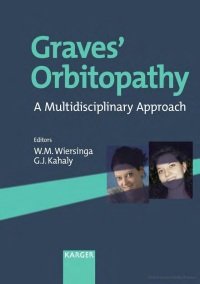
Wilmar M. Wiersinga – Graves Orbitopathy
4.930 ₽
Автор: Wilmar M. Wiersinga
Название книги: Graves Orbitopathy
Формат: PDF
Жанр: Медицина
Качество: Изначально компьютерное, E-book
1 Clinical Manifestations
Dickinson, A.J. (Newcastle upon Tyne)
1 What Are the Common Symptoms of Graves’Orbitopathy?
1 What Are the Common Signs of Graves’Orbitopathy?
2 What Signs Are Unusual in Graves’Orbitopathy?
4 Are There Racial Differences in How Graves’Orbitopathy Manifests?
4 Is the Presentation of Graves’Orbitopathy Different in Older Compared to Younger
Patients?
5 Why Can the Clinical Presentation of Graves’Orbitopathy Be So Variable?
5 Can You Give Me a Short Mechanistic Explanation for All These Clinical
Manifestations?
6 What Do the Terms ‘Activity’ and ‘Severity’ Denote?
7 Why Is It Important to Distinguish Activity and Severity when Evaluating Patients?
8 What Symptoms and Signs Are Valuable for Assessing Activity?
8 How Are These Signs Assessed?
11 How Reproducible Are These Assessments?
11 What Value Does the ‘Clinical Activity Score’Have?
12 Do Patients without Signs of Activity Ever Have Active Disease?
13 What Should I Do if I Am Not Sure whether the Disease Is Active?
13 Are There Any Other Ways to Evaluate Activity Other than Clinical Examination?
13 When Should These Other Methods for Assessing Activity Be Used in Routine
Clinical Practice?
14 What Signs Are Helpful for Assessing Severity?
14 What Value Does the Mnemonic ‘NOSPECS’Have?
14 What Are the Relative Frequencies of Classes I–VI?
16 How Are Signs of Severity Assessed?
20 How Reproducible Are These Assessments?
20 How Do You Decide Whether a Patient Has Dysthyroid Optic Neuropathy?
22 Can Dysthyroid Optic Neuropathy Ever Be Present with Normal Vision?
22 Are Some Patients at Particular Risk?
22 What Other Assessments Are Useful in Evaluating Possible Dysthyroid Optic
Neuropathy?
23 Should These Tests Be Performed in All Patients at Every Assessment?
23 References
27 Orbit-Thyroid Relationship
Lazarus, J.H. (Cardiff); Marino, M. (Pisa)
27 Should This Condition Always Be Called Graves’Orbitopathy?
27 Does Graves’Orbitopathy Occur in the Absence of Hyperthyroidism?
29 Do All Patients with Graves’Disease Have Graves’Orbitopathy?
29 What Comes First in Graves’Disease? The Eye Changes or the Hyperthyroid Symptoms?
30 Do TSH Receptor Antibodies Also Cause GO?
31 Are There Any Other Extrathyroidal Manifestations of Graves’Disease Apart from
Graves’Orbitopathy?
32 References
34 Epidemiology
Daumerie, C. (Brussels); Kalmann, R. (Utrecht)
34 What Is the Present Estimated Prevalence of Graves’ Orbitopathy? Has It Changed
over the Last Decade?
35 Is the Age and Sex Distribution of Graves’Orbitopathy Similar to that of Graves’
Disease?
35 Are There Ethnic Differences?
35 What Are the Risk Factors for the Occurrence of Graves’ Orbitopathy?
36 Is Tobacco Bad for Graves’ Orbitopathy?
37 Is Ocular Co-Morbidity Relevant for Graves’Orbitopathy?
37 Is Elevated Intraocular Pressure Relevant in Graves’Orbitopathy?
38 Is There Significant Non-Ocular Co-Morbidity (Like Diabetes) which Is Relevant
for Graves’ Orbitopathy?
39 References
41 Pathogenesis
Orgiazzi, J. (Lyon)
41 What Are the Pathological Changes in Orbital Tissue of Graves’ Orbitopathy?
44 How Do the Pathological Changes Give Rise to the Clinical Manifestations?
45 What Triggers Graves’Orbitopathy?
46 Is Graves’ Orbitopathy Triggered by an Autoimmune Phenomenon? If so, what Is the
Nature of the Auto-Antigen?
47 Why Is the Orbit a Special Target for Thyroid Autoimmunity?
48 What Kind of Immune Reaction Takes Place within the Orbit?
50 Do Anti-TSH Receptor Antibodies (TRAb) Play a Role in the Onset or Development
of Graves’Orbitopathy?
50 Is There a Familial Predisposition to Graves’ Orbitopathy? Is There a Specific Genetic
Background for Graves’ Orbitopathy?
51 Smoking Increases the Risk of Graves’Orbitopathy and Its Severity: What Is the
Mechanism for It?
52 How May the Observations Described Above and the Current Understanding of the
Disease Lead to More Effective Treatment of Graves’Orbitopathy?
54 References
57 Orbital Imaging
Pitz, S. (Mainz)
57 Is Orbital Imaging Always Necessary?
57 What Are the Relative Benefits of Orbital CT and MRI?
59 What Is Apical Crowding?
61 What Is the Place of Orbital Ultrasound?
62 What Lessons Can We Learn from Orbital Octreoscan?
62 What Other Imaging Techniques May Be Useful?
64 Acknowledgments
64 References
66 Diagnosis and Differential Diagnosis of Graves' Orbitopathy
Mourits, M.P. (Amsterdam)
66 Can You Give an Overall Scheme for the Diagnosis of Graves’ Orbitopathy?
66 Which Clinical Findings Are Helpful in Making a Diagnosis of Graves’Orbitopathy?
70 Can One Make a Diagnosis of Graves’Orbitopathy Based on Medical History and
Clinical Picture Alone?
70 Do We Always Need to Order Thyroid Autoantibodies and Thyroid Function Tests?
71 Which Imaging Technique Is Best to Make a Diagnosis of Graves’Orbitopathy and Is
Imaging Always Requested?
72 Which Are the Most Frequent Conditions Mimicking Graves’Orbitopathy?
76 Conclusion
76 References
78 Natural History
Kendall-Taylor, P. (Newcastle upon Tyne)
78 Does Graves’ Orbitopathy Occur at the Same Time as Hyperthyroidism?
78 Does Restoring Euthyroidism Lead to Improvement in Graves’Orbitopathy?
79 What Effect May Hypothyroidism Have?
80 What Is the Typical Course of the Disease?
81 What Is the Difference between Activity and Severity?
83 How Do You Determine which Phase of the Disease the Patient Is Displaying? [see
also chapter by Dickinson, pp. 1–26]
83 How Does the Phase of the Disease Influence Choice of Treatment?
84 Will the Graves’Orbitopathy Eventually Burn Itself Out?
84 Will the Orbital Changes Return to Normal when the Condition Eventually Resolves?
85 How Long Is it Likely to Take before the Disease Becomes Inactive?
85 Once the Condition Has Become Inactive (Whether Treated or Untreated) Is it Likely
to Flare Up Again?
85 Are There Any Other Factors, Additional to Thyroid Status, which May Influence the
Course of the Disease?
86 References
Management
88 General Management Plan
Boboridis, K. (Thessaloniki); Perros, P. (Newcastle upon Tyne)
88 What Are the Priorities when Faced with a New Presentation of Graves’Orbitopathy?
89 How Good Is the Evidence that Quitting Smoking Helps?
89 Does Thyroid Status Affect the Eyes?
90 What Simple Measures Can Help the Eyes?
91 Is There a Place for Botulinum Toxin?
92 How Do You Define Mild, Moderately Severe, and Very Severe Graves’Orbitopathy?
92 Can You Give a Simplified Overall Management Scheme?
93 References
96 Combined Thyroid-Eye Clinics
Wiersinga, W.M. (Amsterdam)
96 What Are Combined Thyroid-Eye Clinics?
97 Why Is a Multidisciplinary Approach Recommended?
98 Can Patients-Support Groups Be Helpful?
98 I Have Heard of a Fast-Track Clinic for Graves’ Orbitopathy Patients: What Is That?
99 References
100 Thyroid Treatment
Marcocci, C.; Pinchera, A. (Pisa)
100 Does It Matter for the Eyes How the Patient Is Rendered Euthyroid?
103 Are There Any Specific Criteria to Prefer One of the Treatment Modalities for
Hyperthyroidism in Graves’Orbitopathy?
104 Is There Any Risk Factor which May Predict Worsening of Graves’ Orbitopathy after
Radioiodine?
105 Should the Presence of Graves’ Orbitopathy Limit the Use of Radioiodine Therapy?
105 Does Transient Hypothyroidism following Therapy Influence the Course of Graves’
Orbitopathy?
107 Has Total Thyroid Ablation a Role in the Management of Hyperthyroidism in
Graves’Orbitopathy?
108 References
111 Management of Mild Graves' Orbitopathy
Salvi, M.; Currò, N. (Milan)
111 What Is the Degree of Intra-Orbital Involvement in Mild Graves’Orbitopathy?
111 Are Mild Forms of Graves’Orbitopathy Likely to Progress to More Severe
Graves’Orbitopathy?
112 Is a ‘Wait and See’Policy Justified in Mild Graves’Orbitopathy?
114 Are Low-Dosage Oral Steroids Advisable or Is Orbital Irradiation Preferable?
115 Can We Reassure Patients About the Long-Term Safety of Orbital Irradiation?
116 What Is the Rationale for Antioxidant Therapy in GO?
117 References
120 Management of Moderately Severe Graves' Orbitopathy
Kahaly, G.J. (Mainz)
120 Is Immunosuppression Indicated in Moderately Severe Graves’ Orbitopathy?
121 What Are the Results of Randomized Trials with Steroids?
131 What Are the Results of Randomized Trials Using Orbital Radiotherapy?
135 Do You Favor Combination Therapy?
138 What Are the Results of Randomized Trials Using Nonsteroid Immunosuppressants?
144 What Are the Results of Randomized Trials Using Somatostatin Analogs?
147 What Should You Do if Steroids Fail?
148 What Are the Actual Evidence-Based Therapeutic Recommendations for Patients with
Moderately Severe Graves’ Orbitopathy?
149 Acknowledgments
149 References
153 Management of Very Severe Graves' Orbitopathy
(Dysthyroid Optic Neuropathy)
Lane, C.M. (Cardiff); Boschi, A. (Brussels)
153 How Do You Define Dysthyroid Optic Neuropathy?
153 Are There Specific Risk Factors for Dysthyroid Optic Neuropathy?
154 Which Symptoms Should Alert Me?
155 What Are the Ophthalmological Signs of Dysthyroid Optic Neuropathy?
156 Are Additional Investigations Helpful?
156 How Fast Can Dysthyroid Optic Neuropathy Develop? Is Urgent Treatment Necessary?
157 What Is the Evidence Base for the Treatment of Dysthyroid Optic Neuropathy?
157 What Is the Role of Surgery in Dysthyroid Optic Neuropathy?
158 How Many Patients Become Blind due to Dysthyroid Optic Neuropathy?
158 References
160 Rehabilitative Surgery
Baldeschi, L. (Amsterdam)
160 Why Is This Chapter Called Rehabilitative Surgery and Not Cosmetic Surgery?
161 What Are the Steps and Timing of Rehabilitative Surgery?
161 How Should Patients Be Selected for Rehabilitative Surgery
162 References
163 Orbital Decompression
Baldeschi, L. (Amsterdam)
163 What Is Orbital Decompression?
163 What Are the Aims of Orbital Decompression?
167 Which Surgical Technique Should Be Preferred?
172 What Are the Possible Complications of Orbital Decompression?
172 Can Complications Be Forecasted or Prevented?
173 References
176 Eye Muscle Surgery
Nardi, M. (Pisa)
176 What Is the Cause of Ocular Motility Impairment?
176 How Do You Identify the Affected Muscles?
178 How Can You Avoid Diagnostic Errors in Complex Cases?
179 How Can You Evaluate the Need for Surgery?
182 When Is the Right Time for Surgery?
182 What Can You Realistically Expect from Surgery?
182 How Should You Advise the Patient?
183 The Surgical Plan: What Procedures Are Recommended?
185 What Are the Possible Complications of Surgery and How Can I Avoid or Manage Them?
187 References
188 Eyelid Surgery
Neoh, C. (Newcastle upon Tyne); Eckstein, A. (Essen)
188 What Are the Indications for Eyelid Surgery in Patients with Graves’Orbitopathy?
189 Is Botulinum Toxin Useful?
190 Is Surgical Intervention Indicated in Corneal Ulceration Secondary to Exposure
Keratopathy?
190 Does Orbital Decompression Have Any Effect on Lid Retraction?
191 Does Squint Surgery Influence the Lid Configuration?
193 What Surgical Procedures Are Available for Correction of Upper Lid Retraction?
195 Are There Complications?
196 What Surgical Procedures Are Available for Correction of Lower Lid Retraction?
196 Should This Be Combined with Horizontal Lid Tightening?
196 Which Materials Are Suitable for Use as Spacers? Should the Use of Allogeneic
Grafts Be Avoided?
197 Are There Complications?
198 What About Upper Lid Debulking and Upper and Lower Lid Blepharoplasty?
198 References
Miscellaneous Issues
201 Quality of Life
Wiersinga, W.M. (Amsterdam)
201 What Is Quality of Life?
201 What Is the Usefulness of Quality of Life Measurements?
203 What Is Known about General Health-Related Quality of Life in Graves’Orbitopathy?
204 Is There a GO-Specific Quality of Life Questionnaire?
206 What Are the Results of the GO-QoL?
206 Can You Explain Response Shift in Quality of Life?
207 Can GO-QoL Be Used as a Separate Outcome Measurement in GO?
208 Is Quality of Life Fully Restored after Treatment of GO?
209 Can I Apply the GO-QoL in My Own Practice?
210 References
212 Atypical Manifestations
von Arx, G. (Olten)
212 What Are the Atypical Manifestations of Graves’Orbitopathy?
212 How Do You Explain Unilateral Graves’ Orbitopathy (We Don’t have
Graves’Hyperthyroidism in Just One Thyroid Lobe, Have We?)
216 Will Unilateral Graves’ Orbitopathy Proceed to Bilateral Graves’ Orbitopathy?
217 Is the Clinical Presentation of Unilateral Graves’ Orbitopathy Different from Bilateral
Graves’ Orbitopathy?
217 How Does Unilaterality Affect Treatment?
218 Is Euthyroid Graves’Orbitopathy a Reason to Refrain from Specific Eye Treatment?
219 What Is Globe Subluxation?
219 References
221 Childhood Graves' Orbitopathy
Krassas, G.E. (Thessaloniki)
221 Is Childhood Graves’Orbitopathy Really that Rare?
222 Is the Clinical Presentation of Graves’Orbitopathy in Childhood Different from that in
Adulthood?
222 Why Is Graves’Orbitopathy in Children Less Severe than in Adults?
224 What Is the Best Therapeutic Approach for Graves’Orbitopathy in Children and
Adolescents?
226 What About Surgical Decompression of the Orbit in Childhood?
226 References
229 Prevention
Bartalena, L. (Varese)
229 What Is Primary, Secondary and Tertiary Prevention?
229 Can a General Strategy Be Applied to Prevent Graves’Orbitopathy?
230 What Can Be Done in the Primary Prevention of Graves’Orbitopathy?
231 What Can Be Done in Terms of Secondary Prevention of Graves’ Orbitopathy?
233 What About Tertiary Prevention of Graves’Orbitopathy?
234 What Should One Do when Talking to a Graves’ Orbitopathy Patient Who Smokes?
234 Acknowledgements
234 References
237 Future Developments
Salvi, M. (Milan); Baldeschi, L. (Amsterdam)
237 Is There Evidence that Steroids in Graves’Orbitopathy Act as True
Immunosuppressants and Modify Disease Outcome?
238 What Are the Reasons for Exploring the Potential Efficacy of New
Immunosuppressive Medications?
238 Is There Evidence for the Efficacy of New Immunotherapy Agents in
Graves’Orbitopathy?
239 Which Anticytokine Treatment Would Be the Most Effective in Your Opinion?
239 What About Rituximab?
241 What About Interfering with the TSH Receptor Pathways?
241 Are Technical Developments in Surgical Approaches to Be Expected?
243 Are Conceptual Developments in Surgical Approaches to Be Expected?
243 References
246 Historical Notes on Graves' Disease
Mourits, M.P. (Amsterdam)
246 Is It Fair to Call Graves’ Disease Graves’Disease?
247 Various Eye Signs Carry Specific Names: Are They Still Relevant?
248 How Did Old Theories Explain the Relationship between Hyperthyroidism and
Proptosis?
249 Which Are Rundle’s Contributions to Our Understanding of Graves’ Orbitopathy?
252 Which Are Kriss’Contributions to the Management of Graves’ Orbitopathy?
252 When Was Evidence-Based Medicine Incorporated in Graves’Orbitopathy?
253 References
We are very pleased to present Graves’ Orbitopathy: A Multidisciplinary
Approach.
The title of the book is a reflection of our opinion that real progress can be
made in understanding thyroid eye disease and in improving outcome of the disfiguring
and often invalidating eye changes associated with Graves’ orbitopathy
only if specialists of various disciplines work closely together. In other words, we
favour a multidisciplinary approach in which internists/endocrinologists, ophthalmologists/
orbital surgeons and basic scientists combine their forces. This has been
the philosophy since the foundation of EUGOGO, the European Group on Graves’
Orbitopathy in 1999. The group is currently composed of 13 centres in 8 European
countries (Belgium, France, Germany, Greece, Italy, the Netherlands, Switzerland
and the United Kingdom), and, in accordance with our philosophy, each centre is
represented by specialists in internal medicine and ophthalmology. A further
requirement of EUGOGO membership is that each participating centre must have
combined thyroid-eye clinics in which the patient can be seen simultaneously by
physicians from both disciplines. It is gratifying to note that the number of combined
thyroid-eye clinics has been increasing slowly but steadily throughout
Europe over the last decade, thereby enhancing the quality of patient care.
EUGOGO meets twice a year, and we have had many lengthy and at times
heated discussions on how to assess the eye changes in a most objective manner
and what the best treatment should be. It has taken us several years to reach an
acceptable degree of agreement among ourselves, again illustrating the many
pitfalls in the management of Graves’ orbitopathy as well as the importance of
using a multidisciplinary approach. Only then could we embark on prospective
XIII
clinical trials (the size of the group allows completion of clinical studies in a
much shorter time than possible for each individual centre), on teaching courses
how to investigate and treat the patient with Graves’ orbitopathy (so far three
courses have been held – Thessalonica 2005, Pisa 2006, and Mainz 2007), and
on papers in scientific journals describing the outcome of our studies and recommendations
on disease management.
The present book reflects our current thinking on Graves’ orbitopathy: all
authors are EUGOGO members. The internal consistency between chapters is the
result of our ongoing discussions during the annual EUGOGO meetings. The outline
of the book is unusual by its choosing the question-and-answer format. The
purpose is to enable the book to also be used as a quick reference source for the
practicing physician confronted with an ordinary or extraordinary management
question: most likely the answer can be found in one of the 194 questions asked in
this book. We do not apologise for some overlap between chapters (especially on
smoking and thyroid treatment), because these issues are relevant to many aspects
of Graves’ orbitopathy and it facilitates fast retrieval of the information you are
looking for. Topics such as unilateral eye disease, childhood Graves’ orbitopathy,
and disease-specific quality-of-life assessment which are not easily found elsewhere
receive the attention they deserve. The editors welcome feedback from the
readership: please send your comments to us; also on how future editions could
be improved. You may also consult the EUGOGO website (www.eugogo.org).
We would like to thank the patients with Graves’ orbitopathy who cooperated
in our endeavours to better understand their disease. We also thank S. Karger AG,
Medical and Scientific Publishers, for their efforts to edit, produce, and publish
the book within a very short time. Last but not least, we are grateful to the authors
for their excellent contributions. It again proves how much can be accomplished
by a group of dedicated people.
Описание
Graves Orbitopathy — это современное клиническое руководство, посвященное орбитопатии Грейвса (эндокринной офтальмопатии). Книга подробно разбирает механизмы развития заболевания, взаимосвязь с тиреоидной патологией и актуальные подходы к диагностике и лечению.
Авторы анализируют иммунологические аспекты, методы визуализации орбиты, консервативную терапию, показания к хирургическому лечению и реабилитацию пациентов. Особое внимание уделено междисциплинарному подходу: взаимодействию эндокринологов и офтальмологов для достижения лучших результатов.
- эндокринологам и офтальмологам, специализирующимся на заболеваниях орбиты
- врачам, сталкивающимся с аутоиммунными тиреоидными болезнями
- ординаторам и аспирантам по специальностям «эндокринология» и «офтальмология»
- специалистам, желающим обновить знания по современному менеджменту Graves Orbitopathy
Только зарегистрированные клиенты, купившие данный товар, могут публиковать отзывы.
Похожие



Другие книги раздела «Офтальмология»
- Robert B. Nussenblatt – Uveitis Fundamentals and Clinical Practice
- Robert D. Stratton – Studies on Retinal and Choroidal Disorders
- Robert I. Fox – Sjogrens Syndrome
- S. Boyd – Retinal and Vitreoretinal Diseases and Surgery
- S. Dithmar – Fluoreszenzangiographie in der Augenheilkund (Немецкий язык, 2008)
- S. Dua – Computational Analysis of the Human Eye with Applications
- S. Mallajosyula – Surgical Atlas of Orbital Diseases
- S. Olitsky – Pediatric Clinical Ophthalmology
- Stanislao Rizzo – Vitreo retinal Surgery. Progress 3
- Thomas J. Walsh – Visual Fields. Examination and Interpretation
- Thomas Spoor – Atlas of Oculoplastic and Orbital Surgery
- U. Kompella – Drug Product Development for the Back of the Eye
- Ulrich Spandau – Complications During and After Cataract Surgery
- V. Purvin – Common Neuro-Ophthalmic Pitfalls
- Walter Lisch – Corneal Dystrophies
- Z. Cattaneo – Blind Vision The Neuroscience of Visual Impairment
Все книги раздела «Офтальмология» →
Смежные разделы: Медицина на испанском языке · Медицина на немецком языке · Медицина на французском языке · Анестезиология и Реаниматология · Акушерство и Гинекология · Ветеринария · Гастроэнтерология и Гепатология · Дерматология и косметология · Диетология и нутрициология · Иммунология и Аллергология · Кардиология · Лапароскопия и Эндоскопия
Рекомендуем также
- W. Zhang – Measurement Technology for Micro-Nanometer Devices (2016)
- Yu Yao – Robust Control (2016)
- T. Gasser – Basiswissen Urologie (6 Auflage, 2015, Немецкий язык)
- D. Ubelaker – The Global Practice of Forensic Science (2015)
- G. Christ – Handbook of Oncology Social Work (2015)
- J. Wu – Variational Methods in Molecular Modeling (2017)
- M. Rai – Nanotechnology for Bioenergy and Biofuel Production (2017)
- W. Hustrulid – Open Pit Mine Planning Design (2013)

Отзывы
Отзывов пока нет.