

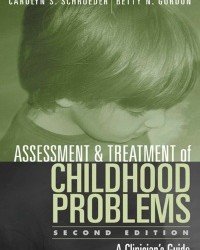
C. Schroeder – Assessment and Treatment of Childhood Problems (2nd edition)
1.440 ₽
Автор: C. Schroeder
Название книги: Assessment and Treatment of Childhood Problems (2nd edition)
Формат: PDF
Жанр: Психология
Страницы: 641
Качество: Изначально компьютерное, E-book
This popular book guides clinicians and students in assessing and treating common childhood problems. Written in a highly accessible style, the volume presents an overview of healthy development, examines risk and protective factors for psychopathology, and spells out a behaviorally oriented model of assessment and treatment planning for children aged 2-12. Each problem-focused chapter reviews the literature on the topic at hand and provides step-by-step guidelines for practice, illustrated with helpful case examples. Featuring appendices that describe widely used assessment instruments, the book also contains more than 20 reproducible measures, clinical forms, and parent handouts, ready to photocopy and use.
As with the first edition of this book, this second edition of Assessment and Treatment of Childhood
Problems is based on our work in a primary health care setting. For almost 28 years our
focus has been on enhancing children’s development, preventing problems, and helping parents
to manage stressful life events and common but often persistent and troublesome behavior
problems. The primary health care setting has provided us with a unique opportunity to
follow children as they develop from birth through adulthood. We view this development as a
function of the dynamic interaction among the characteristics of the child and the parents, the
environment, and chance events, and understand psychopathology to be normal development
gone awry. Although we recognize the importance of adolescence, the focus of this book is on
the development of children ages 2–12 years and the problems that can occur during these
ages.
It has been 11 years since the publication of the first edition of this book and much has
occurred during the intervening years. Of major importance is the emergence of the field of
developmental psychopathology, with its focus on normal development and developmental
variations throughout the life span. This interface between developmental psychology and clinical
child psychology has greatly enhanced our understanding of when and how things can go
wrong for children, and it provides guidance on developing effective preventive as well as assessment
and intervention strategies. The advances of biological and genetic science have been
enormous, and their influence on behavior and development has received an incredible amount
of attention since the first edition was published. Theory and research in these areas have
enhanced our understanding of the behavioral symptoms of problems such as depression,
anxiety, and disruptive behavior disorders. We have learned, for example, that some behavioral
disorders can be chronic and lifelong, thus requiring ongoing or periodic attention to
maintain treatment gains. We have tried to reflect these advances in the literature reviews for
each problem area, and it is our hope that this book will lead clinicians to a better understanding
of the “state of the field” and will help guide them to a more empirically based approach to
their work.
The importance of a theoretical approach to the work of the child clinician cannot be
overstated. Our thinking has been strongly influenced by behavioral, social learning, and
cognitive-behavioral theorists. Approaches to assessment and intervention that reflect these
orientations are emphasized. For each problem area presented, we have tried to describe treatment
methods that are developmentally sensitive and have some documented efficacy for the
specific problem in question. The field continues to struggle, however, with how to transfer
these treatments to community-based clinics—that is, the real world. Thus, the clinician must
be creative in developing intervention strategies that have not been empirically validated for
the majority of children with a specific problem but may be effective for an individual child or
family. A theoretical aproach to guide the selection and/or development of these strategies is
of critical importance.
This book reflects the importance of a collaborative relationship between the child, the
clinician, and parents in assessing and treating childhood problems. The clinician’s role is
multifaceted, including that of educator, advocate, service provider, and case manager. He or
she provides expertise based on knowledge of developmental processes and the empirical literature
related to children’s problems. Parents, on the other hand, have the primary and ultimate
responsibility for their children’s well-being and bring a unique understanding of their
child and family. It is through this collaboration with parents that we are often able to change
the trajectory of a child’s life, by enhancing parents’ abilities to deal with the tasks of parenting
and by enabling them to help their children cope successfully with the stresses of growing up
in an imperfect world.
In this second edition we have attempted to provide a more complete picture of the problems
that can occur between ages 2 and 12 years by adding three new chapters: eating problems,
depression, and attention-deficit/hyperactivity disorder. We deleted the chapter on the
development of the pediatric psychology practice at Chapel Hill Pediatrics since this information
has been published elsewhere (e.g., Schroeder, 1996). The book is organized into three
sections, with the first section providing a foundation for understanding specific problem areas
and for developing assessment and intervention strategies. Chapter 1 provides an overview of
child development with an emphasis on “where things can go wrong” in the developmental
process. It also covers factors that can make children more resilient, or cause them to be more
vulnerable to life stresses, as well as ways to use this information in the prevention of problems.
Chapter 2 focuses on issues of diagnostic classification, prevalence of problems, steps in
the assessment process, and treatment issues. The Comprehensive Assessment-to-Intervention
System described in this chapter is used throughout the book as the framework by which clinicians
can systematically gather the information necessary to understand and intervene in the
problem areas covered in later chapters. The second section of the book deals with problems
that can occur in childhood: eating problems, toileting problems, habits and tics, sleep difficulties,
sexuality and sexual problems, fears and anxieties, depression, disruptive behavior, and
attention-deficit/hyperactivity disorder. The final section of the book covers life events that
can be sources of considerable stress for many children and parents during the course of growing
up: siblings, divorce, and death. For each problem area or stressful event, we provide a brief
review of the literature, a guide to comprehensive assessment, specific treatment options, and
a case example that illustrates the central features of the problem. Finally, in the appendices
we provide descriptions of published assessment instruments as well as a number of clinical
forms and rating scales that are not commercially published.
Who do we hope will read this book? It is written for all professionals who provide services
to children. These include not only child psychologists but also pediatricians, family physicians,
child psychiatrists, nurses, social workers, guidance counselors, and trainees in all of
these and other health-related fields.
We would like to thank the many people at The Guilford Press who helped shepherd this
work to a final completion, most especially the production staff. There are many people who
by their very presence greatly influenced our work: the parents and children with whom we
have been fortunate to work and our colleagues at Chapel Hill Pediatrics and the University of
North Carolina at Chapel Hill. Our husbands encouraged us to write a second edition and
provided support and understanding throughout the process. Finally, our children, Mark and
Matthew (CSS), and Sarah and Andrew (BNG), have taught us a great deal about parenting
and resilience. When we completed the first edition of the book in 1991, they were in college
or graduate school; in 2002, at the time of the second edition, they are young adults with families
of their own. They have continued to teach us about development and developmental variations
as they occur in their lives and our own.
Описание
Только зарегистрированные клиенты, купившие данный товар, могут публиковать отзывы.


Отзывы
Отзывов пока нет.