
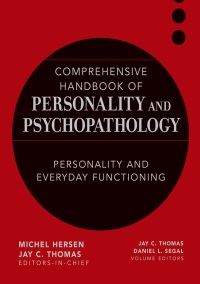
J. Thomas – Comprehensive Handbook of Personality And Psychopathology (3 Volume set)
4.850 ₽
Автор: J. Thomas
Название книги: Comprehensive Handbook of Personality And Psychopathology
Формат: PDF
Жанр: Психопатология
Страницы: 497+561+512
Качество: Изначально компьютерное, E-book
The Comprehensive Handbook of Personality and Psychopathology presents the foundations of major theories of personality. Volume 1 describes specialized theoretical models and demonstrates the impact that personality has on functioning. Volumes 2 and 3 describe the major classifications of psychological disorders in adults and children as well as the most popular treatment modalities. Throughout the work, a team of eminent researchers and clinicians present data reflecting the influence of personality and psychological problems on an individual's ability to interact with family and peers, and perform in the work or school environment.
Remarkably, the linkage between personality and psychopathology,
although extensive, has not been underscored in
the larger tomes on these subjects. In the last decade there
have been many books on personality, adult psychopathology,
and child psychopathology, but none seems to have related
the three in an integrated fashion. In part, this three-volume
Comprehensive Handbook of Personality and Psychopathology
(CHOPP), with the first volume on Personality and Everyday
Functioning, the second on Adult Psychopathology, and
the third on Child Psychopathology, is devoted to remedying
this gap in the literature. Another unique feature of CHOPP
appears in the volumes on Adult Psychopathology and Child
Psychopathology, where impact of adult and child psychopathology
on family, work, school, and peers is highlighted,
in addition to the relation of specific psychopathology to normal
development. Given the marked importance of such impact,
contributors were asked to delineate the negative impact
of psychopathology on the individual’s daily environments.
In light of the aforementioned features, we trust that
CHOPP is timely and that it will be well received in many
quarters in psychology. The work should stand as an entity
as a three-volume endeavor. However, given the structure of
each volume, we believe that it is possible to break up the
set into individual volumes for relevant courses on personality,
normal development, adult psychopathology, and child
psychopathology.
Volume 1 (Personality and Everyday Functioning) contains
23 chapters divided into four parts (Foundations, Broad-Range
Theories and Systems, Mid-Range Theories, and Special Applications).
This volume is unique in that it encompasses both
the broad theories of personality and those theories with a
more limited range, known as mid-range theories. Broadrange
theories were originally developed to explain the behavior
of normal people in everyday situations. But it also is
important to have a reference point for those individuals suffering
from various sorts of psychopathology. Chapters in
this section follow a general format where possible:
A. Statement of the Theory
B. Developmental Considerations
C. Biological/Physiological Relationships
D. Boundaries of the Theory
E. Evidence in Support of and against the Theory
F. Predictions for Everyday Functioning
1. Family Life
2. Work or School
3. Retirement
4. Recreation
Thus, Volume 1 sets the stage for Volumes 2 and 3 while
at the same time standing on its own for understanding everyday
life from the personality perspective.
Volume 2 (Adult Psychopathology) contains 30 chapters
divided into three parts (General Issues, Major Disorders and
Problems, Treatment Approaches). Volume 3 (Child Psychopathology)
contains 27 chapters divided into three parts
(General Issues, Major Disorders and Problems, Treatment
Approaches). As previously noted, a unique feature in these
volumes is mention of the impact of psychopathology on
the family, work, school, and peers, often neglected in standard
works. In both Volumes 2 and 3, most of the contributors
have adhered to a relatively standard format for Part
Two. In some instances, some of the authors have opted to
combine sections.
A. Description of the Disorder
B. Epidemiology
C. Clinical Picture
D. Etiology
E. Course, Complications, and Prognosis
F. Assessment and Diagnosis
G. Impact on the Environment
1. Family
2. Work or School
3. Peer Interactions
H. Treatment Implications
In addition, authors in Volume 3 include the sections Personality
Development and Psychopathology and Implications
for Future Personality Development. We trust that the relatively
uniform format in Part Two of Volumes 2 and 3 will
make for ease of reading and some interchapter comparisons
within and across volumes.
Many individuals have worked very hard to bring this series
of volumes to fruition. First, we thank our editor at John
Wiley, Tracey Belmont, for once again understanding the
import and scope of the project and having confidence in our
ability to execute in spite of interfering hurricanes, other natural
events, and varied life events. Second, we thank our
editors of the specific volumes for planning, recruiting, and
editing. Third, we thank our eminent contributors for taking
time out from their busy schedules to add yet one more writing
task in sharing their expertise. Claire Huismann, our
project manager at Apex Publishing, deserves special recognition
for her extraordinary efforts, competence, and patience
throughout the creation of this series. And finally, but
hardly least of all, we thank all at John Wiley and Pacific
University, including Carole Londeree, Linda James, Alison
Brodhagen, Greg May, and Cynthia Polance, for their excellent
technical assistance.
Michel Hersen and Jay C. Thomas
Описание
J. Thomas. Comprehensive Handbook of Personality And Psychopathology (3 Volume set) — это фундаментальное трехтомное издание, которое объединяет современные научные данные о личности и психопатологии. Книга подробно рассматривает взаимосвязи между нормальными и патологическими проявлениями личности, предлагая целостный взгляд на психологические расстройства в контексте теорий личности.
В трех томах собраны материалы по диагностике, этиологии, лечению и профилактике психических расстройств. Авторы анализируют различные теоретические подходы — от психоанализа и когнитивно-поведенческой терапии до нейробиологических и культурных факторов, влияющих на развитие личности и патологий.
- Практикующим клиническим психологам и психотерапевтам для углубления диагностики и планирования терапии
- Преподавателям и студентам старших курсов психологических факультетов как справочный материал
- Исследователям в области психологии личности и психопатологии
- Специалистам смежных областей (психиатрия, социальная работа), желающим систематизировать знания
Только зарегистрированные клиенты, купившие данный товар, могут публиковать отзывы.
Похожие


Другие книги раздела «Психология»
- Manuel J. Checa Gonzalez – Manual Practico de Psiquiatria Forense (Испанский язык)
- Umberto Galimberti – Diccionario de Psicologia (Испанский язык)
- Alberto Monchablon Espinoza – Las Psicosis (Испанский язык)
- La Asociacion Espanola de Psiquiatria – Manual del Residente en Psiquiatria (Испанский язык)
- Mario Souza Machorro – Adicciones. Clinica y Terapeutica (Испанский язык)
- Mary Townsend – Fundamentos de Enfermeria en Psiquiatria (Испанский язык)
- Olga Bruna – Rehabilitacion Neuropsicologica (Испанский язык)
- James Morrison – DSM-5. Guia para el Diagnostico Clinico (Испанский язык)
- Julio Bobes – Manual de Trastornos Adictivos (Испанский язык)
- Luis Martinez – Adiccion a Cocaina (Испанский язык)
- David Moore – Manual de Psiquiatria Medica (Испанский язык)
- Robert Hales – Tratado de Psiquiatria (Испанский язык)
- David Kaufman – Neurologia Clinica para Psiquiatras (Испанский язык)
- Курт Фабри – Основы зоопсихологии
- Thomas L. Schwartz – Practical Psychopharmacology (2017)
- Updesh Kumar – Handbook of Suicidal Behaviour
Все книги раздела «Психология» →
Смежные разделы: Медицина на испанском языке · Медицина на немецком языке · Медицина на французском языке · Анестезиология и Реаниматология · Акушерство и Гинекология · Ветеринария · Гастроэнтерология и Гепатология · Дерматология и косметология · Диетология и нутрициология · Иммунология и Аллергология · Кардиология · Лапароскопия и Эндоскопия
Рекомендуем также
- D. Frank – History of Jewish Philosophy
- D. Moyar – Hegels Phenomenology of Spirit. A Critical Guide
- E. Craig – Routledge Encyclopedia of Philosophy + The Shorter Routledge Encyclopedia of Philosophy (2 books)
- J. Van Den Hoven – Information Technology and Moral Philosophy
- Roy Sorensen – A Brief History of the Paradox. Philosophy and the Labyrinths of the Mind
- Иммануил Кант – Собрание сочинений (6 Томов)
- М. Коэн – Введение в логику и научный метод
- Benjamin H. Bratton – The Stack. On Software and Sovereignty

Отзывы
Отзывов пока нет.