
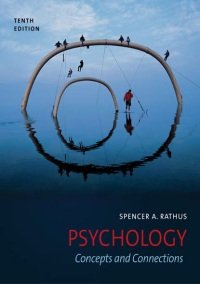
S. Rathus – Psychology. Concepts and Connections (Tenth edition)
1.230 ₽
Автор: S. Rathus
Название книги: Psychology. Concepts and Connections (Tenth edition)
Формат: PDF
Жанр: Психология
Страницы: 804
Качество: Изначально компьютерное, E-book
Connect learning to life with this low cost CENGAGE ADVANTAGE BOOKS version of PSYCHOLOGY: CONCEPTS AND CONNECTIONS! Filled with reader-friendly features and up-to-the-minute research, Spencer Rathus's fascinating book makes the study of psychology a meaningful, personal experience. Rathus connects the core concepts of psychology to the events and issues you encounter every day. He explains classic theories and the latest discoveries in a clear, accessible style while including the timeliest research available. And getting the grade you want is easy with the text's proven “PQ4R” active learning system (Preview, Question, Read, Reflect, Review, and Recite).
My favorite psychology professor told the class, “You probably
judge how well you did in the course by your grade. I
judge how well I did in the course in terms of how many
additional psychology courses you take.”
Now, it’s my turn. Users of this textbook will judge what
they have obtained from it in various ways. I will consider
myself to have been successful if it inspires students to take
additional courses in psychology.
I had several goals in writing this introductory textbook:
They include painting psychology as the rigorous
science it is, teaching students how to think critically, and
introducing students to the various fi elds of psychology
and the concepts they investigate. But it was also essential
to me to inspire students with the subject matter. Thus, I
have tried to use a warm, engaging writing style, including
humor and personal anecdotes. I also believe it is important
to show students how psychology connects with important
issues in their own lives. Psychology is not just “out there.”
Its many concepts provide information and ideas that all
students can apply for their own benefi t and that of those
whom they care about.
PSYCHOLOGY: CONCEPTS
AND CONNECTIONS—
MORE THAN JUST A TITLE
All academic disciplines have their own concepts, and
psychology is no exception. One of the key tasks of any introductory
course is to acquaint students with the basic concepts
of the discipline. Students of introductory psychology
are probably not surprised that concepts such as intelligence,
personality, stress, mental illness (which we refer to as psychological
disorders), and psychotherapy are important to the
discipline. They may be surprised to learn that psychologists
debate whether some familiar concepts, such as psychoanalysis,
have a place—other than a historical place—in psychology
as a science. Students are unlikely to be surprised that the
concepts of personality and learning and memory are found in
psychology, but they may fi nd that these concepts—as defi ned
and used by psychologists—are not quite what they thought
they were. Students may also be somewhat surprised that the
very concept they had of the fi eld of psychology—of what
psychology is—probably makes up less than half of what they
will fi nd in this textbook.
All this is very good. Psychology consists of things that are
familiar and things that are new. One of the purposes of this
course is to set the record straight, to show students what does
and what does not belong within the science of psychology.
THINKING CRITICALLY—
IN LIFE AND IN THE
CLASSROOM
Another goal of this course is to show that psychologists, like
other scientists, are both skeptical and open-minded. They
thrive on debate. They do not even necessarily agree on the
defi nitions of the topics they discuss. For example, there is no
one defi nition of psychology that all psychologists agree on.
When we approach the topic of learning, we will similarly see
that experts in that fi eld disagree about how to defi ne learning.
Later, we will see that psychologists disagree as to what
intelligence is and as to whether there is one kind of general
intelligence or there are several “intelligences.” As if this were
not enough, we will see that there is also major controversy
over the origins of intelligence.
Again, all of this is very good. Scientifi c debate should
not be confused with pointless argument. Honest debate
helps psychologists—and students—come ever closer to the
truth. Students will of course memorize standard defi nitions;
however, it is more important that they come away from this
course with an understanding of the true scientifi c nature of
psychology and of the controversies within psychology.
Critical thinking is the key to understanding these
controversies—and also the key to productive citizenship.
I believe too many individuals blindly follow the demands
of the media and authority fi gures, and it is my goal to help
students hone their critical thinking skills so that they can
evaluate the arguments they hear in the media and from
authority fi gures. In fact, I have incorporated numerous
Critical Thinking exercises throughout the text to encourage
students to think critically about the content of the text and
the real-life situations they encounter every day.
Because of the value of critical thinking, the new edition
of Psychology: Concepts and Connections has a chapter
devoted to critical thinking: Chapter 2 is titled “Sorting
Truth and Fiction in Psychology: Critical Thinking and
Research Methods.” In addition, the Learning Connections
sections in every chapter contain a Critical Thinking item.
Here is a sampling:
• From Chapter 1, “What Is Psychology?”: Do you believe
that the richness and complexity of human behavior can
be explained as the summation of so many instances of
learning? Explain.
• From Chapter 3, “Biology and Psychology”: Why was
Darwin reluctant to publish his theory of evolution?
Do you believe that this textbook, and other textbooks,
should present the theory of evolution?
• From Chapter 8, “Thinking, Language, and Intelligence”:
Critical thinkers pay attention to the defi nition of terms.
Do the talents of dancers, gymnasts, artists, and musicians
strike you as kinds of intelligences? Why or why not?
• From Chapter 15, “Psychological Disorders”: When does
a psychological problem become a “psychological disorder”?
Is the border clearly defi ned?
• From Chapter 17, “Social Psychology”: Critical thinkers
do not overgeneralize. Most people would probably agree
that it is good for children to be obedient. But is it always
good for children—and for adults—to be obedient? As an
individual, how can you determine whether it is good for
you to be obedient? How do you defi ne the limits?
Come into this course as you will. Leave this course as a
skeptic. Believe nothing about psychology until you have had
an opportunity to see and evaluate the evidence—for yourself.
MAKING LIFE
CONNECTIONS
One of the wonderful things about psychology is how the topics
in the fi eld relate to your daily life. These connections are
pointed out throughout the text and also in a special section
at the end of every chapter.
Given that the second chapter is about psychology as a
science—“Sorting Truth and Fiction in Psychology: Critical
Thinking and Research Methods”—the Life Connections section
focuses on distinguishing between true sciences such as
psychology, chemistry, and physics, and false sciences (called
pseudosciences) such as astrology.
Consider two more examples of Life Connections. Chapter
4 is about “Sensation and Perception”—how people make sense
(excuse the pun) of the world in which they dwell. The Life Connections
section in that chapter—“Pain, Pain, Go Away—Don’t
Come Again Another Day”—is about what we can do to alleviate
pain. After reading this section, you may go to the psychology
cabinet as well as the medicine cabinet for relief.
Chapter 9 is about the closely related topics of “Motivation
and Emotion.” The chapter presents one of our most
pressing motives—the hunger drive. The chapter’s Life Connections
section discusses obesity, which for many creates a
perpetual battle with the hunger drive. It explores reasons
why too many people in the United States overeat and offers
concrete advice on what to do about it.
MAKING LEARNING
C ONNECTIONS
My emphasis on making connections is also refl ected in the
book’s pedagogical package. Psychology is a robust science
with a lengthy research tradition; therefore, there is a good
deal of subject matter in Psychology: Concepts and Connections.
The book’s pedagogy is designed to help students
understand the concepts presented so they take away more
of that knowledge from the book. Psychology: Concepts and
Connections fully integrates the PQ4R method in every chapter
to help students learn and retain the subject matter.
PQ4R—A Complete Pedagogical
Package
PQ4R is the acronym for Preview, Question, Read, Refl ect,
Review, and Recite, a method that is related to the work of
educational psychologist Francis P. Robinson. PQ4R is more
than the standard built-in study guide. It goes well beyond
the few pages of questions and exercises that are found at
the ends of the chapters of many textbooks. It is an integral
part of every chapter. It begins and ends each chapter, and it
accompanies the student page by page.
Student do not passively soak up the subject matter as
sponges soak up water. The PQ4R method stimulates students
to actively engage the subject matter. It encourages students to
become proactive rather than reactive
Описание
Psychology. Concepts and Connections (Tenth edition) — это фундаментальный учебник психологии от известного американского психолога Спенсера Ратуса. Книга объясняет ключевые психологические концепции через их реальные жизненные связи, показывая, как теория работает в повседневной жизни, отношениях, карьере и принятии решений.
Автор последовательно раскрывает темы от биологических основ поведения и сенсорных процессов до когнитивных функций, эмоций, мотивации, развития личности, психических расстройств и методов терапии. Особое внимание уделяется научному подходу, критическому мышлению и тому, как психологические знания помогают лучше понимать себя и окружающих.
- Студентам психологических факультетов и смежных специальностей
- Преподавателям, которые ищут современный и доступный учебник
- Практикующим психологам и психотерапевтам для освежения теоретической базы
- Всем, кто хочет системно изучить психологию человека и применять знания в жизни
Только зарегистрированные клиенты, купившие данный товар, могут публиковать отзывы.
Похожие


Другие книги раздела «Психология»
- Manuel J. Checa Gonzalez – Manual Practico de Psiquiatria Forense (Испанский язык)
- Umberto Galimberti – Diccionario de Psicologia (Испанский язык)
- Alberto Monchablon Espinoza – Las Psicosis (Испанский язык)
- La Asociacion Espanola de Psiquiatria – Manual del Residente en Psiquiatria (Испанский язык)
- Mario Souza Machorro – Adicciones. Clinica y Terapeutica (Испанский язык)
- Mary Townsend – Fundamentos de Enfermeria en Psiquiatria (Испанский язык)
- Olga Bruna – Rehabilitacion Neuropsicologica (Испанский язык)
- James Morrison – DSM-5. Guia para el Diagnostico Clinico (Испанский язык)
- Julio Bobes – Manual de Trastornos Adictivos (Испанский язык)
- Luis Martinez – Adiccion a Cocaina (Испанский язык)
- David Moore – Manual de Psiquiatria Medica (Испанский язык)
- Robert Hales – Tratado de Psiquiatria (Испанский язык)
- David Kaufman – Neurologia Clinica para Psiquiatras (Испанский язык)
- Курт Фабри – Основы зоопсихологии
- Thomas L. Schwartz – Practical Psychopharmacology (2017)
- Updesh Kumar – Handbook of Suicidal Behaviour
Все книги раздела «Психология» →
Смежные разделы: Медицина на испанском языке · Медицина на немецком языке · Медицина на французском языке · Анестезиология и Реаниматология · Акушерство и Гинекология · Ветеринария · Гастроэнтерология и Гепатология · Дерматология и косметология · Диетология и нутрициология · Иммунология и Аллергология · Кардиология · Лапароскопия и Эндоскопия
Рекомендуем также
- Лев Гумилев – Собрание исторических сочинений (12 Томов)
- A. Orford – International Law and its Others
- Christian J. Tams – Enforcing Obligations Erga Omnes in International Law (2005)
- J. Agnew – A Companion To Political Geography
- Jeremy M. Weinstein – Inside Rebellion. The Politics of Insurgent Violence
- D. Frank – History of Jewish Philosophy
- D. Moyar – Hegels Phenomenology of Spirit. A Critical Guide
- E. Craig – Routledge Encyclopedia of Philosophy + The Shorter Routledge Encyclopedia of Philosophy (2 books)

Отзывы
Отзывов пока нет.