
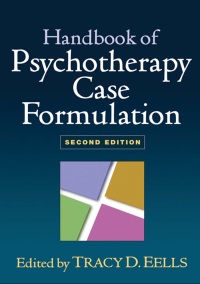
T. Eells – Handbook of Psychotherapy. Case Formulation
2.970 ₽
Автор: T. Eells
Название книги: Handbook of Psychotherapy. Case Formulation
Формат: PDF
Жанр: Психология
Страницы: 465
Качество: Изначально компьютерное, E-book
The primary goal envisioned for the first edition of Handbook of Psychotherapy
Case Formulation was to address the gap between the almost universally
recognized importance of case formulation as a core psychotherapy
skill and the reported lack of adequate training in this skill. The Handbook
also aimed to bring several research-based and statistically reliable methods
of case formulation to a wider clinical audience. Since the first edition, case
formulation has received more attention, as evidenced by the publication of
several texts (e.g., Bruch & Bond, 1998; Hersen & Porzelius, 2002;
Horowitz, 2005; Meier, 2003; Needleman, 1999; Nezu, Nezu, & Lombardo,
2004) and articles (e.g., Bieling & Kuyken, 2003; Caspar, Berger, &
Hautle, 2004; Eells & Lombart, 2003; Eells, Lombart, Kendjelic, Turner, &
Lucas, 2005; Tarrier & Calam, 2002; Westmeyer, 2003) on the topic.
Therefore, a revision is needed to incorporate developments in psychotherapy
training, and recent research and thinking about case formulation. All
chapters on topics covered in the original edition have been updated to include
developments in the method, revisions, new research, and improvements
in training individuals to use the method. The case formulation
methods included represent currently existing and practiced approaches.
Additional goals of this second edition have been to increase the clinical
utility of the book by asking each contributor to include an example of
a completed formulation as it would be developed in practice; to better
integrate the chapters and the book as a whole by adding a concluding
chapter comparing and contrasting each of the formulation methods presented
earlier; and to add material on multicultural competence training in
case formulation. The latter goal was addressed in two ways. A chapter
was added discussing the rationale for considering cultural factors, and presenting
a multiculturally focused method of case formulation. In addition,
each chapter presenting a case formulation method includes a section discussing multicultural considerations and how they would affect the case
formulation process and product.
A hallmark of the first edition was that each chapter describing a
method of case formulation followed the same organizational format. With
minor changes, the second edition retains this format. The reasons for the
standard format are to facilitate comparisons among the methods, to ensure
that similar categories of information are provided for each method,
and to increase the book’s ease of use. All contributors were asked to organize
their chapters according to the following headings: historical background
of their approach, conceptual framework, multicultural and inclusion/
exclusion criteria, steps in case formulation construction, application
to psychotherapy technique, case example, training, and research support
for the approach. The following sections describe what was asked of each
author.
• Historical Background of the Approach. In this section, authors describe
the historical and theoretical origins of their case formulation approach.
• Conceptual Framework. The goal of this section is to present what
is formulated and why. Authors were asked to consider the following questions:
What assumptions about psychopathology and healthy psychological
functioning underlie the approach? What assumptions about personality
structure, development, self concept, affect regulation, and conflict (if any)
are made? What are the components of the case formulation and what is
the rationale for including each component? How are treatment goals incorporated
into the model? Does the formulation predict the course and
outcome of therapy, including obstacles to success? If so, how?
• Multicultural and Inclusion/Exclusion Criteria. How suitable is the
approach for patients of diverse ethnic and cultural backgrounds? How are
these varying sociocultural contexts accounted for within the formulation?
More generally, which patients are appropriate and inappropriate for formulation
with the method? What type and range of problems is the method
suitable for?
• Steps in Case Formulation Construction. The goal of this section is
to provide a detailed, step-by-step description of how to construct a case
formulation with the method under discussion. After reading this section,
readers should be able to make an attempt at constructing a case formulation
using method. Questions authors were asked to address included the
following: How much time is required to formulate the case? What materials
are used (e.g., interviews, questionnaires, progress notes)? Does the patient
participate in constructing the formulation? Are structured interview
techniques or other special procedures required to make the formulation?
What provisions are made for evaluating, amending, or correcting the formulation?
What form does the final product take?
• Application to Psychotherapy Technique. This section addresses
how the therapist might use the formulation in therapy. For example, is the
formulation shared directly with the patient, and if so, in what form?
• Case Example. A concrete case example is presented to illustrate
how the method is applied in the treatment of a specific individual. Authors
were encouraged to present actual materials used in case formulation, for
example, interview transcripts, questionnaires, or diagrams.
• Training. This section addresses how individuals are best trained to
use the case formulation method. The reason for including this section was
to provide interested readers with concrete steps to take in order to learn
the method described.
• Research. This section summarizes scientific evidence for the reliability
and validity of the method. The decision to include this section was
based on the assumption that a case formulation method can be treated as
a psychometric instrument, and therefore, is subject to similar empirical
scrutiny.
It is my hope that this revised text, including the standard format, the focused
questions, the expanded focus on multiculturalism, the greater integration
of material, and the grounding in evidence, provides readers with
multiple and varied tools to draw upon in therapy. As a mentor of mine
once said, “It is always helpful to add another string to your bow.”
Описание
Handbook of Psychotherapy Case Formulation от T. Eells — это практическое руководство по составлению case formulation в психотерапии. Книга подробно разбирает, как собирать информацию о клиенте, строить рабочую гипотезу о его проблемах и создавать индивидуальный план терапии.
В издании рассматриваются основные теоретические подходы: когнитивно-поведенческий, психодинамический, интегративный и другие. Особое внимание уделяется конкретным техникам формулирования случая, учету культурных факторов, работе с сопротивлением и оценке эффективности выбранной стратегии.
- психологам и психотерапевтам, желающим систематизировать работу с клиентами
- студентам и начинающим специалистам, изучающим клиническую психологию
- практикующим терапевтам, которые хотят улучшить навыки формулирования случаев
- специалистам, работающим в интегративном подходе
Только зарегистрированные клиенты, купившие данный товар, могут публиковать отзывы.
Похожие


Другие книги раздела «Психология»
- В. Лейбин – Словарь-справочник по психоанализу (Второе издание)
- В. Менделевич – Клиническая и медицинская психология
- В. Шейнов – Скрытое управление человеком
- Вадим Глухов – Психолингвистика. Теория речевой деятельности
- В. Лейбин – Постклассический психоанализ. Энциклопедия (2 Тома)
- Валерий Лейбин – Психоанализ (2 Издание)
- Г. Грабовой – Числовые ряды психологического нормирования (2 Тома, 2012)
- Д. Райгородский – Психология и психоанализ характера
- Дэвид Файнштейн – Энергетическая психология
- Ж. Лапланш – Словарь по психоанализу
- Й. Стоименов – Психиатрический энциклопедический словарь
- К. Эстес – Бегущая с волками. Женский архетип в мифах и сказаниях
- К. Ясперс – Собрание сочинений по психопатологии (2 Тома)
- Лууле Виилма – Полное собрание сочинений
- Л. Выготский – Собрание сочинений в 6 томах
- Л. Почебут – Кросс-культурная и этническая психология (2012)
Все книги раздела «Психология» →
Смежные разделы: Медицина на испанском языке · Медицина на немецком языке · Медицина на французском языке · Анестезиология и Реаниматология · Акушерство и Гинекология · Ветеринария · Гастроэнтерология и Гепатология · Дерматология и косметология · Диетология и нутрициология · Иммунология и Аллергология · Кардиология · Лапароскопия и Эндоскопия
Рекомендуем также
- M. Benton – Introduction to Paleobiology and the Fossil Record (2009)
- С. Кавтарадзе – Анатомия архитектуры
- A. Cobb – Herbicides and Plant Physiology
- J. Prohens – Handbook of Plant Breeding. Vegetables (2 Volume set)
- J. Zinck – Geopedology. An Integration of Geomorphology and Pedology for Soil and Landscape Studies (2016)
- Pan Ming Huang – Handbook of Soil Sciences (2012)
- U. Quattrocchi – CRC World Dictionary of Grasses
- Q. Tran – Emerging Trends in Applications and Infrastructures for Computational Biology Bioinformatics, and Systems Biology (2016)

Отзывы
Отзывов пока нет.