
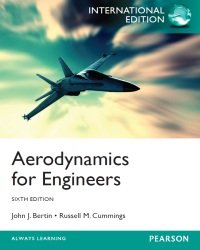
John J. Bertin – Aerodynamics for Engineers (6th edition)
3.880 ₽
Автор: John J. Bertin
Название книги: Aerodynamics for Engineers (6th edition)
Формат: PDF
Жанр: Авиация и космонавтика
Страницы: 833
Качество: Изначально компьютерное, E-book
A great deal has happened since the preface to the fifth edition of Aerodynamics for Engineers
was written early in 2008. During the spring and early summer of 2008, John Bertin and
I were busy checking chapter proofs for “The Book” (as he liked to call it). John was at home
in Houston and teaching at his beloved Rice University (you may have noticed that covers
of the various editions of Aerodynamics for Engineers were usually blue and light gray, the
colors of Rice University). I was a visiting researcher at the Institute of Aerodynamics and
Flow Technology at The German Aerospace Center (DLR) in Braunschweig. John had two
major struggles in his life at the time: he was working through the last stages of the illness that
would take his wife, Ruth, from him. He had also been diagnosed with pancreatic cancer, and
was dealing with doctors, treatments, and hospitals. We spoke on the phone often about the
various challenges he was facing, both with his wife’s and his own health. Through the support
of his family, as well as his desire to finish the fifth edition, he made it through the summer
of 2008 in reasonably good shape. Copies of the book were shipped to us in July 2008, and
he was very glad that we had finished the undertaking we had started so many years earlier.
Unfortunately, John’s pancreatic cancer took a turn for the worse in late summer
of 2008, and he passed away on October 11, 2008. A large number of former co-workers
from NASA and various universities, as well as his family and friends, attended his funeral
later that month, and we all knew that a very special person had passed from our ranks.
One of the things that John and I talked about during his last months of life was
his desire for Aerodynamics for Engineers to continue to grow and evolve, even if he
was not around to help with that task. I cannot help but think that he asked me to be
his co-author for the fifth edition for this purpose. So, in spite of the fact that John is no
longer with us, his spirit and excitement for learning will continue to live.
So, there were many goals for writing the sixth edition of Aerodynamics for Engineers
: (1) to continue the legacy of Professor Bertin; (2) to rewrite many of the sections
that provide readers with a motivation for studying aerodynamics in a more casual, enjoyable,
and readable manner; (3) to update the technical innovations and advancements
that have taken place in aerodynamics since the writing of the previous edition; and (4) to
add aerodynamics concept boxes throughout the book to enhance the interest of readers.
To help achieve these goals, I provided readers with new sections, listed under What’s
New to This Edition on the next page. In addition, there are numerous new figures containing
updated information, as well as numerous, additional up-to-date references throughout
the book. Finally, numerous new example problems have been added throughout the book
to enhance the learning of aerodynamics by the reader, and answers to selected problems
have been added to help students know when they have done the problems correctly.
Users of the fifth edition of the book will find that all material included in that edition
is still included in the sixth edition, with the new material added throughout the book to
bring a real-world flavor to the concepts being developed. I hope that readers will find the
inclusion of all of this additional material helpful and informative.
Finally, no major revision of a book like Aerodynamics for Engineers can take place without
the help of many people. I am especially indebted to everyone who aided in collecting new materials for the sixth edition. I want to especially thank Preston A. Henne and Robert van’t
Riet of McDonnell Douglas; Eli Reshotko of Case Western Reserve University; David W. Hall
of DHC Engineering; Stuart Rogers of NASA Ames Research Center; David McDaniel of the
University of Alabama, Birmingham; Hans Hornung of Caltech; Andreas Schütte, Thomas
Streit, and Martin Hepperle of DLR; Patrick Champigny of ONERA; Aaron Byerley of the
U.S. Air Force Academy; John McMasters of The Boeing Company; and William H. Mason
of Virginia Tech. In addition, I am very grateful for the excellent suggestions and comments
made by the reviewers of the sixth edition: Roger L. Simpson of Virginia Tech, Tej R. Gupta
of Embry-Riddle Aeronautical University, Serhat Hosder of Missouri University of Science
and Technology, and Lisa Grega of The College of New Jersey. The editorial and production
staff at Pearson has been outstanding in their support of this new edition: I greatly appreciate
their efforts. I am also extremely grateful to the many students at the U.S. Air Force Academy
who have pointed out errors that they found in the previous edition. I hope that everyone
who reads this book will find it useful and educational.
The publishers would like to thank Ramesh Kolluru of BMS College of Engineering,
Bangalore for reviewing the content of the International Edition.
WHAT’S NEW TO THIS EDITION?
• Aerodynamics concept boxes added throughout the book to bring real-world examples
and applications to light as new material is being learned
• Chapter objectives to give readers a better understanding of the goal of each chapter
and what concepts they should understand after reading through the chapter
• Significant re-writing of material and derivations from previous editions to improve
clarity and usefulness
• Extra example problems to improve understanding of how to apply concepts to
useful applications
• Significant new sections added on the topics of: importance of aerodynamics to
aircraft performance, a description of the airplane, the irrotational flow condition,
applications of potential flow theory to aerodynamics, expanded description of
airfoil geometry and nomenclature, high lift military airfoils, the effect of taper
ratio on wing efficiency, induced drag estimation, converging-diverging nozzles,
shock/shock interactions, subsonic compressible transformations, additional compressibility
corrections, critical Mach number, drag divergence Mach number,
base drag, and the distinguishing characteristics of hypersonic flow
• Updated figures and photographs to help readers see concepts from real examples
and on real aircraft
• Answers to selected problems
Enjoy your study of aerodynamics!
INSTRUCTORS RESOURCES
Resources to accompany the text are located on the Instructor Resource Center website
at www.pearsoninternationaleditions.com/cummings . If you are in need of a login
and password for this site, please contact your local Pearson representative. Resources
include; Instructor Solutions Manual, Matlab files for several example problems and
lecture slides for most chapters.
RUSSELL M. CUMMINGS
Описание
Aerodynamics for Engineers (6th edition) Джона Дж. Бертина — фундаментальный учебник, который объясняет принципы аэродинамики и их практическое применение в авиационной и аэрокосмической технике. Книга последовательно рассматривает поведение воздушного потока, силы, действующие на летательные аппараты, и методы расчёта характеристик крыльев, фюзеляжей и целых самолётов.
Издание охватывает как классические темы (теория потенциального потока, пограничный слой, сжимаемость), так и современные подходы к вычислительной аэродинамике, включая CFD. Особое внимание уделяется взаимосвязи теории и реального проектирования летательных аппаратов.
- студентам аэрокосмических и механических специальностей
- инженерам-разработчикам авиационной техники
- специалистам, работающим с расчётами обтекания и аэродинамическими испытаниями
- всем, кто хочет глубоко понять, как устроена аэродинамика полёта
Только зарегистрированные клиенты, купившие данный товар, могут публиковать отзывы.
Похожие




Другие книги раздела «Авиация и космонавтика»
- Earl H. Dowell – A Modern Course in Aeroelasticity (Fifth edition)
- Ernst Heinrich Hirschel – Selected Aerothermodynamic. Design Problems of Hypersonic Flight Vehicles
- Ethirajan Rathakrishnan – Theoretical Aerodynamics
- Hans Mark – Encyclopedia of Space, Science and Technology
- J. Chattot – Theoretical and Applied Aerodynamics and Related Numerical Methods (2015)
- J. Liu – Spacecraft TT&C and Information Transmission (2015)
- John A. Wise – Handbook of Aviation Human Factors
- John Valasek – Morphing Aerospace Vehicles and Structures
- Malcolm Macdonald – The International Handbook of Space Technology
- Martin Turner – Rocket and Spacecraft Propulsion (3rd Edition)
- Max Mulder – Aeronautics and Astronautics
- P. J. Swatton – The Principles of Flight for Pilots
- R. Collinson – Introduction to Avionics Systems (3rd edition)
- R. Doganis – Flying Off Course. Airline Economics and Marketing (4th edition)
- R. Hallion – Nasa Contributions to Aeronautics (2 Volumes)
- R. Vepa – Flight Dynamics Simulation and Control
Все книги раздела «Авиация и космонавтика» →
Смежные разделы: Астрономия · Геология и Геодезия · Железнодорожное дело · Журналистика · Математика · Машиностроение · Нанотехнологии · Научно-популярная литература · Физика · Химия · Экология · Энергетика
Рекомендуем также
- R. Pallela – Marine Sponges. Chemicobiological and Biomedical Applications (2016)
- Красная книга Российской Федерации. Растения и Животные (60 Томов)
- O. Dulac – Pediatric Neurology (3 Volume set, 2013)
- P. Mehra – Manual of Minor Oral Surgery for the General Dentist (2016)
- S. Froum – Dental Implant Complications
- L. Caplan – Caplan’s Stroke (2016)
- X. Chen – Advanced Fibrous Composite Materials for Ballistic Protection (2016)
- G. Neigh – Sex Differences in Physiology (2016)

Отзывы
Отзывов пока нет.