
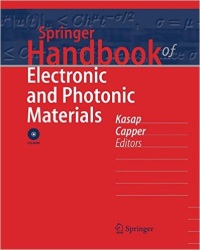
Safa Kasap – Springer Handbook of Electronic and Photonic Materials
1.830 ₽
Автор: Safa Kasap
Название книги: Springer Handbook of Electronic and Photonic Materials
Формат: PDF
Жанр: Физика
Страницы: 1408
Качество: Изначально компьютерное, E-book
Contributions from well known and respected researchers throughout the world
Thorough coverage of electronic and opto-electronic materials that today's electrical engineers, material scientists and physicists need
Interdisciplinary approach encompasses research in disciplines such as materials science, electrical engineering, chemical engineering, mechanical engineering, physics and chemistry
The Editors, Authors, and Publisher are to be congratulated
on this distinguished volume, which will be an
invaluable source of information to all workers in the
area of electronic and photonic materials. Having made
contributions to earlier handbooks, I am well aware of
the considerable, and sustained work that is necessary to
produce a volume of this kind. This particular handbook,
however, is distinguished by its breadth of coverage in
the field, and the way in which it discusses the very latest
developments. In such a rapidly moving field, this is
a considerable challenge, and it has been met admirably.
Previous handbooks and encyclopaedia have tended
to concentrate on semiconducting materials, for the
understandable reason of their dominance in the electronics
field, and the wide range of semiconducting
materials and phenomena that must be covered. Few
have been courageous enough to predict future trends,
but in 1992 Mahajan and Kimerling attempted this
in the Introduction to their Concise Encyclopaedia
of Semiconducting Materials and Related Technologies
(Pergamon), and foresaw future challenges in
the areas of nanoelectronics, low dislocation-density
III-V substrates, semi-insulating III-V substrates, patterned
epitaxy of III-Vs, alternative dielectrics and
contacts for silicon technology, and developments in
ion-implantation and diffusion. To a greater or lesser
extent, all of these have been proved to be true, but it
illustrates how difficult it is to make such a prediction.
Not many people would have thought, a decade
ago, that the III-nitrides would occupy an important
position in this book. As high melting point materials,
with the associated growth problems, they were
not high on the list of favourites for light emitters at
the blue end of the spectrum! The story is a fascinating
one – at least as interesting as the solution to the
problem of the short working life of early solid-state
lasers at the red end of the spectrum. Optoelectronics
and photonics, in general, have seen one of the
most spectacular advances over the last decade, and
this is fully reflected in the book, ranging from visible
light emitters, to infra-red materials. The book covers
a wide range of work in Part D, including III-V and IIVI
optoelectronic materials and band-gap engineering,
as well as photonic glasses, liquid crystals, organic
Prof. Arthur Willoughby
Materials Research Group,
University of Southampton,
UK
photoconductors, and the new area
of photonic crystals. Thewhole Part
reflects materials for light generation,
processing, transmission and
detection – all the essential elements
for using light instead of
electrons.
In the Materials for Electronics
part (Part C) the book charts the
progress in silicon – overwhelmingly
the dominant material for
a whole range of electronic functions
and circuitry – including new
dielectrics and other issues associated
with shrinking geometry of
circuits and devices to produce ever higher packing
densities. It also includes areas rarely covered in other
books – thick films, high-temperature electronic materials,
amorphous and microcrystalline materials. The
existing developments that extend the life of silicon technology,
including silicon/germanium alloys, appear too,
and raise the question again as to whether the predicted
timetable for the demise of silicon has again been declared
too early!! Ferroelectrics – a class of materials
used so effectively in conjunctionwith silicon – certainly
deserve to be here.
The chapters in Part E (Novel Materials and Selected
Applications), break new ground in a number
of admirable ways. Most of us are aware of, and frequently
use, information recording devices such as CDs,
videos, DVDs etc., but few are aware of the materials,
or principles, involved. This book describes magnetic
information storage materials, as well as phase-change
optical recording, keeping us fully up-to-datewith recent
developments. The chapters also include applications
such as solar cells, sensors, photoconductors, and carbon
nanotubes, on which such a huge volume of work
is presently being pursued worldwide. Both ends of the
spectrum from research to applications are represented
in chapters on molecular electronics and packaging
materials.
A particular strength of this book is that it ranges
from the fundamental science (Part A) through growth
and characterisation of the materials (Part B) to applications (Parts C–E). Virtually all the materials covered
here have a wide range of applications, which is
one of the reasons why this book is going to be so
useful. As I indicated before, few of us will be successful
in predicting the future direction and trends,
occupying the high-ground in this field in the coming
decade, but this book teaches us the basic principles
of materials, and leaves it to us to adapt these to
the needs of tomorrow. I commend it to you most
warmly.
Описание
Springer Handbook of Electronic and Photonic Materials — это фундаментальный справочник, в котором подробно рассмотрены современные материалы, используемые в электронике, оптоэлектронике и фотонике. Книга объединяет знания из физики твёрдого тела, материаловедения и прикладной электроники, показывая, как свойства материалов определяют работу полупроводниковых приборов, лазеров, фотодетекторов и солнечных элементов.
Издание охватывает ключевые темы: рост и обработку кристаллов, оптические и электрические свойства полупроводников, диэлектрики, металлы, органические материалы, наноматериалы и новые функциональные композиты. Особое внимание уделяется взаимосвязи структуры материала с его характеристиками и практическим применением в современных устройствах.
- специалистам и исследователям в области материаловедения и полупроводниковой электроники
- инженерам-разработчикам оптоэлектронных и photonic устройств
- студентам старших курсов и аспирантам физических и технических специальностей
- учёным, работающим с наноматериалами и органической электроникой
Только зарегистрированные клиенты, купившие данный товар, могут публиковать отзывы.
Похожие


Другие книги раздела «Физика»
- B. Smirnov – Theory of Gas Discharge Plasma (2015)
- B. Tillery – Physical Science (Tenth edition)
- B. Zwiebach – A First Course in String Theory (Second edition)
- C. Bonnelle – Rare-Earths and Actinides in High Energy Spectroscopy (2015)
- C. Grupen – Handbook of Particle Detection and Imaging (2012)
- C. Hansen – The Visualization Handbook
- C. Poole – Encyclopedic Dictionary of Condensed Matter Physics
- C. Schiller – The Adventure of Physics
- D. Giancoli – Physics. Principles with Applications (7th edition)
- D. Puetzfeld – Equations of Motion in Relativistic Gravity (2015)
- D. Sirdeshmukh – Electrical, Electronic and Magnetic Properties of Solids (2014)
- Desmond Nicholl – An Introduction to Genetic Engineering (3rd edition)
- E. Barsoukov – Impedance Spectroscopy. Theory Experiment and Applications (Second edition)
- E. Economou – Greens Functions in Quantum Physics (Third edition)
- E. Economou – The Physics of Solids (2010)
- E. Manoukian – Quantum Theory
Смежные разделы: Авиация и космонавтика · Астрономия · Геология и Геодезия · Железнодорожное дело · Журналистика · Математика · Машиностроение · Нанотехнологии · Научно-популярная литература · Химия · Экология · Энергетика
Рекомендуем также
- S. Paul – Clinical Cases in Skin Cancer Surgery and Treatment (2016)
- Y. Sakai – Laparoscopic Surgery for Colorectal Cancer (2016)
- V. Stearns – Novel Biomarkers in the Continuum of Breast Cancer (2016)
- A. Mathur – Nanotechnology in Cancer (2017)
- P. Rennert – Novel Immunotherapeutic Approaches to the Treatment of Cancer
- M. Baranska – Optical Spectroscopy and Computational Methods in Biology and Medicine (2014)
- A. Bondanza – Tumor Immunology (2016)
- H. Seligmann – DNA Replication. Current Advances (2016)

Отзывы
Отзывов пока нет.