
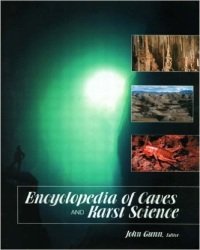
John Gunn – Encyclopedia of Caves and Karst Science
985 ₽
Автор: John Gunn
Название книги: Encyclopedia of Caves and Karst Science
Формат: PDF
Жанр: Геология и Геодезия
Страницы: 1970
Качество: Изначально компьютерное, E-book
The Encyclopedia of Caves and Karst Science contains 350 alphabetically arranged entries. The topics include cave and karst geoscience, cave archaeology and human use of caves, art in caves, hydrology and groundwater, cave and karst history, and conservation and management. The Encyclopedia is extensively illustrated with photographs, maps, diagrams, and tables, and has thematic content lists and a comprehensive index to facilitate searching and browsing.
This is the first encyclopedia of Caves and Karst Science and provides a unique,
comprehensive, and authoritative reference source that can be used both by subjectspecialists
who wish to obtain information from outside of their immediate area of
knowledge and by non-specialists who wish to gain an understanding of the diverse
and multi-disciplinary nature of caves and karst science. It will also be useful to cavers
who wish to learn more about the environments in which they undertake their sport
and to conservationists, engineers, planners, and others who are charged with
developing and managing in a sustainable manner complex karst environments. The
351 entries were selected by a multi-disciplinary Advisory Board of leading scholars,
all of whom are cavers. The entries cover a wide range of topics and each entry also
includes both references and further reading to enable deeper study. While not
intended as an atlas, there is a wide geographical coverage of all scientifically
important karst areas, the level of detail (continent, country, region, or individual site
or cave) reflecting the Advisory Board’s opinions as to the importance of the locality.
It is the first encyclopedia to cover all the disciplines involved in cave and karst
science—archaeology, biology, chemistry, ecology, geology, geomorphology, history,
hydrology, paleontology, and physics as well as exploration, survey, photography,
literature, and art. The resources found in caves and in karst areas are outlined,
including the underground water that supplies around a quarter of the world’s
population. Caves and karst environments are fragile and special places so there is
appropriate consideration of conservation and management, including protected areas.
Contributors are all leading authorities in their area and all entries were subject to
review by the Editor, members of the Advisory Board, or other subject specialists.
The term “cave” is commonly applied to natural openings, usually in rocks, that are large
enough to permit entry by humans. The term is also sometimes applied to openings
constructed by humans but this encyclopedia is confined to natural caves. The
majority of these form parts of a wider landscape known as karst, defined by Derek
Ford in this volume as “terrain with distinctive hydrology and landforms arising from
the combination of high rock solubility and well-developed solution channel
(secondary) porosity underground”. As well as distinctive landforms and drainage,
karst areas have distinctive biological attributes and provide a wide range of resources,
together with particular problems for humans who wish to exploit them. Caves are
natural museums, preserving important archaeological evidence as well as sediments
and deposits that provide clues to past environments. They also present many
challenges for explorers. Although several thousand kilometres of cave have been
explored, it is certain that many passages have yet to be entered and these represent
the only truly unknown parts of the Earth outside of the oceans. Each year several
well-equipped teams undertake major expeditions to discover new cave but it remains
the case that individuals and groups working steadily on smaller projects also succeed in becoming the first humans ever to set foot in a particular passage. While the thrill of
discovery drives many, caving has also become a popular recreational activity in many
countries and many thousands more enjoy visits to commercially developed tourist
caves.
To discover new cave it is usually necessary to have an understanding of the scientific
contexts in which caves are formed while the discovery of new caves provides
opportunities for new scientific discoveries. This synergy between science and
exploration is one of the factors that makes the study of caves and karst so exciting.
Caves are widely distributed, from within the Arctic Circle to the Antarctic and from
below sea level to altitudes of several thousand metres. Karst is also widespread and it
has been estimated that about a quarter of the world’s population draw their water
from karst rocks. Cave and karst science is multi-disciplinary, being undertaken by
archaeologists, biologists, chemists, ecologists, geologists, geographers, historians,
hydrologists, and physicists. It is also applied as conservationists, consultants,
engineers, environmental managers, and planners require an understanding of the
special characteristics of karst in order to manage and sustainably develop the many
resources of karst areas.
Choosing the entries and authors
Given the above it is perhaps surprising that this is the first encyclopedia devoted to
Caves and Karst Science. As such it seeks to describe all of the world’s important karst
areas and the most important caves. However, it is not an atlas and coverage is not, and
could not have been, exhaustive. Instead, an initial list of sites was drawn up with the
assistance of an appointed board of advisers who have very wide subject expertise and
caving experience (see page ii and Notes on Contributors). The list was then widely
publicized and suggestions for additional/ alternative sites sought from the cave and karst
community before a final list was agreed. This comprises 100 entries on the world’s most
significant cave and karst sites, and regional discussions of the world’s largest areas of
caves and karst. In addition to assisting in the choice of important sites and areas the
Advisory Board helped to draw up a list of topical entries considered to be of primary
importance to their particular branch of science. Again there was wide discussion of the
lists both between the Advisory Board and also via the encyclopedia web site.
Following the consultative process a final list was produced broken down by themes,
although some entries fall into more than one field:
Archaeology, Art in Caves and Paleontology: 29 entries, from dating methods to
major sites, and regional discussions of art in caves
Biospeleology: 78 entries on ecology and ecological processes, habitats, cave ecology
& man, subterranean fauna, subterranean biodiversity, regional faunas, the world’s
richest cave faunas, evolution of subterranean fauna, and important subterranean taxa
Caves and Caving: 23 entries on cave media, caving, and the uses of caves
Cave and Karst Regions: 75 entries on the world’s largest and most important areas of
caves and karst together with 28 entries on individual caves and cave systems
Conservation and Management: 19 entries on topics such as environmental impact
assessment, groundwater pollution, and tourist caves
Geoscience: 78 entries on caves and speleogenesis, climate of caves, deposits in caves,
karst settings and landforms, processes and techniques, and pseudokarst
History: 27 entries on key events and personalities in the history of cave and karst
science together with the history of cave exploration in particular regions of the world
Resources and Development: 22 entries on the resources of karst regions and some of
the key problems in their exploitation
The next stage was to allocate a word limit for each entry and to seek suitable authors.
Most entries were planned at 1000 words, although it was recognized that some would
need to be longer, up to a maximum of 4000 words. The Advisory Board suggested some
possible authors who were invited individually. Other authors were approached in more
general terms and invited to offer to write entries that remained unassigned. The objective
was to include the leading authorities on each topic from a range of different countries.
All entries were read by the Editor and by selected members of the Advisory Board or
other reviewers.
The finished work has a total of 351 entries on a wide range of topics. A thematic list,
an extensive index, and cross-references are provided to help readers explore themes
systematically. All the entries have bibliographies and/or suggestions for further reading,
pointing the reader toward original research and textbooks that augment the overview
approach to which an encyclopedia is inevitably limited. Most entries have either line
diagrams expanding on explanations given in the text, or photographs illustrating type
examples. There is also a section of colour pages illustrating the range of themes.
Entries and structure
The 351 entries appear in alphabetical order and are of several kinds (for the complete list
of entries see page xi). Although each entry is self-contained, the links between entries
can be explored in a number of ways. The Thematic List on page xv groups the entries
within broad and more specific categories and provides a useful summary of related
entries. Almost all of the entries have “See Also” links, both within the text and at the
end of the entry, so the reader is encouraged to browse outwards from a starting node.
Finally the Index provides a detailed listing of topics, organisms, and sites or countries
that do not have their own entry but are discussed within the context of broader entries.
One aspect which came as a surprise to the Editor was the difficulty of deciding the
exact titles of several entries and hence the point at which they would appear in the
alphabetic listing. Following much discussion it was decided that all organisms would
appear alphabetically by scientific name (hence “Chiroptera” not “Bats”, and “Pisces” not
“Fish”) and that where the common name for a site commences with a local word for a
cave or geographical feature then the entry should be under the location (hence “Draenen,
Ogof Draenen, Wales” and “Encantado, Sistema del Rio, Puerto Rico”). We recognize
that this may initially cause some confusion but if you cannot find an entry on a topic you
expected to find you should be able to use the Thematic List or Index to locate the title of
the entry that contains the topic you are looking for. Thus, for the examples above the
Index will contain cross references for Bats, Fish, Ogof Draenen, Rio Encantado, and
Sistema del Rio Encantado
Описание
Encyclopedia of Caves and Karst Science Джона Ганна — это фундаментальный справочник, объединяющий знания о пещерах, карстовых процессах и связанных с ними природных явлениях. Книга объясняет, как формируются подземные полости, какие силы влияют на карст, и какие уникальные экосистемы существуют в полной темноте.
Издание охватывает широкий спектр тем: от геологии и гидрологии карста до биологии пещерных организмов, археологии, спелеологии и вопросов охраны подземного наследия. Авторы статей — ведущие мировые специалисты, что делает энциклопедию авторитетным источником актуальной научной информации.
- спелеологам и исследователям пещер
- геологам, гидрогеологам и географам
- биологам, изучающим экстремальные экосистемы
- студентам и преподавателям естественных наук
- специалистам по охране природы и подземному наследию
Только зарегистрированные клиенты, купившие данный товар, могут публиковать отзывы.
Похожие


Другие книги раздела «Геология и Геодезия»
- Stuart A. Harris – Geocryology (2018)
- Robin Chowdhury – Geotechnical Slope Analysis
- S. Pamukcu – Underground Sensing (2018)
- Lianyang Zhang – Engineering Properties of Rocks
- Kok Phoon – Risk and Reliability in Geotechnical Engineering
- Abdon Atangana – Fractional Operators with Variable Order with Application to Geo-Hydrology
- Abdel-Mohsen Onsy Mohamed – Fundamentals of Geoenvironmental Engineering (2018)
- Aurel Persoiu – Ice Caves (2018)
- Ralf Tappert – Diamonds in Nature
- Patti Polk – Collecting Rocks, Gems and Minerals
- Rich P. Mildren – Optical Engineering of Diamond
- Richard S. Carden – Horizontal and Directional Drilling
- James Gaiser – 3C Seismic and VSP
- L. Ikelle – Coding and Decoding. Seismic Data (2018)
- Ilya Tsvankin – Seismology of Azimuthally Anisotropic Media and Seismic Fracture Characterization
- Gerard T. Schuster – Seismic Inversion
Все книги раздела «Геология и Геодезия» →
Смежные разделы: Авиация и космонавтика · Астрономия · Железнодорожное дело · Журналистика · Математика · Машиностроение · Нанотехнологии · Научно-популярная литература · Физика · Химия · Экология · Энергетика
Рекомендуем также
- A. Escarpa – Agricultural and Food Electroanalysis (2015)
- A. Jess – Chemical Technology (2013)
- Gerhard Ertl – Handbook of Heterogeneous Catalysis (Second edition)
- Johannis P. Kamerling – Comprehensive Glycoscience from Chemistry to Systems Biology
- T. Albright – Orbital Interactions in Chemistry (Second edition, 2013)
- V. Andrushko – Stereoselective Synthesis of Drugs and Natural Products
- G. Cariolaro – Unified Signal Theory (2011)
- J. Whitaker – Power Vacuum Tubes Handbook (3rd edition, 2012)

Отзывы
Отзывов пока нет.