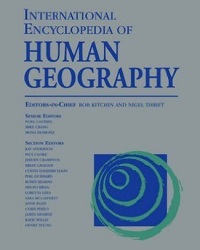
Rob Kitchin – International Encyclopedia of Human Geography
9.750 ₽
Автор: Rob Kitchin
Название книги: International Encyclopedia of Human Geography
Формат: PDF
Жанр: География
Страницы: 6524
Качество: Изначально компьютерное, E-book
The International Encyclopedia of Human Geography provides an authoritative and comprehensive source of information on the discipline of human geography and its constituent, and related, subject areas. The encyclopedia includes over 1,000 detailed entries on philosophy and theory, key concepts, methods and practices, biographies of notable geographers, and geographical thought and praxis in different parts of the world.
This groundbreaking project covers every field of human geography and the discipline’s relationships to other disciplines, and is global in scope, involving an international set of contributors. Given its broad, inclusive scope and unique online accessibility, it is anticipated that the International Encyclopedia of Human Geography will become the major reference work for the discipline over the coming decades.
The Encyclopedia will be available in both limited edition print and online via ScienceDirect – featuring extensive browsing, searching, and internal cross-referencing between articles in the work, plus dynamic linking to journal articles and abstract databases, making navigation flexible and easy
Описание
Over the past 100 hundred years or so, human geography
has grown into one of the most vibrant university discip
lines around the world. Expanding from its origins in the
colonial pursuit of geographic knowledge, modern human
geography has developed into a diverse collection of so
phisticated, spatially inflected knowledges underpinned by
a refined set of theoretical concepts and methodological
tools. As a result, defining contemporary human geography
is not an easy task, not least because what passes for geo
graphic theory and praxis varies across time and space. For
us, what marks the discipline from other social and natural
sciences is its focus on the relationship between people and
the world they inhabit, its core metaconcepts (such as
space, place, landscape, nature, mobility, environment, and
scale), and its use of geographically sensitive methods of
data generation and analysis. Human geography, as the
contents list of this encyclopedia amply demonstrates, fo
cuses on key issues of the day, and opens up new and vital
perspectives on questions that affect our everyday lives. It
engages with and problematizes apparently unequivocal
statements such as:
• the planet is large;
• the planet teems with life; and
• the planet is under threat.
Through the lens of human geography, these statements are
revealed as equivocal and often paradoxical. What do we
mean by ‘large’ in a period in which a scientific shift based
on the discovery of fractals has expanded our perception of
the length and complexity of lines at exactly the same time
that transport and communications technologies shrink the
world to such an extent that we can interact in real time
with people on the far side of the planet and maps of the
planet can be called up online by ordinary citizens and
analyzed in diverse ways? What do we mean by ‘life’ in a
period in which we keep discovering more of it in more and
more unlikely places, while scientific and cultural changes
are continually expanding our definition of what ‘life’
consists of ? What do we mean by ‘threat’ when we are
unable to agree on the nature of a threat, let alone a so
lution, when technologies that offer the promise of salvation
all too often create new problems and when increasing
populations offer new resources as well as consume them?
Human geography seeks to answer such questions not
only in order to understand the world but also to make
practical interventions. Unlike many disciplines, it is built
on unsure foundations without much in the way of a
canon. Some might say that that is its attraction; that it
has perennially been driven by the changing world
around it. The discipline is willing to go where other
disciplines fear to tread because its history is loosely
connected, more like a conglomerate than a series of
well defined strata – it has not been wed to a single or
limited theoretical approach but rather it has explored
and drawn together all manner of approaches in order to
address issues geographically. Equally though, it is born
out of a longing for a planetary citizenship, with that
longing sitting alongside a radical appreciation of how all
the differences that make up the discipline both com
promise and strengthen that goal. Whatever might be the
case, at the heart of this endeavor has been the notion
that geography matters – the spatial configuration of
events is not a mere add on to other somehow deeper,
more abstract aspatial processes, but rather is central to
how the processes unfold.
These tensions between a discipline organized around
understanding the world and a discipline consisting of and
defined by its own approaches, are manifest in how geog
raphy tells its own history (and how one might organize an
encyclopedia). One way would be to trace the changing
approaches, epistemologies, and concerns of the discipline. Thus one could track the multiple interpretations of the
writing of Alexander von Humboldt, often cited as one of
the key disciplinary ancestors. Alternately, one could chart
the intellectual genealogies of ‘key’ texts, concepts, and
places to provide counterpoints to more traditional
chronological histories of various theoretical schools. Or, one
could create accounts that organize the discipline via key
processes and events in the world. To take other examples,
there are presently attempts to write about differences in
more satisfying and nuanced ways, ways that can bring about
new means of living and experiencing the world through
reinventing familiar categories like gender, race, and sexu
ality, categories that have their own complex geographies
which are a very part of the process of reinvention. There
are efforts to reconceive cities taking account of the affective,
the mundane, the ongoing incompleteness, fuzziness, and
unpredictability that make up urban life, and there are at
tempts to reimagine the economic as thoroughly infused
with the cultural. Sometimes clumsy and awkward, some
times plain inspired, these kinds of developments are surely
worth following in a world too often characterized by div
ision and despair. And follow them, this encyclopedia does.
The Encyclopedia
The International Encyclopedia of Human Geography is a
multinational attempt to capture and trace the state of
human geography as a discipline and as a description of
the world as it exists today and as it changes its shape in
the future. Its ambition, in other words, is to provide a
major and continually updated resource that provides an
always temporary but hopefully authoritative means of
answering questions of the sort posed above, and many
others like them. This it does by taking on the venerable
format of an encyclopedia which we can understand both
in its original meaning as a course of education – in this
case with the description ‘human geography’ – or in its
more modern meaning as treating a particular branch of
knowledge comprehensively through the medium of
articles arranged alphabetically, by subject.
Of course, producing an encyclopedia provides real
opportunities, most especially the ability to stretch out
explanations in a way not available in the more common
dictionary form. Thus, our aim has not been to produce a
portable, condensed summary or bite sized definitions of
concepts, but rather clear, authoritative statements that
set out the evolution and implications of geographic
thought. Such an endeavor also produces some inevitable
challenges. We want to use these challenges to explore
how this encyclopedia has been put together, under
standing that such challenges do not have to be under
stood just as undesirable or unpleasant choices between
alternatives. They can equally well be understood as
producing the means to fuel productive encounters.
The first challenge is an obvious one. There is an in
evitable degree of arbitrariness about what is included and
what is not. We have made an honest attempt to cover the
whole range of what can possibly be treated as human
geography in terms of issues on the ground and traditions
within the discipline. This has been achieved through an
intensive, iterative process involving all the editors,
worked through at face to face meetings, conference
phone calls, and e mail. Inevitably, there will be topics,
methods, and thinkers considered important by some that
we felt did not justify a stand alone entry. Moreover, we
fully expect that as some issues grow or decline in im
portance – to the world and/or the discipline – we shall
have occasion in the future to expand or contract the
coverage in different fields. This dilemma of selecting
what to cover brings with it other issues too. Foremost
among these has been how to shape the coverage of each
entry and title each entry in an informative yet pithy way.
There are many bodies of conceptual and substantive
knowledge that cannot easily be encompassed by a single
term or phrase. The result is that some of the entries have
somewhat contrived titles. Better that, though, than titles
that are vague or oblique, especially in these days of vo
luminous information accessible across the Internet.
The second challenge is an authorial one. It was a
guiding principle of this encyclopedia that we would
attempt to extend authorship beyond the ‘charmed circle’
of Anglophone/Western geographers, both as a response
to postcolonial critiques and as a response to the critiques
of scholars from outside the Euro American zone who
felt disenfranchised by what is possible to perceive as an
Anglophone/Western ascendancy. We have then been
attentive to the geographies of the discipline of geog
raphy, not least since scholars in diverse locales see the
world differently in terms of what processes seem most
important and what traditions of interpretation they use.
We have not always been successful in achieving our goal
of wide international authorship, partly because the
geographical establishment is simply larger in some
countries than others and partly because human geog
raphy still bears some of the marks of its own history, not
least as a colonial enterprise. Inevitably perhaps, the
historical geography of geography kept coming home to
roost. Moreover, scholars from different locales had
varying abilities to contribute due to issues of time, ac
cess to resources, and language. As a result, we have not
been able to include some topics and perspectives. That
said, entries have been solicited from 844 scholars located
in over 40 countries around the world working within
different traditions and we have managed to describe the
different ideas and practices of geography in many
countries/language groups. Again, this is a project that
will be added to, over the coming years.
The third challenge was to draw on the expertise of
the human geographical community in ways that ensured some degree of diversity. In particular, we are proud that
we have been able to balance the voices of established
scholars with those of younger writers. This has had
salutary effects. For example, we have been able to trace
the history of philosophical ideas in geography both from
the point of view of those that have been deeply involved
in the explosion of different conceptual possibilities that
took place in the discipline from the late 1960s onward,
as well as the point of view of younger scholars who have
set out quite different agendas.
The fourth challenge was to ensure a relatively con
sistent standard of scholarship for each entry and to
provide a balanced content with respect to ideas and
geographical coverage. To that end, each entry was ini
tially refereed by a section editor who had overall re
sponsibility for a selection of related entries (e.g.,
political, urban, regional development, quantitative
methods, people) and a senior editor. Each senior editor
oversaw three sections in order to ensure sections were
approximately commensurate in style, content, and
length. To provide breadth as well as depth, authors were
asked to draw on examples and traditions from around
the world and not simply rely on charting an issue with
respect to their own local circumstance.
The fifth challenge was to use the Internet in pro
ductive ways. One of the motivations for this encyclo
pedia was the production of a platform upon which we
might then build a future memory for human geography.
It is an attempt to begin to produce a living, breathing
archive which will gradually evolve, by using the powers
of the Internet. Though in this first edition, both print
and Internet editions exist side by side, in later editions
the Internet edition will exist singly, opening the way to a
vision of geography which is in keeping with the age in
which we now live. Since the articles are on the web, it
will be possible to update them on a regular, rolling basis
without having to wait for the revision of every other
article. Equally, they will have all kinds of extra resources
associated with them – illustrations of all types, including
more and more videos as well as maps and diagrams,
‘active’ reference links that will take the reader straight to
the listed journal article, and so on. Then, more articles
will be added at regular intervals, both filling in gaps and
supplementing existing articles. All articles will be left in
situ – old articles will not be deleted – so that, in time, we
will be able to produce a ‘timeline’ for many subjects,
making it possible to see how thinking has evolved,
thereby producing a real sense of historical accretion.
Over time, we hope that the encyclopedia will become an
institutionalized memory of human geography.
The sixth challenge was to produce an encyclopedia
of human geography that was relevant to issues that must
concern us all. We sought an encyclopedia that espoused
responsibility to the planet and its people certainly. But
we also became, however awkwardly and unsuccessfully,
involved in thinking what that responsibility might mean.
A difficult but ultimately productive instance of what this
might entail – and how difficult it can be to think through
– was provided by the proposed boycott of the encyclo
pedia by some authors concerned at Reed International’s
(a sister company to Elsevier) involvement in the arms
trade, an affair settled when Reed withdrew from these
activities. Here, we saw the same concerns being aired by
many participants but radically different solutions being
put on offer. We hope that the encyclopedia mirrors this
diversity of response.
Bringing these six, and especially the last three, points
together we hope and trust that this encyclopedia will be
counted as a contribution to the global commons of
knowledge. The production of a discipline depends on
the goodwill of many who labor over ideas, who dis
seminate, review, and rework them. We are painfully
aware that in the current global climate of academia,
when what counts as valued academic practices is nar
rowing, writing authoritative and scholarly articles for
publications such as this venture provides few rewards
and attracts little institutional support. However, it is a
vital component in the reproduction and development of
a discipline. Rather than simply being understood as the
creation of canonical knowledge by authorial com
munities we would like to thank all those who have
written and reviewed material here for an activity that
may be deemed a professional service but is one that,
sadly, is seen as subverting the institutional priorities of a
number of universities.
Только зарегистрированные клиенты, купившие данный товар, могут публиковать отзывы.

Отзывы
Отзывов пока нет.