
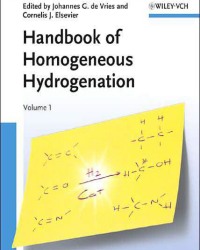
J. De Vries – The Handbook of Homogeneous Hydrogenation (2007)
1.880 ₽
Автор: J. De Vries
Название книги: The Handbook of Homogeneous Hydrogenation
Формат: PDF
Жанр: Химия
Страницы: 1595
Качество: Изначально компьютерное, E-book
This multi-volume handbook is the first to cover all questions concerning homogeneous hydrogenation. As such, it presents the catalysts, the scope of their application, mechanistic aspects, asymmetric methods, combinatorials catalysis, recycling methods and industrial examples. In 45 clearly structured chapters, the book includes all hydrogenation reactions catalyzed by soluble transition metal-based catalysts. All authors adopt an applied approach, emphasizing those aspects important for industrial use.
With some 2,000 illustrations and 50 tables, this is a must-have for everyone working in the chemicals and pharmaceutical industries, as well as for graduate students in chemistry.
It is truly astonishing that such a simple reaction as the addition of one molecule
of hydrogen to a double or triple bond can have so many facets.
When we had chosen the title of Handbook of Homogeneous Hydrogenation
for our book we meant it to be a comprehensive work of reference. In this respect
we are quite satisfied. We only had to skip the chapter on dehydrogenations,
for which we could not find an author. We are extremely grateful to the
other 88 authors for dedicating so much of their valuable time to writing the 81
marvellous chapters included in these volumes. We had envisaged an average of
30 pages per chapter but in the end this was not enough, necessitating an expansion
of the two projected volumes to three.
One may wonder how long this handbook remains up-to-date. Indeed many
areas are continuously undergoing new developments. In addition, new topics
that were hardly emerging five years ago seem to develop at a very fast pace.
Colloidal hydrogenation catalysts, for instance, which until recently were seen
as the Cinderella of both homogeneous and heterogeneous catalysis – too soluble
to be heterogeneous and too ill-defined to be homogeneous – have become
quite respectable since they were recognized to be part of nanotechnology. Reductive
coupling reactions can be considered as a green method to construct
carbon-carbon bonds without taking resort to leaving groups. Indeed, not only
this class of reactions, but all hydrogenations are of course extremely environmentally
benign. Also the number of substrates is continuously expanding; carboxylic
acid derivatives and heteroarenes are good examples of substrates recently
added to the existing pool.
Just when everyone thought the chiral-ligand-boom was coming to an end, extremely
simple monodentate ligands turned out to be quite effective, also allowing
a combinatorial approach using mixtures of ligands. There is now a bewildering
choice of chiral ligands available, increasing the chances of application.
Indeed, the number of industrial applications is steadily increasing; an important
breakthrough in this area was the advent of high throughput experimentation,
which allowed for the first time to find a chiral ligand with good performance
within a matter of weeks.
Our insight into the mechanisms of hydrogenation reactions has grown tremendously,
thanks to advances in spectroscopic techniques, but also thanks to
the hard work of many organometallic chemists. Many authors now also recognise the importance of the rate of these reactions. Turnover frequencies of hydrogenations
are listed throughout the book.
One aspect that remains underdeveloped is the insight in deactivation pathways.
Our knowledge in this area is growing, but the pace is slow. We have devoted
an entire chapter to this topic, since the economics of many processes
could benefit a lot from more insight in ways to reduce catalyst deactivation.
So far none of the industrial processes recycle the catalyst. Yet the number of
ways to do this has grown far beyond simple immobilization. Two-phase catalysis
now comes in many flavours.
Looking into the future, we expect that hydrogenation reactions will also be
tremendously important for the conversion of renewable resources. Going from
carbohydrates to valuable chemicals will require deoxygenating reactions. Thus,
hydrogenation of alcohols, aldehydes and carboxylic acids will become very important
topics.
We hope the readers will appreciate as well as enjoy the contents of this book.
Any comments you may have are of course very welcome.
Описание
The Handbook of Homogeneous Hydrogenation Дж. Де Вриса — фундаментальное издание, которое подробно освещает одну из ключевых технологий современной органической и промышленной химии. Книга системно рассматривает механизмы, катализаторы и практическое применение гомогенного гидрирования в синтезе фармацевтических веществ, тонких химикатов и материалов.
Авторы разбирают современные хиральные комплексы металлов, асимметрическое гидрирование, перенос водорода, вопросы масштабирования реакций и их внедрения в производство. Особое внимание уделено развитию катализаторов на основе рутения, родия, иридия и более доступных металлов, а также экологическим и экономическим аспектам процесса.
- Химикам-синтетикам и исследователям в области катализа
- Студентам и аспирантам профильных специальностей
- Специалистам фармацевтической и химической промышленности
- Всем, кто работает с тонким органическим синтезом и нуждается в надёжных методах восстановления
Только зарегистрированные клиенты, купившие данный товар, могут публиковать отзывы.
Похожие


Другие книги раздела «Химия»
- M. Putz – Quantum Nanochemistry (5 Volume set, 2016)
- M. Haynes – CRC Handbook of Chemistry and Physics (2017)
- A. Maharramov – Non-Covalent Interactions in the Synthesis of New Compounds
- A. Svendsen – Understanding Enzymes (2016)
- R. Izatt – Macrocyclic and Supramolecular Chemistry (2016)
- G. Luther – Inorganic Chemistry for Geochemistry and Environmental Sciences (2016)
- P. Fuchs – Essential Reagents for Organic Synthesis (2016)
- V. Thakur – Handbook of Sustainable Polymers. Structure and Chemistry (2016)
- B. Tieke – Makromolekulare Chemie (2014, Немецкий язык)
- E. Vedejs – Lewis Base Catalysis in Organic Synthesis (2016)
- M. Baerns – Technische Chemie (2013, Немецкий язык)
- C. Breitkopf – Springer Handbook of Electrochemical Energy (2017)
- J. Zheng – Handbook of Ion Channels (2015)
- R. Meyer – Explosives (2016)
- J. Ancheyta – Deactivation of Heavy Oil Hydroprocessing Catalysts (2016)
- J. Speight – Handbook of Petroleum Product Analysis (2015)
Смежные разделы: Авиация и космонавтика · Астрономия · Геология и Геодезия · Железнодорожное дело · Журналистика · Математика · Машиностроение · Нанотехнологии · Научно-популярная литература · Физика · Экология · Энергетика
Рекомендуем также
- A. Berbari – Special Issues in Hypertension (2012)
- G. Campanelli – Inguinal Hernia Surgery (2016)
- W. Snodgrass – Pediatric Urology
- T. Miller – Endurance Sports Medicine (2016)
- S. Colley – Vector Calculus (2016)
- A. Gilbert – Encyclopedia of Geoarchaeology (2017)
- C. Helmis – Advances in Meteorology, Climatology and Atmospheric Physics (2012)
- A. Elewa – Computational Paleontology (2011)

Отзывы
Отзывов пока нет.