
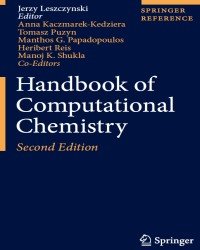
J. Leszczynski – Handbook of Computational Chemistry (2017)
2.780 ₽
Автор: J. Leszczynski
Название книги: Handbook of Computational Chemistry (2017)
Формат: PDF
Жанр: Химия
Страницы: 2365
Качество: Изначально компьютерное, E-book
The first part briefly describes different methods used in computational chemistry without going into exhaustive details of theory. Basic assumptions common to the majority of computational methods based on either quantum or statistical mechanics are outlined. Particular attention is paid to the limits of their applicability. The second part consists of a series of sections exemplifying the various, most important applications of computational chemistry. Molecular structures, modeling of various properties of molecules and chemical reactions are discussed. Both ground and excited state properties are covered in the gas phase as well as in solutions. Solid state materials and nanomaterials are described in part three. Amongst the topics covered are clusters, periodic structures, and nano-systems. Special emphasis is placed on the environmental effects of nanostructures. Part four is devoted to an important class of materials – biomolecules. It focuses on interesting models for biological systems that are studied by computational chemists. RNA, DNA, and proteins are discussed in detail. Examples are given for calculations of their properties and interactions. The role of solvents in biologically significant reactions is revealed, as well as the relationship between molecular structure and function of various classes of biomolecules. Part five features new bonus material devoted to Chemoinformatics. This area is vital for many applications of computational methods. The section includes a discussion of basic ideas such as molecular structure, molecular descriptors and chemical similarity. Additionally, QSAR techniques and screening methods are covered. Also, available open source chemoinformatics software is presented and discussed.
Preface
We are delighted to deliver a second, expanded, and brought up to date edition of
the Handbook of Computational Chemistry. It is apparent that this fast-growing
research area requires constant updates. The second edition of our book provides
the reader with current, key references to both methodologies and the results of the
computational chemistry studies. We selected various focus areas to be covered by
the handbook, and this selection is a subjective choice of the editors since due to a
vast number of studies published every year, only the most representative examples
of applications could be incorporated in the five volumes of this edition.
An amazing transformation of chemistry from an exclusively experimental science
to one with theoretical foundations started in the early twentieth century, when
principles of quantum mechanics had been established. The most notable progress
has been accomplished during the last 50 years during which time it has advanced
through noticeable developments and applications of computational methods. This
transformation has its roots in both theoretical breakthroughs (Heisenberg’s 1925
and Schrodinger’s 1926 first papers on quantum mechanics) and the development
of the first computer – Electronic Numerical Integrator and Computer (ENIAC) –
built in 1943 for the US Department of the Army. However, it took about 20 years
after the creation of the ENIAC computers to deliver computational chemistry
techniques to the scientific community. Such early methods, being semiempirical
in nature, do rely on the large number of experimental parameters. Disappointedly,
though such an approach unites experimental chemistry origins with new theoretical
approaches, it proves to produce in various cases artificial computational results, and
it also lacks reliable parameters for some elements. The next successful chapter for
computational chemistry started in the 1970s with applications of nonempirical ab
initio methods. The first ab initio computer code popular among non theoreticians
– GAUSSIAN 70 – was developed in the 1970s by John A. Pople’s group. It
initiated a computational chemistry revolution that fired up in the 1980s when
supercomputers became accessible to the general scientific community. Also during
this period, density functional theory approaches gained a prominent position
among efficient computational methods. The vital role of computational chemistry
in many research areas was convincingly acknowledged in 1998 when the chemical
and physical community celebrated the Nobel Prize that was awarded to two leading computational experts. It was not by chance that Walter Kohn and John A. Pople
were recognized by the Nobel Committee for their contributions to the development
of efficient computational methods for quantum chemistry.
Over the past years, different methods of theoretical chemistry were successfully
transformed into useful tools that could be applied in diverse areas of research,
science, and technology. Owing to the fundamental methodological developments
and continuous impressive progress in computational technologies in the last quarter
of the twentieth century, several fast and user-friendly programs were developed
and made accessible to a wide community of scientists. These near-automatic
computer codes are evidence of how methods of theoretical chemistry could be
applied as both diagnostic and predictive research tools which support efforts or
even guide the direction of traditional experimental approaches. The user-friendly
features of commercial codes combined with efficient visualization methods make
them accessible to researchers with almost no educational background. Generally,
only a limited knowledge and a little formal experience in theoretical chemistry are
required to use such programs and to obtain some numerical data. This might cause
unexpected outcomes.Most of the methods of theoretical (quantum) chemistry have
a limited range of applications, and their use by an inexperienced amateur who
performs computational studies without understanding such constraint may lead to
serious problems and mistakes.Moreover, a variety of methods of different qualities
exist, and a user without a good background in theoretical chemistry may feel lost
at the choices from usually rich menus of available programs.
The multivolume Handbook of Computational Chemistry is primarily intended
as a guide to help navigate among different computational methods currently in
use. In order to accomplish this goal, it provides a compact description of the
basis of computational chemistry along with many examples of applications of
these methods in various areas. The handbook is designed for researchers who
are just being introduced into computational methods, as well as for those who
are searching for the best choice for a solution to a specific problem involving
theoretical approaches.
The first two volumes briefly describe different methods used in computational
chemistry without going into exhaustive details of theory. Basic assumptions
common to the majority of computational methods based on either quantum or
statistical mechanics are outlined. Particular attention is paid to the limits of
their applicability. Importantly, this volume also establishes definitions of various
acronyms and terminologies used in the area of computational chemistry.
Since we assumed that the readers of this book are interested in applications
of computational methods, a broad range of the most important applications of
computational chemistry is provided. The applications include descriptions of
standard chemical calculations for model molecules under various conditions. The
handbook provides information on prediction of various molecular properties as
well as investigations of chemical reactions.
There are two classes of species, biomolecules and nanomaterials, that are of a
vital interest not only to chemists but also to physicists, biologists, and material
scientists. Two volumes are devoted to description of specific computational methods that are designed to investigate such species. Numerous examples of
applications as well as descriptions of specific research problems and their solutions
for various types of biomolecules and nanoparticles are given in volumes 3 and 4
of the handbook. The reviewed topics will attract the attention of all those who are
already working or planning to start research involving computational approaches.
The fifth volume, an entirely new addition to the second edition, is devoted to the
cheminformatics – both a description of techniques and discussion of applications.
This is an important enhancement of the current Handbook of Computational
Chemistry since the techniques of cheminformatics are vital tools of many computational
chemists, those in research laboratories and, especially, those working in
industry. Techniques developed allow storage, indexing, search, and comparing of
information on chemical compounds. Such information could be used in the wellknown
quantitative structure-property (activity) relationship (QSPR/QSAR) studies
for the prediction of specific property/activity of compounds of interest. QSAR
techniques have been successfully applied for over 50 years in the pharmaceutical
industry, and at the beginning of this century they were also adopted to investigate
properties, biological activities, and toxicity of a new, unique class of compounds –
nanomaterials.
We welcome all comments and suggestions related to the current version of the
handbook as well as recommendations for possible revisions in the future. Many of
the suggestions obtained from the readers of the first edition of the handbook have
been applied to improve the second edition, and we are grateful for all inputs and
comments. Such feedback and active participation help us to focus on areas that are
important for the majority of our readers and improve the context of the book
Описание
Handbook of Computational Chemistry (2017) — фундаментальное справочное издание, которое объединяет актуальные методы и подходы современной вычислительной химии. Книга подробно разбирает теоретические основы, алгоритмы и практическое применение квантово-химических расчётов для изучения структуры, свойств и реакционной способности молекул.
Издание охватывает широкий спектр тем: от ab initio и DFT-методов до молекулярной механики, моделирования растворов, динамики и применения машинного обучения в химических исследованиях. Каждый раздел написан ведущими специалистами в своей области, что делает handbook авторитетным источником актуальной информации.
- Химикам-теоретикам и вычислителям, ведущим научные исследования
- Студентам и аспирантам химических и физико-химических специальностей
- Специалистам в области материаловедения, фармацевтики и биохимии, использующим компьютерное моделирование
- Всем, кто хочет уверенно ориентироваться в современном инструментарии computational chemistry
Только зарегистрированные клиенты, купившие данный товар, могут публиковать отзывы.
Похожие


Другие книги раздела «Химия»
- Илья Леенсон – Язык химии. Этимология химических названий
- James R. Hanson – The Chemistry of Fungi
- Myer Kutz – Applied Plastics Engineering Handbook (2017)
- Paul B. Tomascak – Advances in Lithium Isotope Geochemistry (2016)
- Jochen Hoefs – Stable Isotope Geochemistry (7th edition, 2015)
- James A. Kent – Handbook of Industrial Chemistry and Biotechnology (2017)
- George A. Olah – Hydrocarbon Chemistry (2018)
- Elhadi M. Yahia – Fruit and Vegetable Phytochemicals (Second edition, 2018)
- Boy Cornils – Applied Homogeneous Catalysis with Organometallic Compounds
- Shu Hotta – Mathematical Physical Chemistry (2018)
- Srinivasan Damodaran – Fennema Food Chemistry (Fifth edition, 2017)
- Chang Samuel Hsu – Springer Handbook of Petroleum Technology (2017)
- Daniel Harlov – The Role of Halogens in Terrestrial and Extraterrestrial Geochemical Processes
- Sukumar Laik – Offshore Petroleum Drilling and Production (2018)
- Werner Muller-Esterl – Biochemie (3 Auflage, Немецкий язык, 2018)
- Irene Ash – Handbook of Green Chemicals
Смежные разделы: Авиация и космонавтика · Астрономия · Геология и Геодезия · Железнодорожное дело · Журналистика · Математика · Машиностроение · Нанотехнологии · Научно-популярная литература · Физика · Экология · Энергетика
Рекомендуем также
- S. Paul – Clinical Cases in Skin Cancer Surgery and Treatment (2016)
- Y. Sakai – Laparoscopic Surgery for Colorectal Cancer (2016)
- V. Stearns – Novel Biomarkers in the Continuum of Breast Cancer (2016)
- A. Mathur – Nanotechnology in Cancer (2017)
- P. Rennert – Novel Immunotherapeutic Approaches to the Treatment of Cancer
- M. Baranska – Optical Spectroscopy and Computational Methods in Biology and Medicine (2014)
- A. Bondanza – Tumor Immunology (2016)
- H. Seligmann – DNA Replication. Current Advances (2016)

Отзывы
Отзывов пока нет.