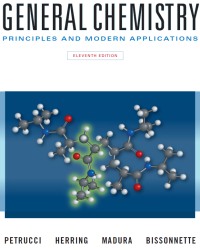
R. Petrucci – General Chemistry (11th edition, 2017)
1.380 ₽
Автор: R. Petrucci
Название книги: General Chemistry (2017)
Формат: PDF
Жанр: Химия
Страницы: 1494
Качество: Изначально компьютерное, E-book
The most trusted general chemistry text in Canada is back in a thoroughly revised 11th edition. General Chemistry: Principles and Modern Applications, is the most trusted book on the market recognized for its superior problems, lucid writing, and precision of argument and precise and detailed and treatment of the subject. The 11th edition offers enhanced hallmark features, new innovations and revised discussions that that respond to key market needs for detailed and modern treatment of organic chemistry, embracing the power of visual learning and conquering the challenges of effective problem solving and assessment.
Preface
“Know your audience.” For this new edition, we have tried to follow this important
advice by attending even more to the needs of students who are taking a serious
journey through this material. We also know that most general chemistry
students have career interests not in chemistry but in other areas such as biology,
medicine, engineering, environmental science, and agricultural sciences. And we
understand that general chemistry will be the only university or college chemistry
course for some students, and thus their only opportunity to learn some practical
applications of chemistry. We have designed this book for all these students.
Students of this text should have already studied some chemistry. But those
with no prior background and those who could use a refresher will find that the
early chapters develop fundamental concepts from the most elementary ideas.
Students who do plan to become professional chemists will also find opportunities
in the text to pursue their own special interests.
The typical student may need help identifying and applying principles and
visualizing their physical significance. The pedagogical features of this text are
designed to provide this help. At the same time, we hope the text serves to
sharpen students’ skills in problem solving and critical thinking. Thus, we have
tried to strike the proper balances between principles and applications, qualitative
and quantitative discussions, and rigor and simplification.
Throughout the text and on the MasteringChemistry® site (www.mastering
chemistry.com) we provide real-world examples to enhance the discussion.
Examples relevant to the biological sciences, engineering, and the environmental
sciences are found in numerous places. This should help to bring chemistry alive
for these students and help them understand its relevance to their career interests.
It also, in most cases, should help them master core concepts.
ORGANIZATION
In this edition we retain the core organization of the previous edition with two
notable exceptions. First, we have moved the chapter entitled Spontaneous
Change: Entropy and Gibbs Energy forward in the text. It is now Chapter 13. By
moving the introduction of entropy and Gibbs energy forward in the text, we are
able to use these concepts in subsequent chapters. Second, we have moved the
chapter on chemical kinetics to Chapter 20. Consequently, the discussion of
chemical kinetics now appears after the chapters that rely on equilibrium and
thermodynamic concepts.
Like the previous edition, this edition begins with a brief overview of core concepts
in Chapter 1. Then, we introduce atomic theory, including the periodic table,
in Chapter 2. The periodic table is an extraordinarily useful tool, and presenting it
early allows us to use the periodic table in different ways throughout the early
chapters of the text. In Chapter 3, we introduce chemical compounds and their
stoichiometry. Organic compounds are included in this presentation. The early
introduction of organic compounds allows us to use organic examples throughout
the book. Chapters 4 and 5 introduce chemical reactions. We discuss gases in
Chapter 6, partly because they are familiar to students (which helps them build
confidence), but also because some instructors prefer to cover this material early
to better integrate their lecture and lab programs. (Chapter 6 can easily be
deferred for coverage with the other states of matter, in Chapter 12.)
In Chapter 7, we introduce thermochemistry and discuss the energy changes
that accompany physical and chemical transformations. Chapter 8 introduces
quantum mechanical concepts that are needed to understand the energy changes
we encounter at the atomic level. This chapter includes a discussion of wave
mechanics, although this topic may be omitted at the instructor’s discretion.
Collectively, Chapters 8 through 11 provide the conceptual basis for describing
the electronic structure of atoms and molecules, and the physical and
chemical properties of these entities. The properties of atoms and molecules
are then used in Chapter 12 to rationalize the properties of liquids and solids.
Chapter 13 is a significant revision of Chapter 19 from the tenth edition. It
introduces the concept of entropy, the criteria for predicting the direction of
spontaneous change, and the thermodynamic equilibrium condition. In
Chapters 14–19, we apply and extend concepts introduced in Chapter 13.
However, Chapters 14–19 can be taught without explicitly covering, or referring
back to, Chapter 13.
As with previous editions, we have emphasized real-world chemistry in
the final chapters that cover descriptive chemistry (Chapters 21–24), and we
have tried to make this material easy to bring forward into earlier parts of the
text. Moreover, many topics in these chapters can be covered selectively,
without requiring the study of entire chapters. The text ends with comprehensive
chapters on nuclear chemistry (Chapter 25) and organic chemistry
(Chapters 26 and 27). Please note that an additional chapter on biochemistry
(Chapter 28) is available online.
CHANGES TO THIS EDITION
We have made the following important changes in specific chapters and
appendices:
• In Chapter 2 (Atoms and the Atomic Theory), new material is included to
describe the use of atomic mass intervals and conventional atomic
masses for elements such as H, Li, B, C, N, O, Mg, Si, S, Cl, Br, and Tl.
Atomic mass intervals are recommended by the IUPAC because the isotopic
abundances of these elements vary from one source to another, and
therefore, their atomic masses cannot be considered constants of nature.
• Chapter 4 (Chemical Reactions) includes a new section that discusses the
extent of reaction, and introduces a tabular approach for representing the
changes in amount in terms of a single variable, representing the extent
of reaction.
• In Chapter 5 (Introduction to Reactions in Aqueous Solutions), we
revised Section 5-1 to differentiate between dissociation and ionization,
and introduced a new figure to illustrate the dissociation of an ionic compound
in water.
• Chapter 6 (Gases) makes increased use of the recommended units of
pressure (e.g., Pa, kPa, and bar). Section 6-7 on the kinetic–molecular theory
has been significantly revised. For example, the subsection on
Derivation of Boyle’s Law has been simplified and now comes after the
subsections on Distribution of Molecular Speeds and The Meaning of
Temperature. Section 6-8 has also been revised so that Graham’s law is
presented first, as an empirical law, which is then justified by using the
kinetic–molecular theory.
• In Chapter 7 (Thermochemistry), we have updated the notation to ensure
that we are using, for the most part, symbols that are recommended by
the IUPAC. For example, standard enthalpies of reaction are represented
by the symbol (not ) and are expressed in kJ mol (not kJ). We
have added a molecular interpretation of specific heat capacities (in
Section 7-2) and an introduction to entropy (in Section 7-10).
• Chapter 8 (Electrons in Atoms) has been substantially rewritten to provide
a logical introduction to the ideas leading to wave mechanics.
Sections 8-2 and 8-3 of the previous edition have been combined and the material reorganized. This chapter includes a new section that focuses on
the energy level diagram and spectrum of the hydrogen atom. The section
entitled Interpreting and Representing the Orbitals of the Hydrogen
Atom has been rewritten to include a discussion of the radial functions.
A new subsection describing the conceptual model for multielectron
atoms has been added to the section entitled Multielectron Atoms. The
sections on multielectron atoms and electron configurations have been
rewritten to emphasize more explicitly that the observed ground-state
electron configuration for an atom is the one that minimizes Eatom and
that the energies of the orbitals is only one consideration. There are two
new Are You Wondering? boxes in this chapter: Is the Born interpretation
an idea we use to determine the final form of a wave function? and Are
all orbital transitions allowed in atomic absorption and emission spectra?
• In Chapter 9 (The Periodic Table and Some Atomic Properties), a number
of sections have been rewritten to emphasize the importance of effective
nuclear charge in determining atomic properties. Anew section on polarizability
has been introduced. Several new figures have been created to
illustrate the variation of effective nuclear charge and atomic properties
across a period or down a group (e.g., effective nuclear charges for the
first 36 elements; the variation of effective nuclear charge and percent
screening with atomic number; the variation of average distance from
the nucleus with atomic number; first ionization energies of the third
row p-block elements; electron affinities of some of the main group elements;
polarization of an atom; the variation of polarizability and atomic
volume with atomic number). The sections on ionization energies and
electron affinities have been significantly revised. Of particular note, we
have revised the discussion of the decrease in ionization energy that
occurs as we move from group 2 to 13 and from group 15 to 16. Our discussion
points out that various explanations have been used. The section
from the tenth edition entitled Periodic Properties of the Elements has
been deleted.
• Chapter 11 (Chemical Bonding II: Valence Bond and Molecular Orbital
Theories) has been revised to include an expanded discussion of the
redistribution of electron density that occurs during bond formation, an
improved introduction to Section 11-5 Molecular Orbital Theory, and an
improved discussion of molecular orbital theory of the CO molecule. We
have moved the section entitled Bonding in Metals online.
• Chapter 13 (Spontaneous Change: Entropy and Gibbs Energy) is a totally
revised version of Chapter 19 from the previous edition. The chapter
focuses first on Boltzmann’s view of entropy, which is based on
microstates, and then on Clausius’s view, which relates entropy change to
reversible heat transfer. The connection between microstates and particlein-
a-box model is developed to reinforce Boltzmann’s view of entropy.
Clausius’s view of entropy change is used to develop expressions for
important and commonly encountered physical changes (e.g., phase
transitions; heating or cooling at constant pressure; isothermal expansion
or compression of an ideal gas). These expressions are subsequently used
to develop the criterion for predicting the direction of spontaneous
change. The chapter includes a proper description of the difference
between the Gibbs energy change of a system, , and the reaction
Gibbs energy, . The reaction Gibbs energy ( ) is used as the basis
for describing how the Gibbs energy of a system changes with composition
(i.e., with respect to the extent of reaction). The derivation of the
equation is done in a separate section that may be used or skipped at the
instructor’s discretion. The concepts of chemical potential and activity
are also introduced
• In Chapter 14 (Solutions and Their Physical Properties), we have added a
section to describe the standard thermodynamic properties of aqueous
ions. We use the concepts of entropy and chemical potential in
Chapter 13 to explain vapor pressure lowering and why gasoline and
water don’t mix.
• Chapter 15 (Principles of Chemical Equilibrium) has been significantly
revised to emphasize the thermodynamic basis of equilibrium and to
de-emphasize aspects of kinetics. There is an increased emphasis on the
thermodynamic equilibrium constant, which is expressed in terms of
activities, along with an updated discussion of Le Châtelier’s principle to
emphasize certain limitations associated with its use (e.g., for certain
reactions and initial conditions, the addition of a reactant may actually
cause net change to the left). Several new worked examples are included
to show how equilibrium constant expressions may be simplified and
solved when the equilibrium constant is either very small or very large.
• In Chapter 16 (Acids and Bases), significant changes have been made.
Sections 16-1 through 16-3 have been significantly revised to provide a
more logical flow and to emphasize and demonstrate that the distinction
between strong and weak acids is based on the degree of ionization,
which in turn depends on the magnitude of the acid ionization constant.
There are two new sections, namely Sections 16-7 (Simultaneous or
Consecutive Acid–Base Reactions: A General Approach) and 16-9
(Qualitative Aspects of Acid–Base Reactions). Section 16-7 focuses on
writing and using material balance and charge equations. Section 16-9
focuses on predicting the equilibrium position of a general acid–base
reaction. Anew subsection entitled Rationalization of Acid Strengths: An
Alternative Approach has been added to Section 16-10, Molecular
Structure and Acid–Base Behavior. This new subsection focuses on factors
that stabilize the anion formed by an acid.
• In Chapter 19 (Electrochemistry), we have modified the Nernst equation
to have the form . We have changed the text so
that the standard hydrogen electrode is defined with respect to a pressure
of 1 bar instead of 1 atm, and added a problem to the Integrative and
Advanced Exercises to illustrate that this change in pressure causes only a
small change in the standard reduction potentials (see Exercise 108). We
have also added a section on reserve batteries.
• In Appendix D, we have modified the table of Standard Electrode
(Reduction) Potentials at 25 C so that it now includes a column with the
cell notation for the half-reactions.
In addition to the specific changes noted above, we have also changed much
of the artwork throughout the textbook. In particular, all of the atomic and
molecular orbital representations have been modified to be consistent across
all chapters. We have redone all of the electrostatic potential maps (EPMs) to
have the same potential energy color scale unless noted in the textbook
Описание
General Chemistry (11th edition, 2017) от R. Petrucci — один из самых известных и фундаментальных учебников по общей химии для студентов университетов. Книга последовательно и глубоко раскрывает базовые принципы химии: от строения атома и периодического закона до термодинамики, химической кинетики, равновесий и основ органической химии.
Авторы объясняют материал через современные научные подходы, большое количество реальных примеров, задач разного уровня сложности и иллюстраций. Особое внимание уделяется связи теории с практикой и пониманию физического смысла химических процессов.
- Студентам 1–2 курсов химических, биологических, медицинских и технических специальностей
- Преподавателям, которые ищут надёжную основу для построения курса общей химии
- Всем, кто готовится к серьёзным экзаменам по химии (в том числе международным)
- Читателям, желающим получить системные и актуальные знания по современной общей химии
Только зарегистрированные клиенты, купившие данный товар, могут публиковать отзывы.
Похожие


Другие книги раздела «Химия»
- M. Meneghini – Power GaN Devices (2017)
- O. Kolodiazhnyi – Asymmetric Synthesis in Organophosphorus Chemistry
- G. Ahluwalia – Applications of Chalcogenides. S, Se, and Te (2017)
- S. Beddar – Scintillation Dosimetry (2016)
- Z. Ficek – Quantum-Limit Spectroscopy (2017)
- B. Fegley – Practical Chemical Thermodynamics for Geoscientists (2013)
- V. Patel – Chemical Kinetics (2015)
- W. Grellmann – Polymer Testing (2nd edition, 2014)
- W. Chin – Quantitative Methods in Reservoir Engineering (2017)
- D. Wang – Flotation Reagents. Applied Surface Chemistry (2 Volume set, 2016)
- G. Bergamini – Applied Photochemistry (2016)
- G. Mitchell – Controlling the Morphology of Polymers (2016)
- A. Correa – Ni- and Fe-Based Cross-Coupling Reactions (2017)
- G. Ouyang – Solid Phase Microextraction (2017)
- J. Kim – Multicomponent Polymeric Materials (2016)
- M. Doi – Computer Simulation of Polymeric Materials (2016)
Смежные разделы: Авиация и космонавтика · Астрономия · Геология и Геодезия · Железнодорожное дело · Журналистика · Математика · Машиностроение · Нанотехнологии · Научно-популярная литература · Физика · Экология · Энергетика
Рекомендуем также
- Robert Langdon – Understanding Cosmetic Laser Surgery
- Dieter Schmidt – Tipps und Tricks fur den Augenarzt (Немецкий язык)
- E. Miserocchi – New Treatments in Noninfectious Uveitis
- Gregg T. Lueder – Pediatric Practice Ophthalmology
- H. Spinelli – Atlas of Aesthetic Eyelid and Periocular Surgery
- Ingrid U. Scott – Diabetes and Ocular Disease (2nd edition)
- Maite Sainz de la Maza – The Sclera (Second edition)
- R. Guthoff – Atlas of Confocal Laser Scanning In-vivo Microscopy in Opthalmology
Отзывы
Отзывов пока нет.