50% Off
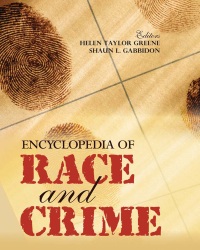
Helen Taylor Greene – Encyclopedia of Race and Crime
Первоначальная цена составляла 3.750 ₽.1.875 ₽Текущая цена: 1.875 ₽.
Автор: Helen Taylor Greene
Название книги: Encyclopedia of Race and Crime
Формат: PDF
Жанр: Политология и Социология
Страницы: 1009
Качество: Изначально компьютерное, E-book
“The organization of the reader's guide―especially the groupings of landmark cases, race riots, and criminology theories―is impressive … Other related titles lack the breadth, detail, and accessibility of this work … Recommended for all libraries; essential for comprehensive social studies collections.”
―Library Journal
As seen almost daily on local and national news, race historically and presently figures prominently in crime and justice reporting within the United States, in the areas of hate crimes, racial profiling, sentencing disparities, wrongful convictions, felon disenfranchisement, political prisoners, juveniles and the death penalty, and culturally specific delinquency prevention programs.
The Encyclopedia of Race and Crime covers issues in both historical and contemporary context, with information on race and ethnicity and their impact on crime and the administration of justice. These two volumes offer a greater appreciation for the similar historical experiences of varied racial and ethnic groups and illustrate how race and ethnicity has mattered and continues to matter in the administration of American criminal justice.
Key Features
Covers a number of broad thematic areas: basic concepts and theories of criminal justice; the police, courts, and corrections; juvenile justice; public policy; the media; organizations; specific groups and populations; and specific cases and biographies
Addresses such topics as gender, hate/bias crimes, immigrant experiences, international and cross-cultural issues, race and gangs, and race and law,
Presents experiences of all major racial and ethnic groups in the U.S., including Asians, Blacks, Latinos, Native Americans, and Ethnic Whites, as well as religious minorities, such as Muslims
Includes coverage of recent incidents like the alleged rape of a black female North Carolina Central University student by white male members of the Duke University Lacrosse Team;, the Jena 6 incident; the Tulia, Texas drug arrests; the Rodney King beating; the O. J. Simpson trials in the 1990s; and more recent racial profiling incidents
Two appendices provide information on locating and interpreting statistical data on race and crime, as well as detailed instructions on how to access statistical data on the web for such specific areas as arrests, drugs, gang membership, hate crimes, homicide trends, juvenile justice, prison populations, racial profiling, the death penalty, and victimization
Criminology and criminal justice involve the scientific
study of crime, criminals, and the criminal
justice system. Interest in the problem of crime
began centuries ago, and in the 18th century,
after several European countries experienced
social unrest, writings about crime began to
appear. During the 19th century, social scientists
studied social problems, including crime and
responses to it. Interest in criminology in the
United States began in the late 19th century and
flourished in the 20th century. Initially there
were two major areas in the study of criminology:
theoretical and applied criminology.
Theoretical criminology included the etiology of
crime, theories of criminality, typologies of crime
and criminals, and the extent of crime. Applied
criminology included the study of justice agencies
and processes, often referred to as criminal justice,
as well as the law. Today, the terms criminology
and criminal justice are often used
interchangeably, and the dichotomy between the
two is less clear. For example, some of the subject
matter in many criminology and criminal justice
textbooks often overlaps although the original
foci of each remain.
During the late 20th and early 21st centuries,
the field of criminology has grown nationally and
internationally. Today there are hundreds of
undergraduate and graduate programs in the
United States. Criminology is an interdisciplinary
field of study with contributions to the body of
knowledge by economists, historians, political
scientists, psychologists, sociologists, and other
scholars. The study of criminology and criminal
justice has expanded considerably and includes
administration of justice, comparative studies,
convict criminology, critical analyses, feminist
criminology, prisoner reentry, homeland security,
juvenile justice, policy analyses, race and crime,
and terrorism.
Rationale for the Encyclopedia
The study of race and crime has a long history in
the discipline of criminology and the study of
criminal justice. In the 19th century Cesare
Lombroso, an Italian positivist considered by
many to be the father of criminology, suggested
that crime was a product of biological factors,
including race (Lombroso, 1876/1911). In the early
20th century, some American scholars, including
Kellor (1901), Du Bois (1904), Work (1913),
Sellin (1928), Moses (1936), Shaw and McKay
(1942), and Frazier (1949), countered the biological
perspective by noting how social, economic,
and political conditions contribute to crime,
regardless of race. Early criminology texts devoted
whole chapters to race and crime that not only
presented crime figures but also sought to explain
the trends related to race and crime (Gabbidon &
Greene, 2001). At that time, race was a much
broader concept that focused on minorities, especially
Blacks, and took into consideration the
ethnicity of White immigrants. Even so, there was
not a significant emphasis on the topic (Bonger,
1943/1969) until the last quarter of the 20th century,
when race and crime became a recognized
specialty area of study within the field (Gabbidon,
2007; Gabbidon & Greene, 2009; Walker, Spohn,
& DeLone, 2007). In fact, many criminology and
criminal justice programs now either require or
offer a course on race and crime as an elective.
Race has historically featured, and continues to
feature, prominently in reporting on crime and
justice
within the United States. Incidents like the
alleged rape of a Black female North Carolina Central University student by (White male) members
of the Duke University Lacrosse Team in
Durham, North Carolina; the Jena 6 incident in
Jena, Louisiana; the Tulia, Texas, drug arrests; the
Rodney King beating; the O. J. Simpson trials in the
1990s and in 2008; and more recent racial profiling
incidents remind us of the race and crime nexus.
These historical and contemporary issues signaled
the need for a comprehensive compilation of
relevant facts and information on topics related to
race and crime and the crime and justice experiences
of racial/ethnic groups in the United States.
Also needed was an alternative source of information
other than the media that can better explain
and objectively analyze complex issues related to
race and crime.
The encyclopedia is designed to provide reference
material and an introduction to historical
and contemporary race and crime topics. It supports
study, research, and instruction by presenting
brief overviews and references to more in-depth
presentations in other published sources. This volume
will give undergraduate and graduate students,
laypersons, professionals, researchers, and
scholars access to information on race and crime
topics that heretofore has been difficult to find in
one place. Such a volume will provide users with
state-of-the-art knowledge on the topic.
Content and Organization
The encyclopedia includes entries related to race
and crime that are organized in the Reader’s Guide
as follows:
Biographies
Cases
Concepts and Theories
Corrections
Courts
Drugs
Juvenile Justice
Media
Organizations
Police
Public Policy
Race Riots
Specific Populations
Violence and Crime
Each entry includes a definition of the term and
explains how it is related to race and crime. The
entries also provide cross-references to other
entries that likely provide additional information
on the topic. Each entry closes with a Further
Readings section that provides references to additional
scholarly sources on the topic.
It should be noted that the encyclopedia uses a
variety of terms to describe racial and ethnic
minorities. For example, it is well established that
the term race refers to the classification of distinctive
groups. In the United States, the major racial
groups are Whites (also referred to as Caucasians),
African Americans (also referred to as Blacks),
Native Americans (also referred to as American
Indians), and Asian Americans. The term ethnicity
refers to ethnic groups that are believed to be identifiable
less by race and more by culture and place
of origin. For example, the largest ethnic group in
America is Latinos (also referred to as Hispanics).
Latinos come from the Caribbean and Latin
American countries. Arab Americans represent
another ethnic group that is well established in the
United States.
We have followed the American Psychological
Association’s policy of capitalizing the terms Black
and White when used to refer to race/ethnicity. We
have used the term Latina/o/s as the plural form in
entry titles; however, in the text of entries themselves,
we have used the shorter form Latinos for
typographical simplicity.
It is important to pause here to remind readers
that both race and ethnicity are social constructs
or terms that were created to note the
differences among human groups. At the moment,
scientists have found that all racial and ethnic
groups have the same general biological makeup,
with only 1% variation among groups. As such,
the classification of humans based on race and
ethnicity is severely flawed. For example, how
would we classify a naturalized citizen who
immigrated to the United States from another
country? Should we classify him or her as African
American just because his or her skin is black? By doing so, we would not be adequately
accounting for his or her unique experience. The
point here is that not only the classification but
also the perceptions that attach to the classifications
are problematic. Therefore, someone darkskinned
from Africa might evoke a different
response from someone dark-skinned from India.
Why? Because even a social construct has the
power to influence the way people are perceived.
In sum, although this encyclopedia uses these
terms, readers should consider the limitations
and dangers of doing so.
Appendixes: Statistics on Race and Crime
Many of the entries in the encyclopedia include
statistical data on race and crime. We have
included two appendixes to help readers locate
and understand this information.
Locating and Interpreting Statistical
Data on Race and Crime
Two programs administered by the U.S.
Department of Justice are the major sources of
federal data on crime, including statistical data
by racial/ethnic groups: the Uniform Crime
Reporting (UCR) Program and the National
Crime Victimization Survey (NCVS). Because the
UCR and NCVS programs are conducted for different
purposes, use different methods, and focus
on somewhat different aspects of crime, the
information they produce together provides a
more comprehensive panorama of the nation’s
crime problem than either could produce alone.
Appendix A provides a brief history and overview
of these programs and describes the kind of
information available on race and crime.
Websites With Data on Race and Crime
Appendix B contains URLs and detailed instructions
on accessing statistical data from both governmental
sources and various nongovernmental
organizations. Users of the electronic version of
the encyclopedia will be able to click on these
links to go directly to the relevant websites in
order to obtain the most recent data available
online. This information will enable readers to
explore and evaluate empirical evidence on a variety
of topics related to race and crime, including
the following:
Arrests
Contacts between police and the public
Death penalty
Drugs and crime
Gang membership
Hate crimes
Homicide trends in the United States
Juvenile justice
Prison populations
Racial profiling
Victimization
How the Encyclopedia Was Created
Creation of the encyclopedia involved several stages,
including identifying topics, choosing headwords/
entries, recruiting authors, and reviewing and editing.
The preliminary list of headwords was developed
by the volume editors with the assistance of
Diana Axelsen, the developmental editor. Review
Board members were asked to review the initial list
and make revisions and suggestions via e-mail and at
a meeting with the editors at the 2006 annual
meeting of the American Society of Criminology.
Additional headwords were suggested by contributors
and as a result of emerging issues like the Jena 6
and the Supreme Court’s ruling in Kennedy v.
Louisiana.
The methods used for identifying authors
included requests for contributors sent to listservs
for the Division of People of Color and Crime and
the Division of Women and Crime of the American
Society of Criminology, the Minorities and Women’s
Section, regional organizations of the Academy of
Criminal Justice Sciences, and the Association of
Doctoral Programs in Criminology and Criminal
Justice. Review Board members were also asked to
identify contributors and to distribute information
about the encyclopedia at their institution and
among their colleagues elsewhere. The 2007
Directory of Minority Criminologists was also a
valuable resource for identifying contributors.
Contributors also were identified during attendance
at the annual meetings of the American
Society of Criminology and the Academy of
Criminal Justice Sciences and by perusing the conference
programs.
Reviewing and editing of the entries began with
assigning a reviewer to read, edit, and provide feedback to the author of each entry. Entries were
assigned to editors and Editorial Board members
according to their expertise in criminology and
criminal justice. After the initial review and editing,
the entry was processed through Sage’s developmental
editor.
Acknowledgments
The authors would like to thank the Review Board
members, Marvin D. Free, Delores Jones-Brown,
Ramiro Martinez, Jr., Everette B. Penn, and Vernetta
D. Young, for their assistance in both locating and
reviewing entries. Countless members of the
American Society of Criminology, the Academy of
Criminal Justice Sciences, and the Association of
Doctoral Programs in Criminology and Criminal
Justice were also instrumental in helping us secure
the contributors. We are especially thankful for
Hillary Potter (DPCC Listserv) and Lorenzo Boyd
(Minorities and Women Listserv) for repeatedly
posting our messages concerning the encyclopedia.
Many of our colleagues coauthored entries with
graduate students, providing those students with
an opportunity to experience both research and
publishing. We especially thank Everette Penn and
Zina McGee for working with so many of their
graduate students on several entries. Elycia Daniel,
our managing editor, is thanked for helping us to
manage numerous tasks that the project entailed.
Of course, we are grateful for the knowledgeable
contributors who took time away from their busy
academic (and personal) lives to write entries. We
have learned so much from your work!
At Sage, we want to thank Jerry Westby for suggesting
that we consider doing an encyclopedia on
race and crime. Jerry put us in touch with Jim
Brace-Thompson, who was supportive of the project
from the beginning. Along the way, his continued
positive encouragement kept us going. We also
thank Laura Notton and Leticia Gutierrez for their
technical assistance. A special acknowledgment is
reserved for Diana Axelsen, for her invaluable
assistance and for keeping us motivated to complete
the final stages of the project. Thanks, Diana!
Helen would like to thank her family and colleagues
for inspiration during this project. I also
thank Ms. Monica Freelon, Ms. Crystal Hadnott,
and Ms. Lakesha Jones for their assistance. I am
grateful for the privilege and experience of working
with Dr. Gabbidon on this project.
Shaun would like to thank his family for putting
up with him at the computer for long hours
working on another book project! I also thank
Dr. Greene for her leadership on this project.
There is no doubt in my mind that this project
would not have been completed without her devotion.
Thanks, Helen! At Penn State Harrisburg, I
continue to be grateful for the outstanding research
support. I thank my graduate assistant Ms. Lisa
Kim for her assistance with the appendixes.
Helen Taylor Greene and Shaun L. Gabbidon
Описание
Encyclopedia of Race and Crime — фундаментальный справочник, подготовленный Helen Taylor Greene, который исследует сложные пересечения расовых вопросов и криминальной юстиции в США. Книга объединяет статьи ведущих экспертов, освещая исторический контекст, статистику, теории и актуальные проблемы, с которыми сталкиваются представители разных расовых групп в системе правопорядка.
Издание подробно рассматривает такие темы, как расовое профилирование, дискриминация в полиции и судах, влияние сегрегации на преступность, смертную казнь, иммиграцию, а также роль СМИ в формировании стереотипов. Особое внимание уделяется как академическим теориям, так и реальным кейсам и политике.
- студентам и преподавателям социологии, криминологии и политологии
- специалистам по уголовному праву и правозащитникам
- исследователям, интересующимся вопросами расы, неравенства и социальной справедливости
- всем, кто хочет глубже понять механизмы системного расизма в американской системе уголовного правосудия
Только зарегистрированные клиенты, купившие данный товар, могут публиковать отзывы.
Похожие


Другие книги раздела «Политология и Социология»
- G. Albrecht – Encyclopedia of Disability
- H. Henderson – Holidays, Festivals, and Celebrations of the World
- J. Forest – Countering Terrorism and Insurgency in the 21st Century
- Joseph de Rivera – Handbook on Building Cultures of Peace
- Karen Greenberg – The Torture Papers. The Road to Abu Ghraib
- Loren Brandt – China’s Great Economic Transformation
- M. Stuart Madden – Exploring Tort Law
- M. Zander – Cases and Materials on the English Legal System
- Michael O’Neill – The Struggle for the European Constitution
- N. Jackson – Encyclopedia of Domestic Violence
- Peter Calvert – A Political and Economic Dictionary of Latin America
- R. Carson-DeWitt – Drugs, Alcohol, and Tobacco. Learning About Addictive Behavior
- L. Given – The Sage Encyclopedia of Qualitative Research Methods
- L. R. Martin – The Oxford Handbook of Health Communication Behavior Change
- Marjorie Taylor – The Oxford Handbook of the Development of Imagination
- P. Peterson – International Encyclopedia of Education (8 Volume Set, 3rd edition)
Все книги раздела «Политология и Социология» →
Смежные разделы: Бизнес-Книги · Биография · Боевики и Триллеры · Детективы · Детские книги · Школа · Дом и Семья · Здоровье · Искусство · Историческая проза · Классика · Компьютеры
Рекомендуем также
- Y. Pathak – Nano-Biomaterials For Ophthalmic Drug Delivery (2016)
- V. Aspinall – Introduction to Veterinary Anatomy and Physiology Textbook (2015)
- S. Standring – Grays Anatomy. The Anatomical Basis of Clinical Practice (41st edition, 2016)
- K. Sasaki – Hydrogen Energy Engineering (2016)
- M. Abo – Rehabilitation with rTMS (2015)
- C. Marcucci – A Case Approach to Perioperative Drug-Drug Interactions (2015)
- H. Lapp – The Cardiac Catheter Book Diagnostic and Interventional Techniques (2014)
- J. Anthony – Cardiac Drugs in Pregnancy (2014)
Отзывы
Отзывов пока нет.