
50% Off 
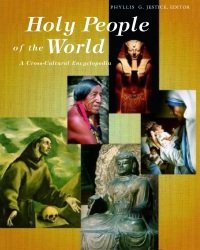
Phyllis G. Jestice – Holy People of the World. A Cross-Cultural Encyclopedia
Первоначальная цена составляла 3.760 ₽.1.880 ₽Текущая цена: 1.880 ₽.
Автор: Phyllis G. Jestice
Название книги: Holy People of the World. A Cross-Cultural Encyclopedia
Формат: PDF
Жанр: Политология и Социология
Страницы: 1047
Качество: Изначально компьютерное, E-book
A cross-cultural encyclopedia of the most significant holy people in history, examining why people in a wide range of religious traditions throughout the world have been regarded as divinely inspired.
• Approximately 1,200 entries including biographical sketches of holy men and women, plus 20 overview articles and 64 comparative essays
• 270 contributors include scholars from 20 countries―all leading authorities on the individuals and religions they write about
• Hundreds of historical photographs, illustrations, and paintings depicting holy men and women
• End-of entry bibliographic citations to guide readers to further sources on each topic
• Exhaustive subject index
• Rich cross-referencing structure that aids navigation among related entries
This encyclopedia gathers in a single reference work scattered
information about founders, leaders, heroes, shamans,
holy people, and many other figures venerated or honored in
indigenous traditions and imported religions throughout
the world. People with access to the supernatural in African
and Native American religious practices are cross-referenced
with articles about their counterparts in Buddhism,
Judaism, Confucianism, Shinto, Islam, Baha’i, Jainism, Hinduism,
the Sikh faith, and Christianity.
In English, individuals intimate with the divine are called
holy. The word is distinguished from sacred, and the distinction
is an important one. Originally a past participle of a
now-archaic verb, sacren, meaning to consecrate, sacred may
be used to describe human veneration; whereas holy often
refers to an object or a person hallowed by God. A pious
Christian refers to the “sacred books of the East,” and calls
the Bible holy.
Holiness is often linked to death.A Christian martyr who
conquers death reenacts Christ’s paradoxical victory on the
cross in anticipation of a bodily resurrection: “O, death,
where is thy sting? O, grave, where is thy victory?” (1
Cor.15:56). Neither the historical Buddha nor Muhammad
was a martyr. But the Buddha, like Christ, overcame death.
This was not the case for Muhammad; and relic cults had
only a minor importance in Sunni Islam—the sanctity ascribed
to sufi graves is an exception. Each world religion has
a unique attitude toward the body; and in every case the
founder defined the body’s relation to holiness.
The case of Gautama, the historic Buddha (543–586
B.C.E.), is instructive. He left no writings and his teachings
were not written down until near the turn of the millennium.
Yet his authority was so great that works attributed to
him have been composed in many languages and in many
lands over many centuries. The distribution of Gautama’s
bodily remains at his death set the stage for early Buddhist
relic worship. By the third century B.C.E. the Mauryan emperor
Ashoka built hundreds, perhaps thousands of stupas
(burial mounds) containing the Buddha’s relics.Pilgrims believed
that veneration caused the Buddha’s remains to multiply,
while a decline of pilgrims would lead his relics to
shrink and gradually disappear.Worship animates the holy
person’s remains. Miracle stories describe the Buddha’s past
activities.And arrival of pilgrims at shrines locates these supernatural
events in the present, where they can aid the personal
faith of the worshipper.
Thus the “life” instantiated by the faithful has both a collective
and an individual orientation: one, turned toward the
past, seeks the welfare of departed souls; the other looks forward
to the devotee’s own postmortem deliverance. Reciprocity
also governs relations with the personage entombed
at the shrine. Even in folk Daoism a god’s powers (his ling)
lies with patronage—a forgotten god is a disempowered
deity. Only pilgrims can instantiate the sanctity ascribed to
the deceased—for, as we saw,without pilgrims the Buddha’s
relics shrink and disappear.Moreover, ritual devotion makes
the entombed personage an intermediary. In sum, a multitude
of reliquary shrines unites living and departed souls
into a community that persists throughout time.
In Ashoka’s reign pilgrimage sanctified the rise of voluntary
associations, a movement directly opposed to the Vedic
enumeration of priestly, ruling, mercantile, and servant
castes. Yet Buddhists accepted, in modified form, the Vedic
doctrine of karma, a system of rewards and punishments attached
to one’s actions over several lifetimes. Buddhists see
redemption as a release (moksha) from reincarnation. In
contrast, Christians believe God himself lived out a human
life in Jesus of Nazareth.The Hebrew Bible says,“God created
[both male and female] in his own image” (Gen. 1: 27). The
imagehood of God in the human being, as described in Genesis,
however, offers no theological message. God’s incarnation
in Jesus, does, however, equate redemption with a bodily
resurrection
This belief distinguishes Christians from Buddhists.Buddhists
developed a generic view of the body.A doctrinal belief
in the three bodies of the Buddha (the Trikaya), however,
cannot be equated with the Christian Trinity. Buddhists saw
life as an event in a beginningless cycle of birth, death, and
rebirth, composed of the realms of gods, demigods, humans,
animals, ghosts, and hell beings. This panoramic view of the
body was also expressed in sacred writings called “dharma
relics”—alphabetical formulae with no lexical meaning
(called mantras and dharani) and sutras—that were inserted
in stupas and sacred images with the dissemination
of scripture throughout Asia from about 100 B.C.E.to 100
C.E.To help their practitioners escape reincarnation Buddhists
abolished sacrifice and made desire the source of
karmic consequences. Since desire is common to all living
beings it is a faculty consistent with a generic view of the
human body. And dharma relics, especially mantras, offer a
language free of desire. They are written words representing
sacred sounds which, having no lexical meaning, are often
understood to be the literal words or sounds of the Buddha.
Mantras—originally sung in Vedic religion to invoke the
gods during sacrificial rituals—not only were inserted,
sometimes along with sutras, in stupas and images, but
these formulae were also chanted in tantric rituals throughout
Asia. They acted in the place of the Buddha’s bodily
relics. Incantations such as OM MANI PADME HUM (an invocation
of the bodhisattva Avalokitesvera) express on the
popular plane the Buddhist ideal of holiness or nirvana (a
“blowing out”). The sanctity ascribed to writings without
lexical meaning was thought to be indescribable in the same
sense that cessation of craving is indescribable. Dharma
relics preserved essential aspects of Indian oral traditions at
a time when vast collections of Buddhist scriptures were disseminated
throughout Asia.
Kings,monks, wandering holy people, and itinerant merchants
were major figures in the rise of Buddhism and Christianity.
They all contributed, albeit in different ways, to transform
the sanctified, the memorialized, and the despised or
forgotten dead into figures with distinctive cultural traits.
To some extent there was a comparable process in
Islam, but cultural fusion was more difficult to attain.
Conflicting teachings and dissimilar, often incompatible,
burial practices contributed to the rise of Islam in the first
half of the seventh century. A century after Muhammad
(570–632) died, Islam had reached the Atlantic in one direction
and the borders of China in the other. It now
counts about a billion adherents, with followers in most
countries of the world. Islam’s diffusion is often likened to
a flow of water over ground in the sense that the cult tends
to take on the ideological hues of the regions of the earth
it flows over.
Mortuary practices varied locally and to some extent
even the afterlife escaped a uniform definition. Perhaps as a
result, Sunni orthodox theology has always been rather wary
of the tombs of holy people.As mentioned earlier, Islamic religious
experience largely came out of conflict with other
monotheistic religions, and this fact is linked to the relative
paucity of relic cults.Another contributing factor to the slow
development of saints’ shrines in Islam is the lack of a clear
distinction between spiritual and temporal realms. Like
other cults with ambivalent relations to the dead, Islamic
culture is also obsessed with purity.All creatures and things
are perceived to be inherently pure or polluted.
In short, different religions have developed varying attitudes
toward the remains of the holy dead, attitudes that
both reflect and help shape worshippers’ attitudes toward
themselves, their communities, and the divine. Even religious
expressions that initially rejected the whole notion of
a relic cult have often accepted key elements of a cult of
“holy people,” especially at the level of popular religion.
Around the world, different religions’ positions on holy
people have influenced each other, as people across the face
of the earth have tried to make sense of their purpose in
the universe.
Lionel Rothkrug
Holy People of the World: A Cross-Cultural Encyclopedia focuses
on the relationship between humans and the divine in
the world religious traditions. Its particular theme is that
most effective intermediary between heaven and earth: the
holy human being who has a foot in both realms. It is intended
as a contribution to the study of comparative religion,
seeking to understand both diversity and similarities
in world religions through this aspect of popular religion.
The encyclopedia is largely biographical in format and comprises
1,183 entries; more than 1,000 of these are biographies
of holy people from around the world—well known
and obscure, representatives of many religions, and from all
periods from which traditions of holy people survive. A concise
selection of articles treats specific types of holy people
(for example, Bhakti saints and Imams). In addition, there
are major articles on attitudes toward holy people in many
religions, ranging from the cult of saints in Christianity to
the less familiar role of holy people in African and
Amerindian traditions. In an effort to consider some of the
common themes of holy people around the world, there are
also 64 comparative articles on such issues as miracles, purity
and pollution, and sexuality and holy people.
But what is a “holy person”? This encyclopedia has employed
a broad definition, seeking to explore the variety of
religious experience without privileging the Roman Catholic
traditional definition of a “saint.” Even the term “saint” has
been avoided except in the case of Christianity, lest the
reader be drawn into preconceptions that do not necessarily
fit other religious traditions. Instead the encyclopedia examines
“holy people”—human beings who have been regarded
as efficacious contacts to the holy, who because of a special
sense of “otherness” have been held up as objects of veneration
as well as paradigms for human behavior.The role of the
holy person depends on personal charisma, rather than ecclesiastical
office, and exists either in the mainstream or on
the margin of most world religions.
What this encyclopedia offers is very much a sampler
pack of holy folk from around the world. Adequate biographies
of Muslim holy people alone could easily fill many volumes;
a compilation of all significant holy people of the
world would fill a library rather than a three-volume encyclopedia.
Therefore we have attempted to be representative
rather than comprehensive. The holy people chosen for inclusion
are intended to show major trends in attitudes about
the human being as a bridge to God, the gods, the forces of
heaven—however the divine or supra-human is defined in a
given religion. The advisory board members, experts in the
various religious traditions, were asked to suggest a variety
of holy people over a wide range of time, in the hope that
various “fashions” in holiness would emerge by looking at a
broad chronological sweep.We also did our best to allow for
the large regional variations of any religion that has moved
into a variety of cultural contexts, for example including
Muslim holy people not just from the traditional Islamic
lands but from India, Africa, and America. The women and
men included in this encyclopedia are founders of religions,
mystics, healers, sages, reformers, and teachers.
Coverage is uneven, because in the final analysis this
project is only a single step in scholarly understanding of the
phenomenon of holy people especially as an expression of
popular religious belief and practice. In some religious traditions,
holy people have been studied for generations and
play a central role—in traditional European Christianity, for
example, scholarly studies of saints began in the seventeenth
century, and the official hierarchy of the church fully embraced
the idea of a “communion of saints” as a valued element
of religiosity by the second century C.E. It is only much
more recently, though, that Protestant Christians have begun
to escape the Reformation polemical line that insists that
there are no special mediators between God and humans except
Jesus and to acknowledge the charismatic role of great
churchmen and -women as spiritual guides, even if they are not intercessors in a conventional Roman Catholic sense.
Similarly, Judaism has tended to downplay the role of the individual
charismatic holy person, some scholars of Judaism
even arguing that there are no holy people in the religion.
In other religions, the issue of the holy person has as yet
won little study. Sunni Islam has tended to be suspicious of a
privileged role of holy people, as a result of which there have
been many fewer studies than of a comparable phenomenon
in Christianity. The study of popular Buddhism can fairly be
said to be in its infancy, again creating what is probably a
skewed picture of Buddhist holy people. Buddhist scholars
are better covered in this work than more popular sorts of
holy people, not necessarily because the latter were rare but
because a body of specialized studies has not yet been produced
that could underpin their appearance in a reference
work. Recent studies of African holy people show enormous
promise of providing a wider definition of the holy person,
both in the universal religions of Islam and Christianity and
in the indigenous religions,whose details are only beginning
to come into focus. A project like the present one, undertaken
in the year 2020, would probably be very different because
of advances in scholarship in many traditionally understudied
fields.
In part, this encyclopedia’s contents were also determined
by the current composition of religion and history departments
at universities around the world.There are many people
ready and willing to write about fifteenth-century Christian
female mystics—many fewer have studied indigenous
African religions, or have been willing to explore the issue of
holy people in Judaism. Similarly, the editor had twenty-one
offers from scholars of ancient philosophy who all wanted to
write the article on Plotinus, but finding anyone to write articles
on ancient Mediterranean hero cults was much more
complicated and at times impossible.A particular challenge
was finding Islamic scholars able to commit the time to providing
articles because of the disruption to many of their
lives and many new calls on their time in the wake of the
World Trade Center attack.
This encyclopedia was the product of many hands and
minds. First thanks are of course due to the busy scholars
who nevertheless agreed to serve as members of the advisory
board, providing lists of holy people to be included,
coming up with lists of possible authors, and acting as a resource
in everything from how to alphabetize Islamic entries
to obscure questions of Aztec god-kings. Two hundred
and sixty-nine people from over twenty countries wrote articles,
some of them providing whole collections of beautifully
crafted articles on holy people in their field of expertise.
The recruiting process was long and difficult, and would
have been impossible had it not been for so many scholars
who were generous in opening their own professional contacts
to my importunities, whether the referrals were to
friends and students or to whole internet discussion lists on
religious topics (among whom the H-Buddhism list is
surely outstanding in courtesy, kindness, and helpfulness).
The ABC-CLIO editorial staff has been consistently helpful
and patient with the many delays that seem inevitable in a
project of this magnitude, especially Karna Hughes and
Martha Whitt. Copyeditor Kathy Streckfus did her uttermost
to impose consistency in the face of great diversity.
Thanks are also due to Lionel Rothkrug and David Bundy,
whose idea this encyclopedia was in the first place. These
volumes are dedicated to my colleagues in the History Department
at the University of Southern Mississippi, who
have made me so welcome and have provided a refuge in an
often chaotic world.
Phyllis G. Jestice
Associate Professor
University of Southern Mississippi
On the feast day of St. Boniface
Описание
Holy People of the World. A Cross-Cultural Encyclopedia Филлис Джестис — это уникальное справочное издание, которое представляет собой первое в своём роде глобальное исследование феномена святости. Книга рассматривает, как разные культуры и религии определяют, кто такой «святой человек», и какие черты, практики и роли приписывают таким личностям.
Энциклопедия охватывает более 1000 персоналий и понятий из всех основных религиозных традиций мира — от христианских святых и буддийских бодхисаттв до шаманов, суфийских мистиков, африканских целителей и современных харизматических лидеров. Авторы анализируют общие модели и культурные различия в восприятии святости, роли посредников между человеком и божественным, а также влияние святых людей на общество, политику и культуру.
- исследователям религии, антропологам и социологам, изучающим феномен святости;
- студентам и преподавателям религиоведения, теологии и культурной антропологии;
- читателям, интересующимся мировыми религиями и духовными практиками в сравнительной перспективе;
- специалистам по межкультурному диалогу и истории идей.
Только зарегистрированные клиенты, купившие данный товар, могут публиковать отзывы.
Похожие


Другие книги раздела «Политология и Социология»
- Б. Исаев – Введение в политическую теорию (2013)
- В. Жуков – Политология. Учебник (2015)
- Мойзес Наим – Конец власти (2016)
- Тим Вейнер – ФБР. Правдивая история
- А. Медушевский – Социология права (2015)
- Роберт Блэквилл – Война иными средствами (2017)
- Андрей Медушевский – Политические сочинения
- Б. Сташкiв – Право соцiального забезпечення (2018)
- Nicola Doring – Forschungsmethoden und Evaluation in den Sozial- und Humanwissenschaften (Немецкий язык)
- Paul Bernhard Hill – Handbuch Familiensoziologie (Немецкий язык)
- Ali Farazmand – Global Encyclopedia of Public Administration, Public Policy, and Governance (2018)
- Владимир Жириновский – Избранное (3 Тома)
- Морис Дюверже – Политические партии (5 Издание, 2020)
- Илья Земцов – Советский политический язык
- Лев Гудков – Возвратный тоталитаризм
Все книги раздела «Политология и Социология» →
Смежные разделы: Бизнес-Книги · Биография · Боевики и Триллеры · Детективы · Детские книги · Школа · Дом и Семья · Здоровье · Искусство · Историческая проза · Классика · Компьютеры
Рекомендуем также
- K. Kabashima – Immunology of the Skin (2016)
- J. Lioy – Disorders of the Neonatal Airway (2015)
- K. Barrett – Ganong Fisiologia Medica (24 edicion, Испанский язык, 2013)
- J. Eickhoff – The FLP Microsatellite Platform (2016)
- О. Бакланов – Космос-Моя Судьба. Записки из Матросской тишины (2 Тома)
- M. Khan – Cardiac Drug Therapy (2015)
- Stefania Bonura – Le 101 Donne Piu Malvagie Della Storia (Итальянский язык)
- К. Королев – Скандинавская мифология. Энциклопедия

Отзывы
Отзывов пока нет.