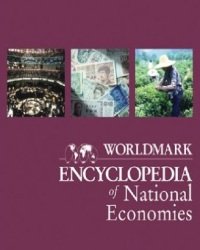
Tom Pendergast — WorldMark Encyclopedia of National Economies (4 Volumes, 2002)
984 ₽
Автор: Tom Pendergast
Название книги: WorldMark Encyclopedia of National Economies (4 Volumes)
Формат: PDF
Жанр: Политология и Социология
Страницы: 2335
Качество: Изначально компьютерное, E-book
«Worldmark Encyclopedia of National Economies provides students and business leaders with a thorough understanding of the current and historical economic development of approximately 200 foreign nations. Clearly arranged by country within broad geographic regions, the «Worldmark Encyclopedia of National Economies provides accurate, in-depth analysis of each country's economic environment, reliable statistics on the country's current economic conditions and trends and key demographics of the nation's citizens.
THE POWER OF ECONOMIC
UNDERSTANDING
The economies of the world are becoming increasingly
interconnected and interdependent, a fact dramatically
illustrated on 2 July 1997 when the Thai government
decided to allow its currency to “float” according
to market conditions. The result was a significant drop
in the value of the currency and the start of the Asian
economic crisis, a contagion that spread quickly to other
Asian countries such as the Republic of Korea, Indonesia,
Malaysia, and the Philippines. Before long the epidemic
reached Brazil and Russia.
In this way, a small economic change in one lessdeveloped
country sent economic shock waves around
the world. Surprisingly, no one predicted this crisis,
though economist Paul Krugman in a prominent 1994
Foreign Affairs article argued that there was no Asian
economic miracle and the kind of growth rates attained
in recent years were not sustainable over the long term.
In such an interconnected global economy, it is imperative
to have an understanding of other economies and
economic conditions around the world. Yet that understanding
is sorely lacking in the American public.
Various studies have shown that both young people
and the public at large have a low level of literacy about
other nations. A survey of 655 high school students in
southeast Ohio indicated that students were least informed
in the area of international economic concerns,
and the number of economics majors at the college level
is declining. The economic and geographic illiteracy has
become such a national concern that the U.S. Senate recently
passed a resolution calling for a national education
policy that addresses Americans’ lack of knowledge
of other parts of the world.
The information provided by the media also frequently
reflects a distorted understanding of world
economies. During the Asian economic crisis, we often
heard about the collapse of various Asian countries such
as Korea and Thailand. They were indeed suffering a severe
crisis, but usually companies, not countries, collapse.
The use of the “collapse” language was therefore
misleading. In another example, a distinguished journalist
writing in a prominent East coast newspaper claimed
that Vietnamese women paid more in transportation and
food costs than they were earning while working in a factory
manufacturing Nike shoes. Such a statement, while
well intended in terms of genuine concern for these
women workers, makes no economic sense whatsoever,
and is actually not accurate. The wages of these women
are indeed extremely low by U.S. standards, but such
wages must be viewed in the context of another society,
where the cost of living may be dramatically lower and
where low salaries may be pooled. At other times, a
fact—such as the fact that a minority of the Japanese
workforce enjoys employment for life—is exaggerated to
suggest that the Japanese economy boomed as it did in
the 1980s because of the Japanese policy of life-long employment.
Such generalizing keeps people from understanding
the complexities of the Japanese economy.
“THINGS ARE NOT WHAT THEY SEEM.” In defense of
this lack of economic understanding, it must be said that
understanding economics is not easy. Paul A. Samuelson,
author of the classic textbook Economics (1995),
once stated about economics “that things are often not
what at first they seem.” In Japan, for example, many
young women work as office ladies in private companies
as an initial job after completing school. These young
ladies often stay at home with their parents and have few
basic expenses. Over several years they can accumulate
considerable savings, which may be used for travel, overseas
study, or investing. Thus, as Samuelson noted in his
textbook, actual individual economic welfare is not based
on wages as such, but on the difference between earnings
and expenditures. Wages are not the only measure of the
value of labor: one must also consider purchasing power
and how costs of living vary dramatically from place to
place. Without taking into account purchasing power, we
overestimate economic well-being in high-cost countries
such as Japan and Switzerland and underestimate it in
low-cost countries such as India and Cambodia.
Consider the following examples: The cost of taking
an air-conditioned luxury bus from the Cambodian capital
of Phnom Penh to its major port, Sihanoukville, is
less than $2. The same bus trip of equal distance in Japan
or the United States would cost $50 or more. Similarly a (subsidized) lunch at a factory producing Nike shoes in
Vietnam may cost the equivalent of 5 U.S. cents in 1998,
while lunch at a student union on a U.S. college campus
may cost $5. Thus a teaching assistant on a U.S. campus
pays 100 times more for lunch than the Vietnamese factory
worker. Who is more “poorly paid” in these situations?
Add to this the reality that in many developing
countries where extended families are common, members
of the family often pool their earnings, which individually
may be quite low. To look only at individual earnings
can thus be rather misleading. Such cultural nuances
are important to keep in mind in assessing economic conditions
and welfare in other nations.
Various economic puzzles can also create confusion
and misunderstanding. For example, currently the United
States has the highest trade deficit in world history: it imports
far more that it exports. Most countries with huge
trade deficits have a weak currency, but the U.S. dollar
has remained strong. Why is this the case? Actually, it is
quite understandable when one knows that the balance of
trade is just one of many factors that determine the value
of a nation’s currency. In truth, demand for the U.S. dollar
has remained high. The United States is an attractive
site for foreign investment because of its large and growing
economic market and extremely stable politics. Second,
the United States has a large tourism sector, drawing
people to the country where they exchange their
currency for U.S. dollars. Several years ago, for the first
time ever, there were more Thais coming to the United
States as tourists than those in the United States going to
Thailand. Third, the United States is extremely popular
among international students seeking overseas education.
Economically, a German student who spends three years
studying in the United States benefits the economy in the
same way as a long-term tourist or conventional exports:
that student invests in the U.S. economy. In the academic
year 1999-2000, there were 514,723 international
students in the United States spending approximately
$12.3 billion. Thus, the services provided by U.S. higher
education represent an important “invisible export.”
Fourth, 11 economies are now dollarized, which means
that they use the U.S. currency as their national currency.
Panama is the most well known of these economies and
El Salvador became a dollarized economy on 1 January
2001. Other countries are semi-officially or partially dollarized
(Cambodia and Vietnam, for example). As the result
of dollarization, it is estimated by the Federal Reserve
that 55 to 70 percent of all U.S. dollars are held by
foreigners primarily in Latin America and former parts
of the U.S.S.R. Future candidates for dollarization are
Argentina, Brazil, Ecuador, Indonesia, Mexico, and even
Canada. With so many countries using U.S. dollars, demand
for the U.S. dollar is increased, adding to its
strength. For all these reasons, the U.S. currency and
economy remained strong despite the persisting large
trade deficits, which in themselves, according to standard
economic logic, suggest weakness.
SYSTEMS OF CLASSIFICATION. As in other fields, such
as biology and botany, it is important to have a sound
system of classification to understand various national
economies. Unfortunately, the systems commonly used
to describe various national economies are often flawed
by cultural and Eurocentric biases and distortion. After
the end of World War II and the start of the Cold War,
it became common to speak of “developed” and “underdeveloped”
countries. There were two problems with this
overly simplistic distinction. First, it viewed countries
only in terms of material development. Second, it implied
that a nation was developed or underdeveloped across all
categories. As an example, “underdeveloped” Thailand
has consistently been one of the world’s leading food exporters
and among those countries that import the least
amount of food. Similarly, in “developed” Japan there
are both homeless people and institutions to house the elderly,
while in “underdeveloped” Vietnam there are no
homeless and the elderly are cared for by their families.
Which country is more “developed”?
Later the term “Third World” became popular. This
term was invented by the French demographer Alfred
Sauvy and popularized by the scholar Irving Horowitz in
his volume, Three Worlds of Development. “First World”
referred to rich democracies such as the United States and
the United Kingdom; “Second World” referred to communist
countries such as the former U.S.S.R. and former
East Germany. The term “Third World” was used to refer
to the poorer nations of Africa, Latin America, and
Asia (with the exception of Japan). But this distinction is
also problematic, for it implies that the “First World” is
superior to the “Third World.” Another common term introduced
was modern versus less modern nations. The
Princeton sociologist Marion J. Levy made this distinction
based on a technological definition: more modern nations
were those that made greater use of tools and inanimate
sources of power. Thus, non-Western Japan is quite
modern because of its use of robots and bullet trains.
Over time, however, many people criticized the modern/
non-modern distinction as being culturally biased and implying
that all nations had to follow the same path of
progress.
More recently, economists from around the world
have recognized the importance of using a variety of factors
to understand the development of national
economies. Each of these factors should be viewed in
terms of a continuum. For example, no country is either
completely industrial or completely agricultural. The entries
in this volume provide the basic data to assess each
national economy on several of these key criteria. One
can determine, for example, the extent to which an economy
is industrial by simply dividing the percentage of the economy made up by industry by the percentage made
up by agriculture. Or one can determine how much energy
national economies use to achieve their level of economic
output and welfare. This provides an important
ecological definition of efficiency, which goes beyond
limited material definitions. This measure allows an estimate
of how “green” versus “gray” an economy is;
greener economies are those using less energy to achieve
a given level of economic development. One might like
to understand how international an economy is, which
can be done by adding a country’s exports to its imports
and then dividing by GDP. This indicator reveals that
economies such as the Netherlands, Malaysia, Singapore,
and Hong Kong are highly international while the isolationist
Democratic People’s Republic of Korea (North
Korea) is far less international.
Another interesting measure of an economy, particularly
relevant in this age of more information-oriented
economies and “the death of distance” (Cairncross 1997),
is the extent to which an economy is digitalized. One measure
of this factor would be the extent to which the population
of a given economy has access to the Internet.
Costa Rica, for example, established a national policy that
all its citizens should have free access to the Internet. In
other economies, such as Bhutan, Laos, and North Korea,
access to the Internet is extremely limited. These differences,
of course, relate to what has been termed “the digital
divide.” Another important factor is whether an economy
is people-oriented, that is, whether it aims to provide
the greatest happiness to the greatest number; economist
E.F. Schumacher called this “economics as if people mattered.”
The King of Bhutan, for example, has candidly
stated that his goal for his Buddhist nation is not Gross
National Product but instead Gross National Happiness.
Such goals indicate that the level of a country’s economic
development does not necessarily reflect its level of social
welfare and quality of life.
Another important category that helps us understand
economies is the degree to which they can be considered
“transitional.” Transitional economies are those that were
once communist, state-planned economies but that are becoming
or have become free-market economies. This transitional
process started in China in the late 1970s when
its leader Deng Xiaoping introduced his “four modernizations.”
Later, Soviet leader Mikhael Gorbachev introduced
such reforms, called perestroika, in the former Soviet
Union. With the dissolving of the U.S.S.R. in 1991,
many new transitional economies emerged, including
Belarus, Uzbekistan, Kyrgyzstan, and the Ukraine. Other
countries undergoing transition were Vietnam, Laos,
Cambodia, and Mongolia. These economies can be
grouped into two types: full transitional and partial transitional.
The full transitional economies are shifting both
to free markets and to liberal democracies with free expression,
multiple parties, and open elections. The partial
transitional economies are changing in the economic
realm, but retaining their original one-party systems. Included
in the latter category are the economies of China,
Vietnam, Laos, and Cuba. This volume provides valuable
current information on the many new transitional
economies emerging from the former Soviet world.
KEY THEMES IN THE WORLD ECONOMY. In looking at
the economies of countries around the globe, a number
of major common themes can be identified. There is increasing
economic interdependence and interconnectivity,
as stressed by Thomas Friedman in his recent controversial
book about globalization titled The Lexus and
the Olive Tree: Understanding Globalization. For example,
the People’s Republic of China is now highly dependent
on exports to the United States. In turn, U.S.
companies are dependent on the Chinese market: Boeing
is dependent on China for marketing its jet airliners; the
second largest market for Mastercard is now in China;
and Nike is highly dependent on China and other Asian
economies for manufacturing its sports products. Such
deep interdependence augurs well for a peaceful century,
for countries are less likely to attack the countries with
whom they do a vigorous business, even if their political
and social systems are radically different. In fact, new
threats to peace as reflected in the tragic terrorist attack
of 11 September 2001, primarily relate to long-standing
historical conflicts and grievances.
Conventional political boundaries and borders often
do not well reflect new economic realities and cultural
patterns. Economic regions and region states are becoming
more important. The still-emerging power of the European
Union can be gauged by reading the essays of any
of the countries that are currently part of the Union or
hoping to become a part of it in the coming years. This
volume may help readers better understand which nations
are becoming more interconnected and have similar economic
conditions.
The tension between equity (fairness) and efficiency
is common in nearly all national economies. In some
economies there is more stress on efficiency, while in others
there is more stress on equity and equality. Thus, as
should be expected, countries differ in the nature of the
equality of their income and wealth distributions. For each
entry in this volume, important data are provided on this
important factor. The geographer David M. Smith has
documented well both national and international inequalities
in his data-rich Where the Grass is Greener (1979).
Invisible and informal economies—the interactions
of which are outside regulated economic channels—represent
a growing segment of economic interactions in
some countries. In his controversial but important volume,
The Other Path (1989), the Peruvian economist Hernando
de Soto alerted us to the growing significance of the informal
economy. In countries such as Peru, research has shown that in some cases individuals prefer work in the
informal to the formal sector because it provides them
with more control over their personal lives. The Thai
economist Pasuk Phongpaichit and her colleagues have
written a fascinating book on Thailand’s substantial invisible
economy titled Guns, Girls, Gambling, and Ganja
(1998). Thus, official government and international statistical
data reported in this volume often are unable to
take into account such data from the hidden part of
economies.
In an increasingly internationalized economy in
which transnational corporations are highly mobile and
able to move manufacturing overseas quite rapidly, it is
important to distinguish between real foreign direct investment
and portfolio investment. At one point during
Thailand’s impressive economic boom of the late 1980s
and early 1990s, a new Japanese factory was coming on
line every three days. This is foreign direct investment,
involving actual bricks and mortar, and it creates jobs that
extend beyond the actual facility being constructed. In
contrast foreign portfolio investment consists of a foreign
entity buying stocks, bonds, or other financial instruments
in another nation. In our current wired global economy,
such funds can be moved in and out of nations almost instantaneously
and have little lasting effect on the economic
growth of a country. Economies such as Chile and
Malaysia have developed policies to try to combat uncertainty
and related economic instability caused by the
potential of quick withdrawal of portfolio investments.
Some argue that transnational corporations (owned
by individuals all over the world), which have no national
loyalties, represent the most powerful political force in
the world today. Many key transnational corporations
have larger revenues than the entire gross national products
of many of the nations included in this volume. This
means that many national economies, especially smaller
ones, lack effective bargaining power in dealing with
large international corporations.
Currently, it is estimated by the International Labor
Office of the United Nations that one-third of the world’s
workforce is currently unemployed or underemployed.
This means that 500 million new jobs need to be created
over the next 10 years. Data on the employment situation
in each economy are presented in this volume. The
creation of these new jobs represents a major challenge
to the world’s economies.
The final and most important theme relates to the ultimate
potential clash between economy and ecology. To
the extent that various national economies and their peoples
show a commitment to become greener and more
environmentally friendly, ultimate ecological crises and
catastrophes can be avoided or minimized. Paul Ray and
Sherry Anderson’s The Cultural Creatives: How 50 Million
People Are Changing the World (2000) lends credence
to the view that millions are changing to more environmentally
conscious lifestyles.
In trying to understand the global economy, it is critically
important to have good trend data. In each of the
entries of this volume, there is an emphasis on providing
important economic data over several decades to enable
the reader to assess such patterns. Some trends will have
tremendous importance for the global economy. One phenomenon
with extremely important implications for population
is the policy of limiting families to only one child
in China’s urban areas. This deliberate social engineering
by the world’s most populous country will have a powerful
impact on the global economy of the 21st century.
The global environmental implications are, of course, extremely
positive. Though there is much debate about the
economic, political, and socio-cultural implications of this
one-child policy, overall it will probably give China a
tremendous strategic advantage in terms of the key factors
of human resource development and creativity.
THE POWER OF UNDERSTANDING. By enhancing our
knowledge and understanding of other economies, we
gain the potential for mutual learning and inspiration for
continuous improvement. There is so much that we can
learn from each other. Denmark, for example, is now getting
seven percent of its electrical energy from wind energy.
This has obvious relevance to the state of California
as it faces a major energy crisis. The Netherlands and
China for a long period have utilized bicycles for basic
transportation. Some argue that the bicycle is the most
efficient “tool” in the world in terms of output and energy
inputs. Many new major highways in Vietnam are
built with exclusive bike paths separated by concrete
walls from the main highway. The Vietnamese have also
developed electric bicycles. The efficient bullet trains of
Japan and France have relevance to other areas such as
coastal China and the coastal United States. Kathmandu
in Nepal has experimented with non-polluting electric
buses. In the tremendous biodiversity of the tropical
forests of Southeast Africa, Latin America, and Africa,
there may be cures for many modern diseases.
We hope to dispel the view that economics is the
boring “dismal science” often written in complex, difficult
language. This four-volume set presents concise, current
information on all the economies of the world, including
not only large well-known economies such as the
United States, Germany, and Japan, but also new nations
that have emerged only in recent years, and many microstates
of which we tend to be extremely uninformed. With
the publication of this volume, we hope to be responsive
to the following call by Professor Mark C. Schug: “The
goal of economic education is to foster in students the
thinking skills and substantial economic knowledge necessary
to become effective and participating citizens.” It
is our hope that this set will enhance both economic and geographic literacy critically needed in an increasingly
interconnected world.
—Gerald W. Fry, University of Minnesota
Описание
WorldMark Encyclopedia of National Economies (4 Volumes, 2002) — это фундаментальная справочная энциклопедия, подготовленная под редакцией Тома Пендергаста. Издание подробно описывает экономические системы 200 стран и территорий мира на рубеже XXI века, анализируя их текущее состояние, историю развития, ключевые отрасли и перспективы.
Каждый том охватывает определённые регионы и содержит унифицированные статьи с данными о ВВП, торговле, промышленности, сельском хозяйстве, трудовых ресурсах, инфраструктуре, государственной политике и влиянии глобализации. Энциклопедия помогает понять, как география, политика и культура формируют экономику разных государств.
- Политологам, экономистам и студентам международных отношений
- Аналитикам, работающим с глобальными рынками и страновыми рисками
- Преподавателям и исследователям, нуждающимся в сравнительных данных по экономикам мира
- Всем, кто интересуется мировой экономикой и геоэкономикой
Только зарегистрированные клиенты, купившие данный товар, могут публиковать отзывы.


Отзывы
Отзывов пока нет.