
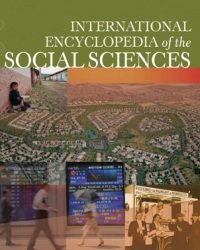
William A. Darity – International Encyclopedia of the Social Sciences (9 Volumes, Second edition)
1.895 ₽
Автор: William A. Darity
Название книги: International Encyclopedia of the Social Sciences (9 Volumes, Second edition)
Формат: PDF
Жанр: Политология и Социология
Качество: Изначально компьютерное, E-book
This 9-volume study of social sciences is a successor to the Encyclopedia of the Social Sciences (ESS, 1930-1935) and the initial set of the International Encyclopedia of the Social Sciences (IESS, 1968) — two groundbreaking MacMillan works that “established standards for knowledge in social science research and practice” (CHOICE, 2001). The entirely new International Encyclopedia of the Social Sciences covers scholarship and fields that have emerged and matured since the publication of the original international edition. Like its predecessors, the set meets the needs of high school and college students, researchers inside and outside academia, and lay readers in public libraries. The new set highlights the expanding influence of economics in social science research and features nearly 3,000 entirely new articles and important biographies contributed by thousands of scholars (including several Nobel prize winners) from around the world on a wide array of global topics, including: achievement testing, censorship, personality measurement, aging, income distribution, foreign aid (political and economic aspects), food (world problems, consumption patterns), cultural adaptation, comparative health-care systems, terrorism, political correctness, agricultural innovation, legislation of morality, sexual violence and exploitation, white collar crime. The new 2nd edition also features biographical profiles of the major contributors to the study of the social sciences, past and present.
Late in 2004 I received a telephone call from Hélène Potter, director of new product development
for Macmillan Reference USA—an imprint of Gale. I did not realize immediately
that it was the telephone call that would shape a large share of my intellectual activity for
the next three years. In fact, I recall hearing about a new edition of the International Encyclopedia
of the Social Sciences (IESS), but I was wholly unclear about what was being asked
of me. I asked Hélène, “So what exactly is it you want me to do? Prepare an article or two
for the new edition?” Her response was, “No, no. We would like you to serve as editor of
the new encyclopedia.” While vaguely glimpsing the labor that would be required to pull
this off properly, but also realizing the importance of the project, I agreed.
I was aware of both the 1930–1935 Encyclopaedia of the Social Sciences, edited by
E. R. A. Seligman and Alvin Johnson, and Macmillan’s 1968 International Encyclopedia of
the Social Sciences, edited by David L. Sills, not only as key reference works of continuing
value but also as vital expressions of the state of the social sciences (and the sociology of the
social science community) at their respective historical moments. It would be an honor and
a unique opportunity to play a key role in the development of the new encyclopedia that
would assess the scope of the social sciences at the start of the twenty-first century.
From the outset, the decision was made to commission an entirely new set of articles
for the second edition of IESS; no articles on overlapping topics from the previous edition
would be reproduced in part or in whole. Instead, we would seek new voices and fresh perspectives
for all of the entries. In fact, a few contributors even chose to make observations
about entries from the previous edition in their articles.
The vision in assembling the new edition was to achieve comprehensiveness in coverage,
to identify authors who would give their articles a critical edge and minimize hagiographic
treatment of the leading figures in the fields represented, and to produce a set of
volumes in which contested intellectual cum ideological terrain is openly and honestly
explored. Indeed, the new edition includes a variety of entries related to the philosophy of
science that call into question what makes the study of the human “social” a “science” in the
first place. Is it a matter of a particular set of practices, that is, variations on the “scientific
method”? Is it a perspective or point of view that guides inquiry, that is, a detachment from
practical or applied aims or a putative “objectivity”? Or is it something else altogether?
WHAT’S NEW IN THE NEW EDITION
The new edition reflects the impact of the rise of critical theory in its postmodernist forms
on the social sciences, especially in the arenas of cultural anthropology, qualitative sociology,
and methodology. Simultaneously, it includes the most sophisticated theoretical reaction to
those developments—the reaction that has sublated those developments by challenging the
nihilistic thrust of postmodernism—in the form of realist theory; the latter is not to be confused
with “realism” or “realpolitik.” The new edition incorporates transformative developments
in the social sciences: the routinization of the use of applied statistics and
mathematical modeling in economics, psychology, and sociology; the rise of cultural studies,
including the study of popular culture; the exploration of race, ethnicity, phenotype,
and identity across the social sciences; the emergence of gender studies and women’s studies;
the “coming out” of queer studies; the study of memory as something far more than a
biomechanical act; and the recent construction and development of concepts like “the
other,” Orientalism, causality, postcolonialism, the clash of civilizations, the gaze, marginalization,
occupational crowding, generation X, and gentrification.
In addition, the new edition embodies the changing demographics of the academy. The
1968 IESS had an editorial advisory board consisting of more than 120 members. This was
a highly distinguished group of scholars, a number of whom are profiled with biographical
entries in the current IESS: Gordon Allport, Gabriel Almond, Kenneth B. Clark, Erik Erikson,
E. E. Evans-Pritchard, E. Franklin Frazier, Morris Janowitz, Harold Lasswell, Paul
Lazarsfeld, Claude Lévi-Strauss, W. Arthur Lewis, Margaret Mead, Robert K. Merton, Gunnar
Myrdal, Talcott Parsons, Don Patinkin, Jean Piaget, Paul Samuelson, Herbert Simon,
George Stigler, and Jan Tinbergen. Lewis, Samuelson, Simon, Stigler, and Tinbergen all
became Nobel laureates in economics. But I count only three women—Mead, Hanna Rizk
at the American University in Cairo, and Monica Wilson at the University of Cape Town—
out of all of the members of the editorial advisory board.
By the late 1960s, the social sciences remained an overwhelmingly male preserve. Nevertheless,
I was startled to find Alvin Johnson making the following remarks in his foreword
to the 1968 IESS when discussing the genesis of the earlier Encyclopaedia of the Social Sciences:
It was not unnatural that Professor Seligman should ask me to examine the great commission
he had undertaken as editor of the Encyclopaedia of the Social Sciences. He
unfolded his plan—himself as editor, an associate editor, a copy editor (probably a
depressed lady scholar), three or four secretaries, and a far-flung farming out of articles.
I loved E.R.A., and I hated to throw cold water on his ideas, but I had to say that
this is no way to make a real encyclopedia. In the first place, articles should not be
farmed out. Every article should be assigned to the man who is to sign it.
I was particularly startled by Johnson’s casual reference to “a depressed lady scholar”—who,
if actually depressed, probably became so because of the professional discrimination she faced
that assigned her to a position lower than the one she deserved—and the ease with which the
assumption was made that the authors of articles would be men. Although we have not yet
attained gender equity in the academy—indeed, it was still possible in 2005 to publish a volume
titled The Origins of Law and Economics: Essays by the Founding Fathers—the current edition
of IESS is richly alert to the contributions of female scholars in the social sciences.
We are much further from achieving racial equity in the academy, but, arguably, black
scholars have made contributions that are disproportionate to their numerical presence in
the social sciences. I believe those contributions are fully evident in the current IESS as well.
Contributions from scholars from marginalized groups—the 1968 editorial advisory board
included, at most, five black scholars—appear in the new edition through the regular
process of identifying important developments in the social sciences. Their work is so central
to ongoing scholarship across the social sciences that it can no longer be ignored, dismissed,
or hidden from view.
EXPERT KNOWLEDGE, DEMOCRACY, AND THE ENCYCLOPEDIA
In his introduction to the 1968 edition, David Sills commented on:
[The] extent to which the social sciences have permeated society itself. It is not just
that the vocabulary of the social sciences has infiltrated everyday speech, although it
is common for persons with no formal training in the social sciences to use such
terms as IQ, subculture, power structure, GNP, and the unconscious in their daily
conversation. More important, many people today perceive the world differently
because they have been exposed to the perspective of the social sciences; they raise
their children differently; they have different attitudes toward government borrowing
and spending; they make different judgments of their friends, neighbors, and
family members; they view both local and national politics differently; they place a
different and more sympathetic interpretation upon the guilt of criminals, drug
addicts, and deviants of all kinds; and they make different judgments of their own
successes and failures.
Sills’s observation is profound. Even on the narrower terrain of vocabulary, the array of
terms and phrases that have migrated from the social sciences into popular discourse goes
far beyond the brief list he offers: antisocial behavior, self-esteem, Type A or Type B personality,
withdrawal symptoms, fixation, penis envy, anorexia, peer pressure, peer culture, inferiority
complex, role model, sexual orientation, dysfunctional behavior, introvert and
extrovert, conventional wisdom, permissiveness, schizo, hyper, klepto, self-fulfilling
prophecy, interest groups, trickle-down, zero-sum game, karma, tough love, self-confidence,
behavioral modification, catharsis, sociopath, phallic symbol, phobia, post-traumatic stress
disorder, hallucination, blind spot, enabler, codependency, separation anxiety, Oedipus
complex, passive-aggressive behavior, cognitive dissonance, obsessive-compulsive disorder
(OCD), extrasensory perception (ESP), split personality, upward mobility, attention deficit
disorder (ADD), narcissism, pathological liar, critical-thinking skills, déjà vu, closure, positive
reinforcement, cultural norms, gender bias.
When concepts migrate they frequently undergo some change in meaning from the
body of scholarship where they originated, and they may return to the social sciences under
modified guise to be used by a new wave of scholars in a different way. Thus, there is an
interdependence between “the experts’” culture and “the people’s” culture, a reciprocity that
results in the reshaping of both as they interact. Indeed, we now have “the people’s” encyclopedia
in the form of the online Wikipedia.
While I admire the democratizing aims of Wikipedia, IESS is a very different type of
project—more informed by attachment to “the experts’” culture. We sought authors for the
entries in the new edition who are specialists on the topics about which they were asked to
write. In addition, we asked them to write in a style that will be accessible to a general audience,
a readership of nonspecialists. That aim largely has been accomplished, with the
exception of some of the articles that are devoted to more detailed, technical aspects of statistics
and econometrics.
The entries in the second edition of IESS are final versions of the articles, and each is
signed by its author or authors. We know who is responsible for what has been said; we
know precisely who is responsible for arriving at a specific conclusion about a major controversy
in the social sciences. Wikipedia has the advantage of having no deadlines (and no
final versions since articles can be edited and updated indefinitely) and no limits to the topics
that can be covered. It is not a social sciences encyclopedia per se—it is an encyclopedia
of all human knowledge; even if it were a social sciences encyclopedia, there would be no
boundaries on topics for consideration. My central complaint is the anonymity of authorship,
which eliminates the ability to situate the perspective, the context, and possibly the
motivation for the position taken by the author. It also eliminates the reader’s ability to
assess whether the author really does possess sound knowledge about the topic
Описание
International Encyclopedia of the Social Sciences (9 Volumes, Second edition) под редакцией William A. Darity — фундаментальное справочное издание, которое объединяет актуальные знания по всем основным направлениям социальных наук. В девяти томах собраны статьи ведущих мировых ученых о ключевых понятиях, теориях, методах и персоналиях в социологии, политологии, экономике, антропологии, психологии и смежных дисциплинах.
Энциклопедия охватывает как классические темы, так и современные направления исследований: глобализацию, неравенство, гендерные исследования, поведенческую экономику, миграцию, демографию и социальную политику. Материал представлен в удобном алфавитном порядке с подробными библиографическими ссылками и перекрестными статьями.
- полезна студентам, аспирантам и преподавателям социальных и гуманитарных наук
- необходима исследователям, аналитикам и специалистам по государственной политике
- помогает журналистам и экспертам быстро находить проверенные академические сведения
- подходит для всех, кто хочет глубоко понимать современные социальные процессы
Только зарегистрированные клиенты, купившие данный товар, могут публиковать отзывы.
Похожие


Другие книги раздела «Политология и Социология»
- M. Malkia – Encyclopedia of Digital Government
- M. Page – Colonialism. An International Social Cultural and Political Encyclopedia
- M. Shaw – International Law (Sixth edition)
- Michael Zander – The Law-Making Process (Sixth edition)
- Paul Atkinson – Sage Qualitative Research Methods
- M. Mann – The Dark Side of Democracy
- Paul Verhaeghen – The Oxford Handbook of Emotion Social Cognition and Problem Solving in Adulthood
- Phyllis G. Jestice – Holy People of the World. A Cross-Cultural Encyclopedia
- Q. Skinner – Visions of Politics (3 Volumes)
- R. Gartner – The Oxford Handbook of Gender Sex and Crime (2014)
- R. Rhodes – The Oxford Handbook of Political Institutions
- Richard A. Landes – Encyclopedia of Millennialism and Millennial Movements
- S. Hussain – Encyclopedia of Capitalism (3 Volume set)
- Sam Goldstein – Handbook of Intelligence + The Cambridge Handbook of Intelligence (2 Books, 2015)
- Shlomo Giora Shoham – International Handbook of Criminology
- Susan Burch – Encyclopedia of American Disability History
Все книги раздела «Политология и Социология» →
Смежные разделы: Бизнес-Книги · Биография · Боевики и Триллеры · Детективы · Детские книги · Школа · Дом и Семья · Здоровье · Искусство · Историческая проза · Классика · Компьютеры
Рекомендуем также
- W. Zhang – Measurement Technology for Micro-Nanometer Devices (2016)
- Yu Yao – Robust Control (2016)
- T. Gasser – Basiswissen Urologie (6 Auflage, 2015, Немецкий язык)
- D. Ubelaker – The Global Practice of Forensic Science (2015)
- G. Christ – Handbook of Oncology Social Work (2015)
- J. Wu – Variational Methods in Molecular Modeling (2017)
- M. Rai – Nanotechnology for Bioenergy and Biofuel Production (2017)
- W. Hustrulid – Open Pit Mine Planning Design (2013)

Отзывы
Отзывов пока нет.