
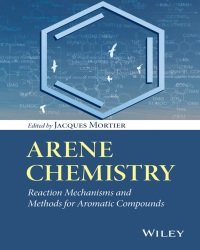
J. Mortier – Arene Chemistry (2015)
1.470 ₽
Автор: J. Mortier
Название книги: Arene Chemistry
Формат: PDF
Жанр: Химия
Страницы: 990
Качество: Изначально компьютерное, E-book
Organized to enable students and synthetic chemists to understand and expand on aromatic reactions covered in foundation courses, the book offers a thorough and accessible mechanistic explanation of aromatic reactions involving arene compounds.
• Surveys methods used for preparing arene compounds and their transformations
• Connects reactivity and methodology with mechanism
• Helps readers apply aromatic reactions in a practical context by designing syntheses
• Provides essential information about techniques used to determine reaction mechanisms
Benzenoid aromatic compounds or arenes have tremendous importance in academic and industrial
chemical applications. Of the circa 10 million compounds that are known today, about three millions
are arenes. Reactions involving arenes represent key steps in fundamental synthesis, especially in
the pharma, agrochemical, and polymer fields. Arene compounds are also widely used as starting
materials to obtain dyes, perfumes, explosives, preservatives, etc. New applications include sectors
such as functional materials, organic electronics, and molecular machines.
The success of these industries is, in large part, due to the towering achievements of arene chemistry,
a mature discipline that emerged well over 150 years ago. Without a doubt, arene chemistry
research is now in its golden age, and its knowledge is indispensable for any synthetic chemists.
Despite these extraordinary academic and commercial implications, there are, as yet, no books
focusing on mechanisms and strategies in this continuing developing field, with a comprehensive
coverage of classical and more recent reactions.
To date, the commonly accepted books on arene chemistry are either out of date or only deal
with specific reaction types. For instance, Modern Arene Chemistry by Astruc (Wiley‐VCH,
Weinheim, 2002) is overly involved in the materials science end of the chemistry covered, while
Aromatic Chemistry by Hepworth, Waring, and Waring (Royal Society Cambridge, 2002), which is
intended specifically for basic‐level chemistry students, is only 168 pages, of which the last 20 are
answers to problems.
Arene chemistry is growing so rapidly that one cannot keep up with progress, and to get information
on aromatic reactions, one needs to consult many different books. Although there are already many
books on the market about nucleophilic aromatic substitution (including Modern Nucleophilic
Aromatic Substitution, by Terrier, Wiley‐VCH, Weinheim, 2013), aromatic rearrangements, reductions,
oxidations, dearomatization reactions, and photochemical and biochemical transformations, it is
quite difficult to get an overview of the significant impact of each topic. On the other hand, electrophilic
aromatic substitution, aryne chemistry, and directed aromatic metalation have advanced dramatically in
understanding over the years but rarely received appropriate attention. Moreover, metal‐catalyzed
cross‐coupling and CH‐functionalization reactions, which have known a recent booming development
widely covered by an extremely abundant literature, deserve to be summarized and commented to
meet the needs of a broader readership. Arene Chemistry: Reaction Mechanisms and Methods for Aromatic Compounds is the first book
of its kind that furnishes a complete overview and a guide and collects in a single opera all the topics
related to the field. This compendium connects methodology and reactivity of aromatic compounds
with mechanism, at the interface of synthesis and physical organic chemistry. It is organized
according to reaction classes, so that someone who would like to run their first aromatic oxidation
can flip open to the corresponding chapter to learn the basics quickly. This book also establishes
the interesting connectivity between the different subjects. Because the presentation of the
material organized according to reaction mechanisms is of central significance to students of
organic chemistry, I feel fairly confident that the pedagogical approach followed will render the
content readily comprehensible. In addition, the text grouped on reaction mechanism type as
opposed to the reaction products should be much more intuitive to aid a deeper understanding of
the area.
Considering that arene chemistry is a field that evolves in parallel in laboratories throughout the
world, I sought to select younger active colleagues and leading senior experts who were not only
authoritative but also as geographically distributed as the field itself. The contributors’ expertise
allows them to frame the literature contextually for the audience while providing a critical view of
the state of the art in terms of potential for growth, future outlook, and limitations. In a rather
limited space, each chapter is organized to understand and expand on aromatic reactions covered in
foundation courses to the latest understanding and to apply them in a practical context by designing
syntheses.
In building the project, 32 topics divided into 10 parts have been identified as deserving a special
coverage. There is detailed contents from which I believe it will be possible to track down most
points. Each chapter covers basics as well as most recent areas of interest to give a complete picture
to both teach and bridge the primary literature. Each chapter should also lead the reader to consult
the secondary literature sources cited by the authors including reviews, books, and monographs, in
order to understand the subject in a more comprehensive manner. This book is organized with the
intention of providing a platform for scientists from different disciplines to generate new ideas and
thoughts by inspiring each other.
As aromatic compounds are ubiquitous, this book should be especially relevant to a large audience,
which covers advanced undergraduates through postgraduates and right up to academic faculty,
and the chemical industry, that is, almost the entire organic chemistry community. The work published
on heteroaromatic chemistry is so extensive that it was impractical to attempt to review progress in
this area at the same time. If so, this would have doubled or tripled the content. However, synthetic
applications described in the different sections can be related to the preparation of carbocyclic aromatic
(benzene) rings embedded in a heterocycle. Typical examples of industrial applications of the relevant
technologies are appropriately illustrated throughout the text.
To sum up, the coverage presents the most significant results and the underlying principles that
are emerging in arene chemistry. Since this book directly addresses arenes and encapsulates most
important synthetic applications, it should be an easy choice for people looking for information on
aromatic reactions, both from mechanistic and synthetic viewpoints.
At the start of the project about 3 years ago, I was aware of the immensity of the task and the difficulty
of covering such a broad area. I hope that this book reflects recent changing trends in research
so that it will cater for the maximum possible range of interests. I accept the entire responsibility for
any significant omission. I heartily encourage those who read and use this book to contact me directly
with comments, errors, and publications that might be appropriate for eventual future editions.
My email address is jacques.mortier@univ‐lemans.fr, my blog is http://jmortier.unblog.fr
As an editor, it has been a very exciting experience to collaborate with acknowledged experts
from all over the world. I wish to express my profound gratitude for the time and effort that they
have dedicated to this process. This work would not have been accomplished without the acknowledged
experts (over 150) including most of the contributors of this book who agreed to read the
chapters and contributed to improving the quality of the book. I like to extend my warm thanks to all of my students, postdoctoral researchers, and colleagues
from the university and the industry for their intellectual contribution and dedication.
I thank the publisher Wiley, especially Jonathan Rose for contacting me to write this book and
for his understanding and help in preparing the book. I am also grateful to François Pascal Raj of
SPi Global who led the copyediting process with great skill.
It would not have been possible to put the book in its final form without the support, encouragement,
love, and patience of my wife, Marie‐Jeanne, and my two sons, Rik and Jan. They are
tenderly acknowledged.
I also think of my mom, Marie‐Thérèse Bernier, whom I miss so much. This book is dedicated
to her memory.
Jacques Mortier
Описание
Arene Chemistry (2015) — фундаментальный обзор современных методов и реакций ароматических соединений. Книга объединяет классические реакции аренов с новейшими подходами в органическом синтезе, включая C-H-функционализацию, металлокатализируемые превращения и асимметрический синтез.
Авторы подробно рассматривают механизмы реакций, региоселективность, современные катализаторы и практическое применение аренов в создании сложных молекул для фармацевтики, материаловедения и агрохимии. Особое внимание уделено переходу от традиционной электрофильной ароматической заместительной реакции к более экологичным и селективным методам.
- студентам и аспирантам, специализирующимся в органической химии
- научным сотрудникам и преподавателям, работающим с ароматическими соединениями
- химикам-синтетикам в фармацевтической и химической промышленности
- всем, кто хочет обновить знания о современных стратегиях функционализации аренов
Только зарегистрированные клиенты, купившие данный товар, могут публиковать отзывы.
Похожие


Другие книги раздела «Химия»
- Handbook of Macrocyclic Supramolecular Assembly
- Jonathan Steed – Supramolecular Chemistry
- John A. Conkling – Chemistry of Pyrotechnics
- Ernst-Christian Koch – High Explosives, Propellants, Pyrotechnics
- Ajoy Bose – Military Pyrotechnics
- Научные сказки периодической таблицы
- Miguel Cases – Foundations of Analytical Chemistry
- Jose Perez-Castineira – Chemistry and Biochemistry of Food
- Reinhard Matissek – Lebensmittelchemie
Смежные разделы: Авиация и космонавтика · Астрономия · Геология и Геодезия · Железнодорожное дело · Журналистика · Математика · Машиностроение · Нанотехнологии · Научно-популярная литература · Физика · Экология · Энергетика
Рекомендуем также
- J. Merriman – Encyclopedia of the Age of Industry and Empire. Europe 1789 to 1914 (5 Volume set)
- А. Велидов – Красная книга ВЧК в 2 томах (1989)
- И. Иванов – Украинский кризис. Документы и материалы (15 Томов, 2015)
- A. Knapp – Prehistoric and Protohistoric Cyprus. Identity, Insularity, and Connectivity
- Alexander Mikaberidze – Historical Dictionary of Georgia
- C. Woolgar – Food in Medieval England
- Paul F. Grendler – The Renaissance. An Encyclopedia for Students (4 Volumes)
- Владимир Потемкин – История дипломатии (3 Тома)

Отзывы
Отзывов пока нет.