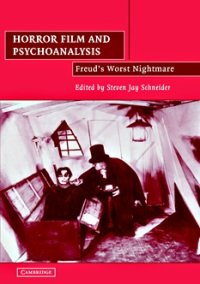
S. Schneider – Horror Film and Psychoanalysis. Freud’s Worst Nightmare (2004)
1.020 ₽
Автор: S. Schneider
Название книги: Horror Film and Psychoanalysis. Freud's Worst Nightmare (2004)
Формат: PDF
Жанр: Театр и Кино
Качество: Изначально компьютерное, E-book
This volume finds the proper place of psychoanalytic thought in critical analysis of cinema through a series of essays that debate its legitimacy, utility, and validity as applied to the horror genre. It distinguishes itself from previous work in this area through the self-consciousness with which psychoanalytic concepts are employed and the theorization that coexists with interpretations of particular horror films and subgenres.
the myth of meta-theory
Over the past thirty years, a plethora of publications have argued in favor
of a specific psychoanalytic approach to some dimension or convention
of cinematic horror. Included among these are articles and books by
such influential scholars as Robin Wood, Carol Clover, Stephen Neale,
Linda Williams, Barbara Creed, even No¨el Carroll in an earlier incarnation.
These efforts have typically taken the form of either interpretive
analysis (of a particular film, subgenre, or the genre as a whole) or depthpsychological
explanation (of the symbolic/mythic import of horror film
monsters; of the horror affect and how it is generated; of the possibly perverse
pleasures viewers obtain from being frightened by visible fictions).
And despite the often vitriolic criticisms of psychoanalysis both inside and
outside academic film studies, the horror genre has continued to see a
steady stream of new psychoanalytic approaches, as well as new variations
on existing ones.
As originally conceived, the present volume was to be a collection of
“meta-theoretical” essays on psychoanalysis and the horror film – not
essays that simply (or not so simply, as the case may be) make use of
Freudian, Jungian, Kleinian, Jonesian, or Lacanian principles, theses,
arguments, or purported discoveries in an effort at shedding light on
aspects of the horror film. Instead, it was envisaged that contributors
would take a step back to address the relative strengths and weaknesses
of such approaches. This was to be a book about psychoanalytic theories of
the horror film rather than a book that offered still more psychoanalytic
theories of the horror film.
But of course there is no such neutral space outside, much less “above,”
the fray from which to conduct an investigation of this sort. Those who
defend a psychoanalytic approach to horror cinema typically have pet
applications of their own. Similarly, those who see fit to critique psychoanalytic
theories of the horror film almost always have alternative,
incompatible (or so it may seem) paradigms in mind.1
Especially since the late 1970s, there has been a tremendous diversity
of psychoanalytic approaches to the horror film. These approaches
differ, and often conflict, in substantial ways. But the objections levied
in recent years by analytic philosophers, film aestheticians, sociologists
and cultural theorists, cognitive and feminist film theorists, and empirical
psychologists, many of whom position themselves well outside the
circle of Freud and his followers, constitute a far more serious threat, or
challenge, to psychoanalytical horror film theory. This is because such
objections would be fatal to psychoanalysis if proven correct.2
To refuse to hear such critics out, to assume a priori that none of their
objections are powerful enough to warrant serious treatment, and to eschew
making any effort at responding in turn is more than just irresponsible
scholarship. It adds strength to the already potent criticisms that
psychoanalytic thought is hermetic and self-confirming, that its film theoretical
applications produce “closed, self-justifying systems” ( Jancovich
1995: 147). And it weakens the power of those prima facie affinities holding
between psychoanalytic concepts and explanations, on the one hand,
and the manifest content of much horror cinema, on the other. The existence
of such affinities is often cited as additional evidence in support of
whichever psychoanalytic theory of the horror film brings them to bear in
the first place; consider, for example, Marguerite LaCaze’s (2002) look
at how the relationship between mourning and melancholia – a relationship
about which Freud had much to say – is thematized in M. Night
Shyamalan’s The Sixth Sense (1999).
Most psychoanalytic horror film theorists to date have not proven very
open to revising their particular accounts as a result of critical engagement
with the work of others operating even from within the psychoanalytic
paradigm. As Malcolm Turvey details in his contribution to this
volume, for instance, a survey of the various explanations offered by psychoanalytic
film theorists concerning the puzzling pleasures of horror
film viewing reveals a host of structurally similar but still more or less conflicting
positions. All of these positions depend on the Freudian notion
of repressed mental content – anxieties, fears, even fantasies and wishes
that get relegated to the unconscious during childhood either because
they are too unpleasurable in and of themselves or because they conflict
with more acceptable/appropriate mental content. While the diversity
Turvey refers to might be held up as indicative of the fertility of psychoanalysis
in this area, “from the point of view of critics of psychoanalytical
film theory, there is no genuine disagreement among psychoanalytical
theorists of the horror film – simply pluralism.” This is because such theorists
typically “do not dialectically engage with each others’ theories by
(a) showing why candidates for repressed mental content proposed by
other theorists cannot explain the phenomenon they want to explain; or
(b) showing why their candidate does explain the phenomenon better
than others” (n. 9).
Clearly, the pluralism Turvey has in mind here is not of the “methodologically
robust” type advocated by No¨el Carroll. According to Carroll,
methodologically robust pluralism only occurs when competing theories
are held up against one another for the purpose of weeding out the weak
ones. Rather, Turvey seems to be thinking of “a situation in which everyone
just rattles around in their own paradigm” (Carroll 1996: 334);
only here, the theorists in question are held to be “just rattling around”
in the same paradigm, broadly construed as psychoanalysis.3 Although
questions have been raised about the presupposed neutrality and external
stance of the arbiter in Carroll’s own problem–solution model of
research,4 and although it is certainly possible for there to be different
ways – all fruitful – of looking at a particular phenomenon, Carroll’s
methodological imperative makes sense when it comes to the consideration
of theories that appear to be in competition or conflict with one
another.
Описание
S. Schneider – Horror Film and Psychoanalysis. Freud’s Worst Nightmare (2004) — сборник научных статей, в котором известные киноведы и психоаналитики исследуют, как теория Фрейда, Лакана и других мыслителей помогает понять природу ужаса в кино.
Авторы анализируют механизмы страха, роль бессознательного, травмы, возвращения вытесненного и садистского удовольствия зрителя. Книга рассматривает классические и современные хорроры — от «Психо» и «Изгоняющего дьявола» до фильмов 1990–2000-х, показывая, почему зритель добровольно погружается в кошмары.
- студентам и преподавателям киноведения и психоанализа
- исследователям жанра horror и теории кино
- психологам, интересующимся влиянием медиа на бессознательное
- всем, кто хочет глубже понять, почему мы любим бояться в кино
Только зарегистрированные клиенты, купившие данный товар, могут публиковать отзывы.
Похожие



Другие книги раздела «Театр и Кино»
- S. Higgins – Harnessing the Technicolor Rainbow. Color Design in the 1930s
- S. Joshi – Icons of Horror and the Supernatural (2007)
- S. Kashner – Furious Love. Elizabeth Taylor, Richard Burton, and the Marriage of the Century
- S. P. MacKenzie – The Battle of Britain on Screen. The Few in British Film and Television Drama
- Scott MacDonald – Art in Cinema (2006)
- Steven Browne – HD Postproduction. Editing and Delivering HD Video
- Steven Jay Rubin – Combat Films. American Realism, 1945-2010 (2011)
- Steven M. Sanders – The Philosophy of TV Noir (2008)
- Susan Delson – Dudley Murphy, Hollywood Wild Card (2006)
- T. Doherty – Teenagers and Teenpics. The Juvenilization of American Movies
- Tamar Jeffers McDonald – Hollywood Catwalk. Costume and Transformation in American Film
- Timothy Shary – Generation Multiplex. The Image of Youth in Contemporary Cinema
- Tom Mankiewicz – My Life as a Mankiewicz
- Vincent LoBrutto – The Filmmaker’s Guide to Production Design (2002)
- William Baer – Classic American Films. Conversations with the Screenwriters (2008)
- Yannis Tzioumakis – American Independent Cinema. An Introduction
Все книги раздела «Театр и Кино» →
Смежные разделы: Архитектура · Живопись и Графический дизайн · Музыка · Мода и Дизайн · Фотография · Культура и Искусство · Декоративно-прикладное искусство
Рекомендуем также
- S. Tosi – The Genetic Basis of Haematological Cancers (2016)
- Der Große Reuter – Springer Universalworterbuch Medizin, Pharmakologie und Zahnmedizin
- Ingo Wirth – Kriminalistik-Lexikon (4 Auflage, 2013, Немецкий язык)
- L. Cong – Chinesische Psychosomatische Medizin (2015, Немецкий язык)
- A. Agarwal – Non-Invasive Sperm Selection for In Vitro Fertilization (2015)
- M. Doyle – Food Microbiology (4th edition)
- P. Ashurst – Chemistry and Technology of Soft Drinks and Fruit Juices (2016)
- C. Balanis – Antenna Theory (2016)
Отзывы
Отзывов пока нет.