
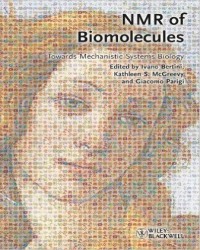
I. Bertini – NMR of Biomolecules (2012)
1.248 ₽
Автор: I. Bertini
Название книги: NMR of Biomolecules
Формат: PDF
Жанр: Биологические науки
Страницы: 629
Качество: Изначально компьютерное, E-book
NMR is one of the most powerful methods for imaging of biomolecules. This book is the ultimate NMR guide for researchers in the biomedical community and gives not only background and practical tips but also a forward looking view on the future of NMR in systems biology.
Contents
Introduction
The Role of NMR in the Study of the Structure and Dynamics of Biomolecules
The Role of NMR in the Study of the Structure and Dynamics of Biomolecular Interactions
NMR in Drug Discovery
Solid-State NMR
Frontiers in NMR Spectroscopy
Computational Aspects
The use of NMR to solve protein structures has a tradition that dates back to 1984
(M.P. Williamson, T.F. Havel, and K. W€uthrich (1985) J. Mol. Biol. 182, 295). Since
that time, the role of NMR in structural biology has constantly increased in terms of
the number of researchers involved and the scientific relevance of the results.
Spectrometers are becoming more and more powerful, with magnetic fields that
currently reach 22 T, and high-temperature superconducting materials raise the
possibility that this value can be surpassed. The investment required for a magnet of
the above intensity is currently around D10 million (US$14.3 million) and an
estimate of D18 million (US$25.7 million) is reasonable for new-generation magnets.
It is clear that NMR is a technology that deserves a special place in research
infrastructures, as individual schools may find it difficult to have a battery of
machines, all at the forefront of the technology, dedicated to various types of
experiments. In 1994, the European Commission (EC) began financing transnational
access to NMR instrumentation at some research infrastructures, which have
continued and grown in number until the present with the EC-funded Bio-NMR1)
project. In Europe, the recent European Strategy Forum for Research Infrastructures
(ESFRI) Roadmap identifiesNMRas a fundamental node in the Integrated Structural
Biology Infrastructure (INSTRUCT),2) while it also plays a role in the EU-OPENSCREEN
(European Infrastructure of Open Screening Platforms for Chemical
Biology)3) infrastructure, Euro-BioImaging,4) and Biobanking and Biomolecular
Resources Research Infrastructure (BBMRI).5)
The EC-funded electronic infrastructures (e-NMR6) and WeNMR7)) provide
nonspecialists with tools for automatic data handling, structure calculations, molecular
dynamics simulations, and the creation of interaction models in such a way that
the potential of the NMR technology can blossom in favor of the progress of science.
Much of this reasoning was debated during the FP6-funded CoordinationAction
NMR-Life8) and resulted in a booklet entitled NMR in Mechanistic Systems Biology,9)
which ultimately served as the spark for this volume. We were pleased when Gregor Cicchetti from Wiley-VCH noticed this booklet and proposed that we edit a book on
the very same subject, and we gathered a number of outstanding contributors to fulfill
the task.
Our intention, which we hope pervades the book, was to provide a text for
graduate students, junior post-docs, and other newcomers that would serve as an
introduction to the field, addressing classical NMR approaches from solution to the
solid state, providing some tips and tricks not available in journal articles, and
providing perspectives on future developments. It is our hope that the Protocols and
Troubleshooting sections will be of assistance and guidance when choosing experiments
and overcoming difficulties.
However, everyone who has experience in editing books knows how difficult a
task it is – obtaining the manuscripts on time, convincing everyone to adhere to a
template and write for students and not for their fellow professors, and even drawing
the line on what content to include and when to call an end to the editorial process,
including substitution of recalcitrant contributors. We editors have tried our best to
overcome these difficulties, but we are aware that much more could have been done.
For example, the development of isotopic labeling has been fundamental for the
development of NMR, but we decided not to address it here. The reader should
therefore be aware that the field of NMR is even broader and more exciting than it
appears from our efforts!
Part I of the book (Introduction) explains NMRs role in Mechanistic Systems
Biology and provides a broad overview of biomolecular structure before identifying
what NMR can teach us about the structure and dynamics of biomolecules. Parts II–
VII address a series of relevant topics in NMR-driven biological research: the role of
NMR in the study of the structure and dynamics of biomolecules, its role in the study
of the structure and dynamics of biomolecular interactions, NMR in drug discovery,
solid-state NMR, frontiers in NMR spectroscopy, and computational aspects.
We would like to take the opportunity to thank, in addition to Gregor, Dr.Marco
Fragai of the Center forMagnetic Resonance (CERM) at the University of Florence for
his assistance in editing some chapters of the book, and Professor Claudio Luchinat,
who consistently demonstrates his friendship and his willingness to support any
initiative of CERM, and the scientific personnel of CERM who have contributed to
discussions and sustained the work.
It is our sincere hope that this book will find a home not only in NMR facilities,
but also in biomedical laboratories around the world, where it can be of use to the
broader scientific community and help diffuse NMR as a technique for the study of
biological systems.
Описание
NMR of Biomolecules — книга, в которой И. Бертини подробно рассматривает применение ядерного магнитного резонанса для изучения структуры, динамики и взаимодействий биологических макромолекул. Издание 2012 года объединяет фундаментальные принципы спектроскопии ЯМР с современными методами анализа белков, нуклеиновых кислот и их комплексов.
Автор объясняет, как получать высококачественные спектры, обрабатывать данные и интерпретировать результаты в контексте биохимии и структурной биологии. Особое внимание уделено двумерным и многомерным экспериментам, релаксации, переносу NOE, остаточным дипольным взаимодействиям и применению парамагнитных зондов.
- Студентам и аспирантам, изучающим биофизику и структурную биологию
- Исследователям, работающим с белками и нуклеиновыми кислотами
- Специалистам по биологической спектроскопии, желающим углубить знания
- Учёным, применяющим ЯМР в drug discovery и молекулярной биологии
Только зарегистрированные клиенты, купившие данный товар, могут публиковать отзывы.
Похожие


Другие книги раздела «Биологические науки»
- D. Field – Biocode. The New Age of Genomics (2015)
- D. Murhammer – Baculovirus and Insect Cell Expression Protocols (2016)
- D. Thangadurai – Genomics and Proteomics (2015)
- F. Christiansen – Immunogenetics
- F. Martin – Microbial Environmental Genomics MEG (2016)
- F. Storici – Gene Correction (2014)
- G. Evtugyn – Biosensors. Essentials (2014)
- G. Saha – Physics and Radiobiology of Nuclear Medicine
- H. Remaut – Bacterial Membranes (2014)
- H. Seligmann – DNA Replication. Current Advances (2016)
- H. Yawo – Optogenetics (2015)
- J. Cao – Breast Cancer (2016)
- J. Gorodkin – RNA Sequence, Structure and Function (2014)
- J. Kuo – Electron Microscopy (2014)
- J. Lackie – The Dictionary of Cell and Molecular Biology (2013)
- J. Morel – Molecular and Physiological Mechanisms of Muscle Contraction
Все книги раздела «Биологические науки» →
Смежные разделы: Медицина на испанском языке · Медицина на немецком языке · Медицина на французском языке · Анестезиология и Реаниматология · Акушерство и Гинекология · Ветеринария · Гастроэнтерология и Гепатология · Дерматология и косметология · Диетология и нутрициология · Иммунология и Аллергология · Кардиология · Лапароскопия и Эндоскопия
Рекомендуем также
- Brenda Schick – Advances in the Sign Language Development of Deaf Children
- L. Campbell – Language Classification
- M. Traxler – Handbook of Psycholinguistics (Second edition)
- A. El-Sayed – Fundamentals of Aircraft and Rocket Propulsion (2016)
- A. Polyanin – A Concise Handbook of Mathematics Physics and Engineering Sciences (2010)
- J. Arias – Nanotechnology and Drug Delivery (2 Volume set, 2016)
- M. Hurley – SFPE Handbook of Fire Protection Engineering (2016)
- B. Bhushan – Scanning Probe Microscopy in Nanoscience and Nanotechnology

Отзывы
Отзывов пока нет.