
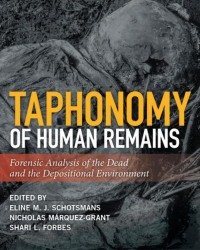
M. Schotsmans – Taphonomy of Human Remains (2017)
2.880 ₽
Автор: M. Schotsmans
Название книги: Taphonomy of Human Remains (2017)
Формат: PDF
Жанр: Судебная медицина
Страницы: 532
Качество: Изначально компьютерное, E-book
A truly interdisciplinary approach to this core subject within Forensic Science
Combines essential theory with practical crime scene work
Includes case studies
Applicable to all time periods so has relevance for conventional archaeology, prehistory and anthropology
Combines points of view from both established practitioners and young researchers to ensure relevance
Описание
Taphonomy of Human Remains (2017) — фундаментальная книга, которая объединяет теорию тафономии с практическими задачами судебной медицины и криминалистики. Авторы рассматривают, как природные процессы влияют на человеческие останки после смерти, помогая точнее определять время наступления смерти, обстоятельства и условия захоронения.
Издание подробно разбирает взаимодействие человеческих и природных факторов: от разложения мягких и твердых тканей, влияния микроорганизмов и летучих органических соединений до изменений ДНК, водной среды, термического воздействия, выветривания и деятельности падальщиков. Отдельное внимание уделено особенностям различных местонахождений — от почвенных изменений рядом с телом до массовых захоронений. Книга содержит актуальные исследования, методологические подходы к оценке post-mortem interval и обширный раздел с реальными кейсами: тело в бетоне, сапонифицированный мозг, анализ разрушения тканей одежды и специализированные типы захоронений.
- Судебным медикам и судебным антропологам, занимающимся оценкой времени смерти
- Криминалистам и следователям, работающим с местами обнаружения останков
- Археологам и палеонтологам, изучающим тафономические процессы
- Студентам и исследователям в области судебной науки и биоархеологии
Только зарегистрированные клиенты, купившие данный товар, могут публиковать отзывы.
Похожие


Другие книги раздела «Судебная медицина»
- Patricia Rosa Linda Trujillo Mariel – Medicina forense (Испанский язык, 2015)
- Burkhard Madea – Handbook of Forensic Medicine
- Kim A. Collins – Forensic Pathology of Infancy and Childhood
- Michael P. Burke – Forensic Pathology of Fractures and Mechanisms of Injury
- Wolfram Meier-Augenstein – Stable Isotope Forensics (Second edition, 2018)
- David R. Senn – Forensic Dentistry (Second edition)
- Updesh Kumar – Handbook of Suicidal Behaviour
- Balwant Rai – Evidence-Based Forensic Dentistry
- W. Silver – Dental Autopsy
- Jeremy Rich – Forensic Medicine of the Lower Extremity
- Steven B. Karch – Postmortem Toxicology of Abused Drugs
- Stella Compton Dickinson – The Clinician’s Guide to Forensic Music Therapy
- Raymond Chip Tafrate – Forensic CBT
- R. Mann – Photographic Regional Atlas of Non-Metric Traits and Anatomical Variants in the Human Skeleton
- Andre Arnes – Digital Forensics (2018)
- Anil Aggrawal – Forensic and Medico-legal Aspects of Sexual Crimes and Unusual Sexual Practices
Все книги раздела «Судебная медицина» →
Смежные разделы: Медицина на испанском языке · Медицина на немецком языке · Медицина на французском языке · Анестезиология и Реаниматология · Акушерство и Гинекология · Ветеринария · Гастроэнтерология и Гепатология · Дерматология и косметология · Диетология и нутрициология · Иммунология и Аллергология · Кардиология · Лапароскопия и Эндоскопия
Рекомендуем также
- M. Yousef – miRNomics. MicroRNA Biology and Computational Analysis (2014)
- P. Bourgine – Morphogenesis (2011)
- J. Lancaster – Fundamental Mathematics and Physics of Medical Imaging (2017)
- A. Svendsen – Understanding Enzymes (2016)
- V. Greanya – Bioinspired Photonics (2016)
- A. Khanna – MRI Essentials for the Spine Specialist
- W. Bauer – University Physics with Modern Physics (2nd edition, 2013)
- V. Feigin – Handbook of Clinical Neuroepidemiology

Отзывы
Отзывов пока нет.