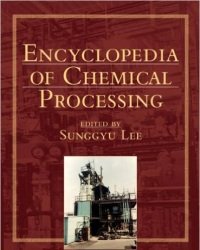
S. Lee – Encyclopedia of Chemical Processing (2006)
1.894 ₽
Автор: S. Lee
Название книги: Encyclopedia of Chemical Processing
Формат: PDF
Жанр: Химия
Страницы: 3338
Качество: Изначально компьютерное, E-book
A complete reconceptualization of the classic reference series the Encyclopedia of Chemical Processing and Design, whose first volume published in 1976, this resource offers extensive A-Z treatment of the subject in five simultaneously published volumes, with comprehensive indexing of all five volumes in the back matter of each tome. It includes material on the design of key unit operations involved with chemical processes; the design, unit operation, and integration of reactors and separation systems; process system peripherals such as pumps, valves, and controllers; analytical techniques and equipment; and pilot plant design and scale-up criteria.
This reference contains well-researched sections on automation, equipment, design and simulation, reliability and maintenance, separations technologies, and energy and environmental issues. Authoritative contributions cover chemical processing equipment, engineered systems, and laboratory apparatus currently utilized in the field. It also presents expert overviews on key engineering science topics in property predictions, measurements and analysis, novel materials and devices, and emerging chemical fields.
The Encyclopedia of Chemical Processing is an authoritative, dynamic, and most
comprehensive multi-volume reference work on the broad subject of chemical processing,
which will enable readers to have an enriching experience about general as well as targeted
knowledge in this field. The Encyclopedia caters to engineers, scientists, researchers,
inventors, professors, and students, as well as general readers in academia, industry,
research institutions, government, and legal practices. In addition, the Encyclopedia has
been designed to address the needs of practicing engineers and scientists, businessmen,
lawyers, industrial executives, and professionals in the chemical processing and technology
arena.
The Encyclopedia encompasses the entire realm of chemical processing, offering upto-
date, reliable, and comprehensive coverage of process technologies that have steadily
progressed over the years, and at the same time identifying and addressing new breakthroughs
and emerging technologies in chemical processing. The Encyclopedia contains
a large number of entries that are devoted to life science subjects and futuristic materials
and technologies, namely, biotechnology, nanomaterials and nanotechnology, and materials
and technologies geared for microelectronics. Under the advice of an editorial advisory
board comprised of distinguished and renowned scholars from around the world, the
Encyclopedia will serve as the most respected reference work in the field of chemical
processing.
The Encyclopedia covers cradle-to-grave information on processing novel materials,
emerging process technologies and resultant materials, and manufacturing organic and
inorganic chemicals. Specific topics of interest include synthesis reactions, properties
and characterization of materials, appropriate choice of catalysts, reactor design, process
flowsheets, energy integration practices, pinch design, design of separation equipment and
peripherals, environmental aspects of chemical plant operation such as safety and loss prevention,
obedience of environmental regulations, waste reduction and management, and
much more. The Encyclopedia also contains descriptions of different types of reactors
and separation systems and their design, unit operations, system integration, process
system peripherals such as pumps, valves, and controllers, analytical techniques and
equipment, as well as pilot plant design and scale-up criteria.
Fundamental aspects of industrial catalytic processes are detailed including catalyst
preparation, characterization, structure-property relationships, deactivation and defouling,
and catalyst regeneration methods. Examples of industrial processes that use different
types of catalysts for chemical manufacture are also detailed. Identification and utilization
of alternative resources for complementing our energy needs are addressed, which include
renewable energy resources, oxygenated fuels, biofuels, fuel cells, and batteries.
Polymers are ubiquitous in today’s life, and their utilization is limited only by chemists’
and chemical engineers’ imaginations. The Encyclopedia attempts to cover the wide spectrum
of polymerization and polymer processing, including metallocene processes, description
of structure, properties and end use of different polymers, copolymers, polymer blends
and composites, polymer coatings, and rubber compounds. Additional topics of interest
that are also covered include but are not limited to polymer characterization, molding
technology, and polymer and rubber recycling. Advanced materials being used in myriad
applications are also accounted for; examples of these are ceramics, nanomaterials, nanocomposites,
carbon nanotubes, hydrophilic polymers, photovoltaic materials, biomaterials,
and biomedical materials. The issues potentially related to global warming cannot be understated in the present
world, largely due to the increasing use of fossil fuels by automobiles and industries
around the world. The degree to which this environmental issue affects society and the
remedial measures needed in order to alleviate these concerns are well-addressed in the
Encyclopedia, which covers emerging environmental technology, bioremediation, greenhouse
gas alleviation, waste minimization, sequestration of carbon dioxide, etc.
Biotechnology is a rapidly growing area of chemical, biological, and life sciences, and as
such is also well-covered in the Encyclopedia. Enzymes, biomaterials, bioseparation, bioprocessing,
bioreactor design, biocatalysis, BioMEMS, protein design, chiral drug separation,
and hydrogels are few of the topics of merit that are included.
The Encyclopedia also identifies and addresses emerging technologies in great detail
including but not limited to nanotechnology, plasma technology, thin film technology,
supercritical fluid technology and its applications, as well as microfabrication and micromachining
for the microelectronics area.
The authors of this initial printed version of the Encyclopedia are recognized experts in
their fields, lending credibility and prestige to the Encyclopedia. All the authors were
invited based on their records of accomplishment in the chosen topical areas. All entries
were individually reviewed by peers as well as the Editor. As part of the review and revision
processes, every effort was exercised to maintain the consistency, accuracy, readability,
and up-to-date nature of the information presented.
The Encyclopedia is published in both online and printed formats. The printed version
consists of multiple traditional hardbound volumes with articles arranged alphabetically.
The online version of the Encyclopedia is created by coupling the content of the printed
edition with a powerful search engine, user-friendly interface, and customer-focused
features. The online database is dynamic and evolving in nature, with additional articles
added each quarter.
The Editor feels honored to have been asked to undertake the important and challenging
endeavor of developing the Encyclopedia of Chemical Processing that will cater to the
needs of the rapidly changing world of the 21st century. The Editor is humbled to follow
the impeccable work of the previous editor, Professor John J. McKetta, who led the development
of the Encyclopedia of Chemical Processing and Design, a total of 69 volumes,
which has become one of the most authoritative reference sources for scientists, engineers,
and practitioners for several decades.
I would like to express my most sincere thanks and appreciation to the authors for their
excellent professionalism and dedicated work. Needless to say, an encyclopedia of this
nature would never exist if the expert authors had not devoted their valuable time to preparing
the authoritative entries on their assigned topics. I wish to thank all my colleagues
and friends as well as the editorial board members for all their suggestions, comments,
assistance, volunteerism, and patience. In particular, I appreciate the encouragements, guidance,
and assistance provided by Mr. Russell Dekker, Dr. Chai-sung Lee, Dr. John C.
Angus, Dr. C. C. Liu, Dr. James G. Speight, Dr. Robert Dye, Dr. Sunil Kesavan, Dr. John
Zabasajja, Dr. J. Richard Elliott, Jr., Dr. Abhay Sardesai, Dr. Hirotsugu Yasuda, Dr.
David G. Retzloff, Dr. Patricia Roberts, Dr. Kelly Clark, Dr. Jeffrey Yen, Dr. Peter
Pujado, and Dr. Stephen J. Lombardo. I also would like to thankMr. Jonathan E. Wenzel,
Ms. Leah A. Leavitt, Dr. Teresa J. Cutright, Dr. H. Bryan Lanterman, Dr. Qingsong Yu,
and Dr. Patricia A. Darcy for providing various assistance while editing. I am also deeply
indebted to the former and current employees of the Publisher for their dedicated work
toward successful completion of the project, to name a few, Ms. Alison Cohen, Ms. Oona
Schmid, Ms. Marisa Hoheb, Ms. Maria Kelley, Ms. Meaghan Johnson, and Ms. Joanne
Jay. The contributions of those mentioned made this Encyclopedia possible.
Описание
S. Lee – Encyclopedia of Chemical Processing (2006) — это фундаментальная многотомная энциклопедия, которая систематизирует современные знания в области химической технологии и промышленной переработки веществ. Издание охватывает ключевые процессы, оборудование, методы и материалы, используемые в химической, нефтехимической, фармацевтической и смежных отраслях промышленности.
Книга подробно разбирает базовые принципы химической инженерии, катализ, сепарацию, реакторные технологии, полимеризацию, биохимические процессы, вопросы экологии, энергосбережения и масштабирования производства. Каждый раздел написан ведущими специалистами и содержит актуальные на момент издания данные, схемы, таблицы и библиографию.
- Химикам-технологам и инженерам-процессникам, работающим в промышленности
- Студентам и преподавателям профильных вузов по направлениям «Химическая технология» и «Химическая инженерия»
- Научным сотрудникам, занимающимся разработкой новых производственных процессов
- Специалистам, которым нужен надежный справочный материал по химической переработке
Только зарегистрированные клиенты, купившие данный товар, могут публиковать отзывы.
Похожие



Другие книги раздела «Химия»
- Популярная библиотека химических элементов
- В. Ипатьев – Жизнь одного химика
- В. Кириллов – Основы неорганической химии
- Г. Хенце – Полярография и вольтамперометрия
- Теория и практика электроосаждения металлов
- Норман Гринвуд – Химия элементов
- О. Федорова – Супрамолекулярная химия
- В. Коваленко – Строение и стабильность высших фуллеренов
- Christopher T. Walsh – The Chemical Biology of Phosphorus
- Handbook of Macrocyclic Supramolecular Assembly
- Jonathan Steed – Supramolecular Chemistry
- John A. Conkling – Chemistry of Pyrotechnics
- Ernst-Christian Koch – High Explosives, Propellants, Pyrotechnics
- Ajoy Bose – Military Pyrotechnics
- Научные сказки периодической таблицы
- Miguel Cases – Foundations of Analytical Chemistry
Смежные разделы: Авиация и космонавтика · Астрономия · Геология и Геодезия · Железнодорожное дело · Журналистика · Математика · Машиностроение · Нанотехнологии · Научно-популярная литература · Физика · Экология · Энергетика
Рекомендуем также
- W. Zhang – Measurement Technology for Micro-Nanometer Devices (2016)
- Yu Yao – Robust Control (2016)
- T. Gasser – Basiswissen Urologie (6 Auflage, 2015, Немецкий язык)
- D. Ubelaker – The Global Practice of Forensic Science (2015)
- G. Christ – Handbook of Oncology Social Work (2015)
- J. Wu – Variational Methods in Molecular Modeling (2017)
- M. Rai – Nanotechnology for Bioenergy and Biofuel Production (2017)
- W. Hustrulid – Open Pit Mine Planning Design (2013)
Отзывы
Отзывов пока нет.