
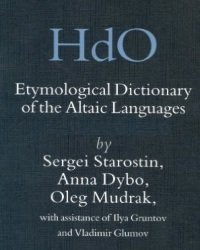
S. Starostin – An Etymological Dictionary of Altaic Languages
1.445 ₽
Автор: S. Starostin
Название книги: An Etymological Dictionary of Altaic Languages
Формат: PDF
Жанр: Лингвистика
Страницы: 2098
Качество: Изначально компьютерное, E-book
This comparative and etymological dictionary of the more than fifty languages traditionally classified as Altaic is arguably the most comprehensive, systematic work as yet on the subject. Subdivided into five branches: Turkic, Mongolian, Tungus-Manchu, Korean and Japanese, it deals with the entire Altaic family. The introduction contains a detailed account of the phonetic correspondences between Altaic languages, as well as their morphological and lexical characteristics. The body of the dictionary presents almost 3000 lexical matches between different subgroups of Altaic, with Proto-Altaic reconstructions and detailed reflexes in ancient and modern languages. Wherever possible comments are given to distinguish between inherited vocabulary and various later interlingual borrowings. With detailed indices for each language. A true reference work of great importance
This is a first attempt at an etymological dictionary of Altaic languages.
The history of Altaic comparative studies is a difficult one. Even now
there is still no consensus among scholars on the very problem of the
existence of Altaic as a genetic unit. We sincerely hope that this publication
will bring an end to this discussion, which has lasted for more
than 30 years.
The dictionary presented below should by no means be regarded as
final and conclusive. We have tried to collect all existing etymologies
that seem to be semantically reliable and fit the established system of
phonetic correspondences. Among the 2800 etymologies presented approximately
half are new, developed by our team during more than 10
years of preparatory work. New etymologies will most certainly follow,
while some of those presented will doubtlessly be rearranged or
even refuted in the course of future research. The current reconstruction
will also inevitably change – as it happened with Indo-European,
Uralic and most of the other established language families during the
decades of their investigation. Nevertheless, we regard it as a valid
starting point, worth presenting to the general academic audience, and
look forward for criticism, suggestions and corrections.
Wherever necessary we give references to etymological literature,
although we decided to keep the discussion as short as possible. Many
existing etymologies are not mentioned in this dictionary because they
contradict the system of correspondences followed in the present volume
or because we think we have found better solutions. It would be
futile, e.g., to struggle with some of the etymologies linking words with
Jpn. *p- to those with Altaic *k῾-, since we do not believe that such a
correspondence exists at all. We must say, however, that most of the
etymologies presented in the classical works of G. Ramstedt and N.
Poppe, as well as very many Japanese etymologies of R. Miller and S.
Martin, have been preserved, which in itself shows that the proposed
phonological reinterpretation of the Proto-Altaic system is just an extension
of previous research.
The Altaic family as a genetic unity of Turkic, Mongolian and Tungus-
Manchu languages had been proposed as early as 1730 by F. J. v. Stralenberg. Until the early 20th century, however, there was no clear
idea about the classification or comparative grammar of Altaic. The few
scholars that studied the languages regarded them rather as part of a
common Ural-Altaic family, together with Finno-Ugric and Samoyedic
languages – an idea now completely discarded.
The undebatable father of scientific Altaic studies was Gustaf John
Ramstedt. He started his research in the very beginning of the century,
and made a huge contribution both to Altaic studies as a whole and to
the study of individual subgroups of Altaic. His research was concluded
by the fundamental “Einführung in die Altaische Sprachwissenschaft”
published in 1952, two years after his death in 1950.
Ramstedt formulated many basic phonetic rules of correspondences
between the Altaic languages, laid the foundations of Altaic comparative
grammar, and finalized the subclassification of the Altaic family by
separating Uralic from Altaic and adding Korean and Japanese to its
classic “Western” core.
Other scholars whose contributions to the Altaic field were really
substantial are N. Poppe, K. Menges, V. Tsintsius, V. Illich-Svitych, S.
Martin and R. A. Miller. A full account of their achievements would
deserve a special study, but suffice it to say that due to their efforts a
basic reconstruction of Common Altaic was already available by the
late fifties / early sixties of the 20th century.
A reaction started in the sixties. A number of scholars (for some reason,
primarily Turcologists) initiated what seemed at that time a
counter-Altaic revolt. The names of the main anti-Altaicists are G.
Clauson, G. Doerfer and A. Shcherbak. Among them G. Doerfer should
be distinguished as the most consistent, most fruitful, and most vigorous
in his anti-Altaic efforts.
Although the arguments of anti-Altaicists were many – from phonetic
to lexico-statistical – their basic argument can be summed up as
follows: the relationship between the Altaic languages is not what a
genuine genetic relationship should be. All the numerous resemblances
between them were explained as a result of secondary convergence
within a “Sprachbund” of originally unrelated languages. The whole
idea of the original Proto-Altaic unity was very seriously threatened.
Simultaneously the Eastern branch of Altaic – Korean and Japanese,
or Korean-Japanese – was brought under heavy suspicion. No serious
alternative for Korean was proposed, but an active search for
non-Altaic relatives of Japanese began. Distinguished scholars like S.
Murayama (who always hesitated between the Altaic and Austronesian
affinity of Japanese) and P. Benedict started searching for Japanese-Austronesian parallels, with Benedict (following mainly the Japanese
scholar Kawamoto) finally proclaiming the inclusion of Japanese –
without Korean and Altaic – into his Austro-Thai family.
After a critical evaluation of the problem we came to the conclusion
that Altaic should be still characterized as a genetic unity, probably
forming a branch of the larger Nostratic macrofamily, but certainly a
separate family on its own. The very fact that it is possible to compile a
dictionary of common Altaic heritage appears to be a proof of the validity
of the Altaic theory.
The work on the dictionary started in the late 80’s. Initially we
worked together with I. Shervashidze, who later switched to different
projects, and the work was continued by S. Starostin, A. Dybo and O.
Mudrak. We must gratefully mention our numerous younger colleagues
and students who helped at various stages of compiling the
dictionary, and especially Ilia Gruntov, Vladimir Glumov, Vasiliy
Chernov and Martine Robbeets. The work was sponsored by grants
from the Soros (“Open Society”) foundation, from the Russian Foundation
of Fundamental Research and the Russian Foundation of Humanities;
since 1997 the research was supported by the Investor Group
“Ariel” within the framework of the “Tower of Babel” project.
All the work was conducted within the STARLING database created
by S. Starostin. The Altaic database is constantly available on line
at the Web address http://starling.rinet.ru. Special thanks go to programmers:
Ph. Krylov who designed the Windows version of
STARLING software, Yu. Bronnikov who designed the scripts for the
Internet site; and to S. Bolotov who designed the fonts for this complicated
edition.
We would like also to express deep gratitude to colleagues who had
read the manuscript and given us many valuable suggestions, both
stylistical and etymological: Bernard Comrie, Alexander Lubotsky and
Cormack McCarthie.
Описание
S. Starostin – An Etymological Dictionary of Altaic Languages — фундаментальный трёхтомный труд, посвящённый сравнительно-историческому изучению алтайской языковой семьи. Словарь содержит более 2500 реконструированных праформ и этимологий, охватывая тюркские, монгольские, тунгусо-маньчжурские, корейский и японский языки.
Автор на основе строгих фонетических соответствий и лексических данных предлагает единую реконструкцию алтайского праязыка, анализирует регулярные звуковые переходы и предлагает новую периодизацию языковых контактов. Издание стало значимой вехой в алтаистике и до сих пор остаётся ключевым справочным источником для специалистов.
- Лингвистам, занимающимся сравнительным языкознанием и реконструкцией
- Специалистам по тюркологии, монголистике, японистике и кореистике
- Студентам и аспирантам филологических факультетов
- Исследователям происхождения языков и древних миграций народов Евразии
Только зарегистрированные клиенты, купившие данный товар, могут публиковать отзывы.
Похожие


Другие книги раздела «Лингвистика»
Все книги раздела «Лингвистика» →
Смежные разделы: Бизнес-Книги · Биография · Боевики и Триллеры · Детективы · Детские книги · Школа · Дом и Семья · Здоровье · Искусство · Историческая проза · Классика · Компьютеры
Рекомендуем также
- M. Yousef – miRNomics. MicroRNA Biology and Computational Analysis (2014)
- P. Bourgine – Morphogenesis (2011)
- J. Lancaster – Fundamental Mathematics and Physics of Medical Imaging (2017)
- A. Svendsen – Understanding Enzymes (2016)
- V. Greanya – Bioinspired Photonics (2016)
- A. Khanna – MRI Essentials for the Spine Specialist
- W. Bauer – University Physics with Modern Physics (2nd edition, 2013)
- V. Feigin – Handbook of Clinical Neuroepidemiology

Отзывы
Отзывов пока нет.