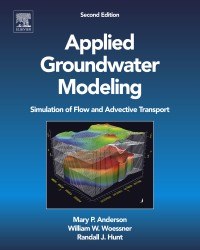
M. Anderson – Applied Groundwater Modeling (2015)
3.780 ₽
Автор: M. Anderson
Название книги: Applied Groundwater Modeling
Формат: PDF
Жанр: Геология
Страницы: 631
Качество: Изначально компьютерное, E-book
This second edition is motivated by the many significant developments in groundwater modeling since the first edition was published in 1992. The increased computational speed and capacity of present day multicore computers as well as the availability of sophisticated graphical user interfaces (GUIs) and geographical information systems have transformed groundwater modeling. But more importantly, new ways of calibrating models and analyzing uncertainty and new powerful codes that provide enhanced modeling tools are revolutionizing the science of groundwater modeling. In this second edition, we discuss many of the important advances in applied groundwater modeling introduced since 1992 and also update the treatment of fundamentals of groundwater flow modeling covered in the first edition. The chapters on model calibration and forecasting (Chapters 9 and 10 in the second edition) are entirely new and include discussion of new tools for parameter estimation and uncertainty analysis in forecast simulations.
Similar to the first edition, our book is intended as an introduction to the applied science of modeling groundwater flow. We focus on groundwater modeling practice.
Modeling Fundamentals
Introduction]
Motivation for Modeling
What Is a Model?
Purpose of Modeling
Limitations of Models
Modeling Ethics
Modeling Workflow
Common Modeling Errors
Use of This Text
Problems
References
Box
Data-Driven (Black-Box) Models
Modeling Purpose and Conceptual Model
Modeling Purpose
Conceptual Model: Definition and General Features
Components of a Conceptual Model
Uncertainty in the Conceptual Model
Common Modeling Errors
Problems
References
Boxes
Geographical Information Systems (GIS)
Describing the Void Space
Basic Mathematics and the Computer Code
Introduction
Governing Equation for Groundwater Flow
Boundary Conditions
Analytical Models
Numerical Models
Code Selection
Code Execution
Common Modeling Errors
Problems
References
Boxes
The Hydraulic Conductivity Tensor
Insights from Analytical Solutions
Designing the Numerical Model
Model Dimensionality and Setting Boundaries
Spatial Dimensions
Selecting Boundaries
Implementing Boundaries in a Numerical Model
Extracting Local Boundary Conditions from a Regional Model
Simulating the Water Table
Common Modeling Errors
Problems
References
Boxes
Two-Dimensional or Three-DimensionaldMore about the D-F Approximation
Profile Models
Spreadsheet Solution of a Finite-Difference Profile Model
The FreshwatereSeawater Interface
Large Water Budget Errors Arising from an HDB
What Controls the Water Table?
Spatial Discretization and Parameter Assignment
Discretizing Space
Horizontal Nodal Spacing
Model Layers
Parameters
Parameter Assignment
Parameter Uncertainty
Common Modeling Errors
Problems
References
Boxes
Numerical Error Inherent to Irregular FD Grids
Vertical Anisotropy and the Transformed Section
Upscaling Hydraulic Conductivity: Layered Heterogeneity and Vertical Anisotropy
When Infiltration becomes Recharge
More on Sources and Sinks
Introduction
Pumping and Injection Wells
Areally Distributed Sources and Sinks
Drains and Springs
Streams
Lakes
Wetlands
Common Modeling Errors
Problems
References
Boxes
Guidelines for Nodal Spacing around a Well Node
Watershed Modeling
Surface Water Modeling
Steady-State and Transient Simulations
Steady-State Simulations
Steady State or Transient?
Transient Simulations
Initial Conditions
Perimeter Boundary Conditions for Transient Simulations
Discretizing Time
Characterizing Transient Conditions
Common Modeling Errors
Problems
References
Particle Tracking, Calibration, Forecasting, and Uncertainty Analysis
Particle Tracking
Introduction
Velocity Interpolation
Tracking Schemes
Weak Sinks
Applications
Particle Tracking Codes
Common Errors in Particle Tracking
Problems
References
Boxes
Effective Porosity
Flow Nets
More on Capture Zones and Contributing Areas
Model Calibration: Assessing Performance
Introduction
Limitations of History Matching
Calibration Targets
Manual History Matching
Parameter Estimation: Automated Trial-and-Error History Matching
Highly Parameterized Model Calibration with Regularized Inversion
A Workflow for Calibration and Model Performance Evaluation
Common Modeling Errors
Problems
References
Boxes
Historical Context for Parameter Estimation
Tips for Running a Parameter Estimation Code
Tips for Effective Pilot Point Parameterization
A “Singularly Valuable Decomposition”eBenefits for Groundwater Modeling
Code/Model Verification and Model Validation
Additional Parameter Estimation Tools
Forecasting and Uncertainty Analysis
Introduction
Characterizing Uncertainty
Addressing Uncertainty
Basic Uncertainty Analysis
Advanced Uncertainty Analysis
Reporting Forecast Uncertainty
Evaluating Forecasts: Postaudits
Common Modeling Errors
Problems
References
Boxes
Historical Overview of Uncertainty Analysis in Groundwater Modeling
Travel Time in Heterogeneous Aquifers: Impossible to Forecast Accurately?
Cost-Benefit Analyses of Future Data Collection
Using Monte Carlo Methods to Represent Forecast Uncertainty
The Modeling Report and Advanced Topics
The Modeling Report, Archive, and Review
Introduction
The Modeling Report
Archiving the Model
Reviewing the Modeling Report
Common Errors in Report/Archive Preparation and Review
Problems
References
Beyond Basic Modeling Concepts
Introduction
Complex Groundwater Flow Processes
Transport Processes
Surface Water Processes
Stochastic Groundwater Modeling
Decision-Support and Optimization
Final Comments
Описание
M. Anderson – Applied Groundwater Modeling (2015) — практическое руководство по численному моделированию подземных вод. Книга подробно разбирает, как строить реалистичные модели aquifer, учитывать геологические особенности, проводить калибровку и анализировать неопределённости.
Авторы объясняют ключевые концепции математического моделирования, работу с MODFLOW и другими инструментами, методы решения уравнения подземного потока, а также современные подходы к оценке воздействия на водоносные горизонты. Особое внимание уделяется интеграции полевых данных, выбору граничных условий и проверке достоверности моделей.
- Гидрогеологам и специалистам по подземным водам, работающим с проектами водоснабжения и охраны окружающей среды
- Инженерам и научным сотрудникам, занимающимся численным моделированием в геологии
- Студентам и аспирантам геологических и экологических специальностей, изучающим groundwater modeling
- Профессионалам, которым нужно уверенно применять MODFLOW и аналогичные программы в реальных задачах
Только зарегистрированные клиенты, купившие данный товар, могут публиковать отзывы.
Похожие



Другие книги раздела «Геология и Геодезия»
- P. Delfiner – Geostatistics. Modeling Spatial Uncertainty (Second edition)
- R. Selley – Encyclopedia of Geology (2004)
- R. Stickney – Encyclopedia of AquaCulture
- Rob Kitchin – International Encyclopedia of Human Geography
- S. Mitra – High Pressure Geochemistry and Mineral Physics
- R. Przybylak – The Climate of the Arctic (2016)
- Sergei Grinevetsky – The Black Sea Encyclopedia (2015)
- Sreepat Jain – Fundamentals of Physical Geology (2014)
- Stephen Dutch – Earth Science. Earth Materials and Resources
- V. Bennett – Earth Oldest Rocks
- W. Wittke – Rock Mechanics Based on an Anisotropic Jointed Rock Model
- Willi Freeden – Handbook of Geomathematics (Second edition, 2015)
- William Press – Numerical Recipes. The Art of Scientific Computing (Third edition)
- А. Корольченко – Пожаровзрывоопасность веществ и материалов и средства их тушения (Второе издание, 2 Тома)
- К. Антонович – Использование спутниковых радионавигационных систем в геодезии
- К. Макаров – Основы инженерной геодезии
Все книги раздела «Геология и Геодезия» →
Смежные разделы: Авиация и космонавтика · Астрономия · Железнодорожное дело · Журналистика · Математика · Машиностроение · Нанотехнологии · Научно-популярная литература · Физика · Химия · Экология · Энергетика
Рекомендуем также
- P. Martino – Atlas of Ultrasonography in Urology Andrology, and Nephrology (2017)
- J. Grafman – Traumatic Brain Injury (2015)
- G. Jaouen – Medicinal Organometallic Chemistry
- M. Gey – Instrumentelles und Bioanalytisches Praktikum (Немецкий язык, 2017)
- B. Bhushan – Nanotribology and Nanomechanics (2017)
- A. Tiwari – Intelligent Nanomaterials (2016)
- M. Sankir – Hydrogen Production Technologies (2017)
- A. Hohl – Testosterone (2017)
Отзывы
Отзывов пока нет.