
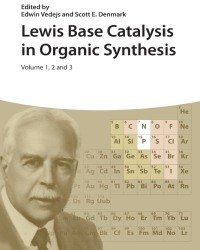
E. Vedejs – Lewis Base Catalysis in Organic Synthesis (2016)
4.890 ₽
Автор: E. Vedejs
Название книги: Lewis Base Catalysis in Organic Synthesis (2016)
Формат: PDF
Жанр: Химия
Страницы: 1441
Качество: Изначально компьютерное, E-book
This three-volume set represents the first comprehensive coverage of the rapidly expanding field of Lewis base catalysis that has attracted enormous attention in recent years. Lewis base catalysis is a conceptually novel paradigm that encompasses an extremely wide variety of preparatively useful transformations and is particularly effective for enantioselectively constructing new stereogenic centers. As electron-pair donors, Lewis bases can influence the rate and stereochemical course of myriad synthetic organic reactions. The book presents the conceptual/mechanistic principles that underlie Lewis base catalysis, and then builds upon that foundation with a thorough presentation of many different reaction types. And last but not least, the editors, Prof. Edwin Vedejs and Prof. Scott E. Denmark, are without doubt the leaders in this emerging field and have compiled high quality contributions from an impressive collection of international experts.
Contents
Volume 1
From Catalysis to Lewis Base Catalysis with Highlights from 1806 to 1970
Principles
Principles, Definitions, Terminology, and Orbital Analysis of Lewis Base–Lewis Acid Interactions Leading to Catalysis
Thermodynamic Treatments of Lewis Basicity
Quantitative Treatments of Nucleophilicity and Carbon Lewis Basicity
Mechanism and Lewis Base Catalysis: Nucleophilicity Is Only Part of the Story
Anhydride Activation by 4-Dialkylaminopyridines and Analogs (n – π*)
Mechanistic Understanding of Proline Analogs and Related Protic Lewis Bases (n – π*)
Mechanistic Options for the Morita–Baylis–Hillman Reaction (n – π*)
Mechanism of C-Si Bond Cleavage Using Lewis Bases (n – σ*)
Bifunctional Lewis Base Catalysis with Dual Activation of X3Si-Nu and C=O (n – σ*)
Bifunctional Lewis Base Catalysis with Dual Activation of R–M and C=O (n – σ*)
The Corey–Bakshi–Shibata Reduction: Mechanistic and Synthetic Considerations – Bifunctional Lewis Base Catalysis with Dual Activation
Volume 2
Applications: Lewis Base Catalysis Involving an n – π* Activation Step
Chiral Lewis Base Activation of Acyl and Related Donors in Enantioselective Transformations
(n – π*)
Catalytic Generation of Ammonium Enolates and Related Tertiary Amine-Derived Intermediates: Applications, Mechanism, and Stereochemical Models (n – π*)
Morita–Baylis–Hillman, Vinylogous Morita–Baylis–Hillman, and Rauhut–Currier Reactions
Beyond the Morita–Baylis–Hilman Reaction (n – π*)
Iminium Catalysis (n – π*)
Enamine-Mediated Catalysis (n – π*)
Volume 3
Applications: Enhanced Nucleophilicity by Lewis Base Activation (n – σ*, n – n*)
Si-C-X and Si-C-EWG as Carbanion Equivalents under Lewis Base Activation (n – σ*)
Activation of B-B and B-Si Bonds and Synthesis of Organoboron and Organosilicon Compounds through Lewis Base-Catalyzed Transformations (n – n*)
Applications: Enhanced Electrophilicity and Dual Activation by Lewis Base Catalysis (n – σ*)
Lewis Base-Catalyzed Reactions of SiX 3 -Based Reagents with C=O, C=N (n – σ*)
Lewis Base-Catalyzed, Lewis Acid-Mediated Reactions (n – σ*)
Lewis Bases as Catalysts in the Reduction of Imines and Ketones with Silanes (n – σ*)
Reactions of Epoxides (n – σ*)
Lewis Base-Catalyzed Generation of Electrophilic Intermediates
Lewis Base Catalysis: A Platform for Enantioselective Addition to Alkenes Using Group 16
and 17 Lewis Acids (n – σ*)
Bifunctional (and Multifunctional) Catalysis
Bifunctional and Synergistic Catalysis: Lewis Acid Catalysis and Lewis Base-Assisted Bond
Polarization (n – σ*)
Bifunctional Catalysis with Lewis Base and X-H Sites That Facilitate Proton Transfer or Hydrogen Bonding (n – π*)
Carbenes: Lewis Base Catalysis Triggers Multiple Activation Pathways
Описание
Lewis Base Catalysis in Organic Synthesis — фундаментальное двухтомное руководство, посвященное применению льюисовых оснований в качестве катализаторов в органической химии. Книга подробно разбирает механизмы активации субстратов, стереоконтроль реакций и современные методологии, которые позволяют проводить синтезы более эффективно и селективно.
Авторы рассматривают как классические примеры (фосфиновые, аминовые, N-гетероциклические карбены), так и новейшие разработки в области органокатализа. Особое внимание уделено роли льюисовых оснований в асимметрическом синтезе, активации силанов, карбонилировании и других ключевых превращениях.
- Для химиков-синтетиков, работающих в академической науке и фармацевтической промышленности
- Для аспирантов и студентов старших курсов, специализирующихся на органической химии
- Для исследователей, разрабатывающих новые каталитические системы и методологии
- Для всех, кто хочет глубже понять принципы современного органокатализа
Только зарегистрированные клиенты, купившие данный товар, могут публиковать отзывы.
Похожие


Другие книги раздела «Химия»
- И. Дияров – Химия нефти. Руководство к практическим и лабораторным занятиям (2013)
- С. Покровская – Технология переработки нефти. Производство нефтяных масел
- J. Fanchi – Introduction to Petroleum Engineering (2017)
- X. Wang – Azo Polymers (2017)
- Y. Chen – Helicene Chemistry (2017)
- H. Belitz – Food Chemistry (4th edition)
- H. Belitz – Lehrbuch der Lebensmittel Chemie (6 Auflage, Немецкий язык)
- J. Burgot – The Notion of Activity in Chemistry (2017)
- J. Velisek – The Chemistry of Food (2014)
- J. Walker – The Protein Protocols Handbook (3rd edition)
- P. Ashurst – Chemistry and Technology of Soft Drinks and Fruit Juices (2016)
- M. Shamsuddin – Physical Chemistry of Metallurgical Processes (2016)
- C. Bruns – The Nature of the Mechanical Bond (2017)
- A. Tiwari – Advanced Ceramic Materials (2016)
- H. Ohshima – Encyclopedia of Biocolloid and Biointerface Science (2016)
- M. Loudon – Organic Chemistry (6th edition, 2016)
Смежные разделы: Авиация и космонавтика · Астрономия · Геология и Геодезия · Железнодорожное дело · Журналистика · Математика · Машиностроение · Нанотехнологии · Научно-популярная литература · Физика · Экология · Энергетика
Рекомендуем также
- M. Benton – Introduction to Paleobiology and the Fossil Record (2009)
- С. Кавтарадзе – Анатомия архитектуры
- A. Cobb – Herbicides and Plant Physiology
- J. Prohens – Handbook of Plant Breeding. Vegetables (2 Volume set)
- J. Zinck – Geopedology. An Integration of Geomorphology and Pedology for Soil and Landscape Studies (2016)
- Pan Ming Huang – Handbook of Soil Sciences (2012)
- U. Quattrocchi – CRC World Dictionary of Grasses
- Q. Tran – Emerging Trends in Applications and Infrastructures for Computational Biology Bioinformatics, and Systems Biology (2016)

Отзывы
Отзывов пока нет.