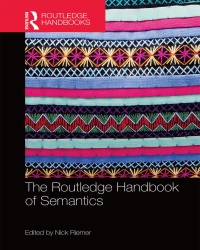
N. Riemer – The Routledge Handbook of Semantics (2015)
986 ₽
Автор: N. Riemer
Название книги: The Routledge Handbook of Semantics
Формат: PDF
Жанр: Лингвистика
Страницы: 551
Качество: Изначально компьютерное, E-book
The Routledge Handbook of Semantics provides a broad and state-of-the-art survey of this field, covering semantic research at both word and sentence level. It presents a synoptic view of the most important areas of semantic investigation, including contemporary methodologies and debates, and indicating possible future directions in the field.
Written by experts from around the world, the 29 chapters cover key issues and approaches within the following areas:
meaning and conceptualisation;
meaning and context;
lexical semantics;
semantics of specific phenomena;
development, change and variation.
The French Marxist Georges Politzer – later to be executed by the Nazis at Mont Valérien –
began his classic Critique of the foundations of psychology with the following remark:
Even if no one considers protesting against the general claim that theories are mortal and
that science can only advance over its own ruins, it is barely possible to make the proponents
of an existing theory recognize its death. The majority of academics is composed
of researchers who, having neither the sense of life, nor that of truth, can only work in
the shelter of officially recognized theories: it is impossible to ask them to acknowledge
a fact which isn’t a given, but which has to be created . . . And so they acknowledge the
mortality of all theories, even their own, but only in the abstract: it always strikes them
as unlikely that, for them, the instant of death could already have arrived.
(1974 [1928]: 1; trans NR)
The young philosopher’s declaration is impressive for many reasons. But if Politzer’s disdain
for his contemporaries smacks of the anticlericalism of the (future) cardinal, he can
also be criticized for grounding the explanation of a social phenomenon – the longevity of
classical psychology, in an “experimental” or “scientific” guise, in the wake of Wundt – on
personal and moral considerations, not on the concrete ones to which, as a good materialist,
he ought really to have appealed.
Both Politzer’s evaluation of the state of psychology in his time and the explanation for
it he offers are worth considering in light of current linguistic semantics, a subfield whose
object – meaning and reference – could hardly be more ambiguous or protean, and which
is studied by a highly various scatter of often incompatible theoretical approaches, each of
which makes truth-claims, at least implicitly, in favour of its own kind of analysis. As the
different chapters of this handbook attest, these various approaches are all in rude good
health, offering stimulating insights into different aspects of the phenomenon we call meaning.
In such a situation of rich theoretical heterogeneity, it is no surprise that consensus is
almost wholly absent about any of the key questions semantics sets out to answer: what
meaning as an object of study might, in detail, amount to; how it – whatever “it” is – should
be theoretically approached; how – even pretheoretically – it should be characterized on the level of individual expressions, constructions, and utterances; and what relation semantics
should entertain with other fields of enquiry within and outside linguistics. Significantly
differing points of view on some or all of these questions are characteristic of the different
competitor theories that populate the field. Depraetere and Salkie’s generalization in Chapter
20 about the study of tense – “even the basics are controversial” – applies in spades to semantics
as a whole.
This heterogeneity might, of course, be no more than a consequence of the comparative
youth of the modern empirical study of language, especially in so far as meaning is
concerned. If this is the case, however, it’s striking how little explicit theory-evaluation is
undertaken by semantics researchers, and how rarely theoretical bridges between different
research programmes are even sought, let alone found. Exceptions exist, of course, such
as the effort made to assess the compatibility between Cognitive Semantics and Relevance
Theory (e.g. Wilson (2011)) or the consistent effort by Anna Wierzbicka to compare her
Natural Semantic Metalanguage (NSM) theory to alternative accounts. In general, though,
the various schools of semantic research pursue largely independent programmes. No doubt
as a result, the lack of consensus within the discipline is all too rarely even acknowledged.
This is particularly the case for the most basic characterization of descriptive meaning in
lexical semantics, on which so many subsequent theoretical explorations rest.
Before one can investigate how meanings relate to syntax or pragmatics, or to each other,
or how they change, vary, or are acquired, one has to have an account of what these meanings
are. This, however, is the locus of the most vexed, but also the most disavowed, questions in the
field. Unless they take lexical meaning as atomic, semanticists of different schools continue to
assert that the “meaning” of such and such an expression is such and such, despite the fact that
many in the discipline are likely not to agree with them, and assuming that any disagreements are
merely a consequence of lack of research, likely to be resolved with further work – something
of a convenient fiction, given that people have been trying to write systematic definitions for
many centuries at least. The disagreements are not trivial, and have substantive consequences
for semantic modelling, as I have argued elsewhere (Riemer 2005). Since the methodological
canons linguistics has adopted from the natural sciences make expert consensus a necessary, if
not a sufficient, condition for confidence in the discipline’s results, its almost complete absence
in the study of meaning is the elephant in the room of any semantics that wants to associate itself
with the empiricism and scientificity mostly assumed in “mainstream” linguistics, and it should,
I believe, prompt some serious reconsideration of the nature of the discipline.
To say that the heterogeneity of current theoretical efforts should be the occasion for disciplinary
self-reflection is not to say that there is anything intrinsically problematic in it. The
theoretical balkanization in studies of meaning need only be seen as a flaw if it is taken for
granted that semantics, on the model of physics, should be aiming at a unique theory of all
meaning. Given the ongoing influence on linguistics of a model of enquiry rooted in how the
natural sciences are, at least, imagined to be, this assumption is the one that is either typically
made, or that seems tacitly presupposed by most semanticists’ work. Different semantic
investigations are most naturally understood as early contributions to the search for the
authoritative, final account of natural language meaning. Investigators are likely to construe
themselves as collectively engaged, at least ideally, in a convergent intellectual project, which
will ultimately issue in the emergence of a single theory of meaning in natural language –
itself taken to be an objective phenomenon open to techniques of observation and explanation
that are certainly exacting and labour-intensive, but at least epistemically uncontroversial.
Theoretical heterogeneity is therefore likely to be seen, in principle, as nothing other than a
staging post on the road towards a final theory of meaning for natural language Current investigations into semantics characteristically form part of a project intended to
illustrate and stress the pluralism and diversity of human mentality and culture. Nevertheless,
the overarching tendency of semantic research I have just sketched, along with its default
goal – to characterize the semantic structure of languages – arguably sits uneasily with this
intention, for two reasons. First, it presupposes that linguistic expressions function in linguistic
interaction by conveying fixed and invariant content, which it is the semanticist’s task to
characterize. This assumption is not only less self-evident than it seems (Riemer 2013), it
also implies the controversial postulation of a clear boundary between linguistic and nonlinguistic
information, and sidelines a hermeneutic perspective that might do better justice to
the contextual co-construction of significance between speaker and hearer (the ideas developed
in Gadamer (2004) [1960], especially chapter 5, give some indication of the premises
of such a perspective).
Second, it all too often implies the existence of a level of analysis on which cultural
and cognitive diversity bottoms out into a format that can be captured in a unique analytical
metalanguage – typically, given the history of linguistics, one built out of meaningful
elements of English or some other first-world, Western language. English (or French, or
German, orâ•‹.â•‹.â•‹.), we assume, can be used to semantically analyze any other language, but
not any language can be used to semantically analyze English or other first-world languages,
since many languages lack the appropriate lexical and other resources. If semantic theory
had succeeded in achieving a widely accepted body of confirmed results in its “Standard
Average European” (SAE)-based metalanguages, it would be hard to see this asymmetry as
anything more than an instance of the obvious dependence of theoretical enquiry on highly
developed technical registers in the languages in which it is conducted. But in the absence of
consensus in the discipline, it is reasonable to ask whether the assumption that all meanings
can be represented in SAE metalanguages is justified.
In its totalizing ambition, there are many reasons to think that the project of reductively
characterizing semantic structure may be undesirable in itself. As Stanley Rosen notes,
“every hermeneutical program is at the same time itself a political manifesto or the corollary
of a political manifesto” (2003: 141). This applies a fortiori to the programme of linguistic
semantics, the goal of which is not, as in (applied) hermeneutics, to interpret texts, but to
give an account of the very constituents of meaning that any textual interpretation presupposes.
Since semantic analyses of language – or, to give them an older name, attempts to
identify the “language of thought” – are closely related to claims about the conceptual abilities
of speakers and the cultural resources of communities, we semanticists surely should
be – and often are – cautious in arguing for the theoretical uniqueness for our current models
of meaning. Claiming that, from the point of view of the linguistic system, such and such an
expression has such and such core or central semantic properties risks reductively diminishing
our picture of the complexity of languages, and hence of the linguistic practices and
conceptual and cultural richness of their speakers.
Science, however, always operates through idealizing analytical procedures which carry
exactly these kinds of risk. If there were strong evidence in favour of the correctness of
one particular semantic model over another, and hence of the particular characterizations of
meaning it supplied, the qualms that I am airing here could be dismissed as misguided and
antiscientific Romanticism. But in the absence of consensus about meaning and its study,
semanticists should surely be careful not to give the wrong impression about the status of
our investigations into meaning. The down-side of doing so is starkly revealed when we consider
the situation of semanticists from the first world turning their attention to mapping the
underlying meaning structure of indigenous and minority languages currently threatened by the forces of global capitalism. Moody-Adams’ (2014) observation, in a recent review of a
book on anthropology and philosophy, about anthropologists’ claim to theoretically account
for culture and society also applies to linguists’ claim to theoretically account for meaning:
as a discipline, ethnography has rightly felt the need to come to terms with its origins
in the context of colonialism, and the question of whether, even unwittingly, the
claims of the (mostly western) “outsider” to be able to provide authoritative understandings
of another’s way of life might be inextricably bound up with the effort to
dominate the other.
In this light, the claim of, for instance, Wierzbicka (2014) to transcend the intellectual
domination of English through a rigorously established unique metalanguage for meaning
description simply seems to replace one code (English) with another (NSM) as the uniquely
authoritative metalanguage of semantic analysis. Wierzbicka’s impetus to resist ethnocentrism
in semantic analysis and its accompanying “colonialism of thought” are admirable and
would be widely shared. But regardless of the particular theoretical framework adopted, it is
offset by the objectivation of meaning that flows from the adoption of a unique and exclusive
metalanguage for the description of semantic content, which arguably duplicates the very
hegemonic move it sets out to avoid. Whether it is English, the NSM, cognitive semantics
analyses, or model-theoretic formalizations that are claimed as the best representational format
for characterizing semantic structure, the result is to reduce what arguably should be
seen as an inherently plural, hermeneutically open-ended and fluid object – the significance
of natural discourse – to a unique and unambiguous level of content, fully capturable in the
theorist’s own code. This theoretical move is, arguably, impoverishing, since it enforces a
unitary conception of meaning, fixes interpretations, and, more often than not, presupposes
the existence of a unique metalanguage in which all meaning can be represented. If semantic
theory had commonly agreed-on explanatory achievements to show for this move, there
would be some reason to think that the attendant impoverishment was no more than a characteristic
instance of the idealization and simplification that always accompanies naturalistic
enquiry. In the absence of such achievements, different questions should arise.
The fact that these kinds of scruple are not usually raised in linguistic semantics makes it
all the more interesting to entertain them. While in other domains of enquiry the abstraction,
reduction, and idealization of descriptive facts reflects no more than the standard objectivizing
procedures of science, in a domain that, like semantics, is inherently bound up with the
intentions, values, and subjective interpretations of human actors, such a methodological decision
risks excluding the hermeneutic dimension arguably unique to meaningful interaction,
and it should not be taken lightly. As a human “science”, semantics concerns a sphere that is
intrinsically bound up with the behaviour of autonomous creatures with their own pluralistic
ways of being and understanding. In such a domain, it is not immediately clear that theoretical
insight is best obtained by objectifying reduction, assimilating meaning to a unique object
open to empirical methods deriving from the study of the objective world, instead of by pluralistic
interpretation, assimilating the study of meaning to that of higher-level socio-cultural
manifestations. Cultural anthropology, literary history, and sociology – all three empirical
disciplines that offer explanations, and not just descriptions, of their objects of study – do not
aim to produce unique and reductive analyses of their explananda; it is no more obvious that
semanticists should try to uniquely characterize the literal meaning of an expression than it
is that literary historians should try to uniquely pin down the single correct interpretation of
a canonical text.
Описание
The Routledge Handbook of Semantics — фундаментальное справочное издание, которое предлагает всесторонний обзор современной семантической теории. Под редакцией Ника Римера в книге собраны работы ведущих мировых специалистов, охватывающие ключевые направления семантики от формальной логики и лексической семантики до прагматики, когнитивных подходов и компьютерной семантики.
Издание последовательно разбирает основные теоретические модели, методы анализа значения, историю развития дисциплины и актуальные дискуссионные вопросы. Особое внимание уделяется взаимодействию семантики с другими областями лингвистики, философии языка и когнитивных наук.
- студентам и преподавателям лингвистических факультетов
- исследователям, работающим в области семантики и прагматики
- специалистам по компьютерной лингвистике и обработке естественного языка
- всем, кто профессионально интересуется теорией значения в языке
Только зарегистрированные клиенты, купившие данный товар, могут публиковать отзывы.
Похожие


Другие книги раздела «Лингвистика»
- S. Bermann – A Companion to Translation Studies (2014)
- S. Chelliah – Handbook of Descriptive Linguistic Fieldwork (2011)
- S. Davis – Semantics. A Reader
- S. Ehrlich – The Handbook of Language, Gender and Sexuality (Second edition, 2014)
- S. Starostin – An Etymological Dictionary of Altaic Languages
- T. Givon – Syntax. An Introduction (2 Volumes)
- Tom Dalzell – The Routledge Dictionary of Modern American Slang (2009)
- Vladimir Orel – A Handbook of Germanic Etymology
- Vyvyan Evans – Cognitive Linguistics. An Introduction
- W. Harbert – The Germanic Languages
- W. Levelt – A History of Psycholinguistics (2014)
- Y. Cui – Teaching Methods in Language Translation and Interpretation (2015)
- А. Плуцер-Сарно – Большой словарь мата (Для филологов) 18+
- А. Шапошников – Этимологический словарь современного русского языка (2010)
- Академия Наук СССР, Н. Шведова – Русская грамматика (1980, Перепечатано)
- Виктор Суходрев – Язык мой-друг мой
Все книги раздела «Лингвистика» →
Смежные разделы: Бизнес-Книги · Биография · Боевики и Триллеры · Детективы · Детские книги · Школа · Дом и Семья · Здоровье · Искусство · Историческая проза · Классика · Компьютеры
Рекомендуем также
- О. Швецова – Технология изготовления изделий по индивидуальным заказам
- R. Patel – Green Biocatalysis (2016)
- T. Jezierski – Canine Olfaction Science and Law (2016)
- M. Colecchia – Pathology of Testicular and Penile Neoplasms (2016)
- Н. Куликов – Водоснабжение (2016)
- C. Salgado – Aesthetic and Functional Surgery of the Genitalia
- A. Khan – Precision Molecular Pathology of Breast Cancer (2015)
- J. Rowley – Chromosomal Translocations and Genome Rearrangements in Cancer (2015)
Отзывы
Отзывов пока нет.