
50% Off 
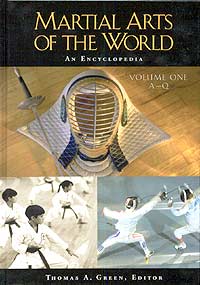
Thomas A. Green – Encyclopedia of Martial Arts Of The World (2 Volumes)
Первоначальная цена составляла 3.720 ₽.1.860 ₽Текущая цена: 1.860 ₽.
Автор: Thomas A. Green
Название книги: Encyclopedia of Martial Arts Of The World
Формат: PDF
Жанр: Культура и Искусство
Качество: Изначально компьютерное, E-book
Carefully crafted entries on the history, philosophy, and evolution of the martial arts worldwide, including contemporary practice.
• Nearly 100 A–Z signed entries, each followed by a bibliography
• Contributions from experts who are both scholars and practitioners of the martial arts
• Entries on fighting systems from around the world―their history, training methods, weapons, and much more
• A rich suite of illustrations including archival and contemporary photographs, drawings, and prints
• A detailed timeline of the development of the martial arts worldwide from 30,000 B.C. to the end of the 20th century
As many gallons of ink have been spilled in trying to define “martial arts” as
have gallons of blood in the genuine practice of martial activities. In this place I
will not spill more ink. On the other hand, I do not contend that the efforts of
those who try to develop such definitions waste their time. My only contention
is that these definitions are inevitably focused by time, place, philosophy, politics,
worldview, popular culture, and other cross-cultural variables. So focused,
they are destined to be less than universal. The same is true, however, of any attempt
to categorize phenomena that, while universally human, are inevitably tied
to worldview, to mindset, and to historical experience.
Many of the attempts to determine the boundaries of the martial arts draw
on the model of the Japanese “cognate arts” by distinguishing between bujutsu
(from bu, “warrior,” and jutsu, also romanized as jitsu, “technique” or “skill”)
and budô (from “warrior” and dô, “way”). Those forms that are considered bujutsus
are conceived to be combative ancestors of those that are considered part
of budô, and the latter are characterized as disciplines derived from the earlier
combat forms in order to be used as means of self-enhancement, physically, mentally,
and spiritually. Bugei (“martial methods,” used to refer collectively to the
combat skills), itself, is commonly compartmentalized into various jutsu, yielding,
for example, kenjutsu (technique or art of the sword), just as each way has its own
name, in this case, kendô (way of the sword).
Such compartmentalization was a product of Japanese historical experience
in the wake of Pax Tokugawa (the enforced peace of the Tokugawa shogunate—
A.D. 1600–1868), and it gained widespread acceptance with the modernization of
Japan in the late nineteenth century. Even in the twenty-first century, however, such
segregation is not universal, as demonstrated by the incorporation of various martial
skills (striking, grappling, and an arsenal of weapons) in the traditional ryûha
(schools or systems) of contemporary Japan (see Friday 1997).
Outside the contemporary Western popular context and the influence of the
Japanese model, it is clear that a vast number of the world’s martial systems do
not compartmentalize themselves as armed as distinct from unarmed, as throwing
and grappling styles rather than striking arts. Grappling and wrestling “at
the sword” in European tradition; the use of knives, trips, and tackles in the
“weaponless kicking art” of capoeira; the spears and swords (and kicks) of Chinese
“boxing” (wushu); and the no–holds (or weapons)– barred nature of
Burmese thaing compel a reformulation of the distinctions among martial arts
that have informed our popular conceptions of them.
In this context, even the notion of “art” is problematic. First, the term may
be used simply as a means of noting excellence, as a reference to quality rather
than attributes. A more serious issue, however, arises from the fact that, in Western
European culture, we commonly draw distinctions between art and life, the
aesthetic and the utilitarian, work and sport, and art and science. These Eurocentric
distinctions break down in the face of Thai ram dab, Indonesian pentjak
silat, and Brazilian capoeira, which are at once dance and martial exercise, and
have been categorized as both, depending on the interests of commentators who,
with a few notable exceptions, have been outsiders to the traditions.
In addition, attempts to comprehend the nature of “martial art” have been
further obscured by distinctions between self-defense/combat and sport (itself a
culture-bound concept). George Godia characterizes the lack of fit between the
contemporary category of sport and the physical culture of traditional societies
well. “To kill a lion with a spear needs a different technique and different training
than to throw a standardized javelin as far as possible. Spearing a lion was a
duty to the young moran [Masai warrior], and different from a throw for leisure,
enjoyment or an abstract result in terms of meters, a championship, or a certificate”
(1989, 268). Perhaps for the same reasons, both our mechanisms for converting
combatives (i.e., combat systems) to sports and for categorizing them
cross-culturally frequently have fallen short of the mark.
The present volume does maintain some working parameters, however.
Martial arts are considered to be systems that blend the physical components of
combat with strategy, philosophy, tradition, or other features that distinguish
them from pure physical reaction (in other words, a technique, armed or unarmed,
employed randomly or idiosyncratically would not be considered a martial
art). While some martial arts have spawned sports, and some of these sports
are considered in this volume, the martial cores of such activities rather than the
sports per se are emphasized. Also, entries focus on those martial systems that
exist outside contemporary military technology. Thus, topics include Japanese
samurai (despite their part in the Japanese armies in earlier centuries), American
frontier gunslingers, and nineteenth-century European duelists (despite their use
of firearms), as well as the sociocultural influences that have led to changing
fashions in modern military hand-to-hand combat.
Moreover, this volume is not instructional. Rather, it strives to present clear,
concise descriptions of martial topics based on sound research principles. In an
effort to ensure this, the overwhelming majority of authors are both academics
and active martial practitioners.
Obviously, a single work cannot hope to cover such a wide-ranging field
as the martial arts of the world comprehensively. Although every attempt has
been made to include major topics from a broad spectrum of traditions—insofar
as material exists to document such traditions and qualified authors could
be found to clarify them—any overview cannot be exhaustive within this format.
The richness and diversity of the world’s martial traditions make it inevitable
that there is much that has been summarized or omitted entirely. The
entries, however, do provide an introduction to the growing scholarship in the
subject, and, to facilitate the pursuit of more specialized topics, each entry concludes
with a bibliography of relevant works. Readers are urged to explore their
relevant interests by means of these references. Martial Arts of the World attempts
to range as widely as possible in its regional coverage and its subject
matter. In general, longer, more comprehensive essay formats for entries (e.g.,
“India,” “Religion and Spiritual Development: Japan”) have been favored over
shorter entries (e.g., “Zen Buddhism”).
I am indebted to Texas A&M University for a Faculty Development Leave
from the College of Liberal Arts in 1999–2000 that allowed me to devote extra
time to the project at a crucial stage in its development. Courtney Livingston
provided invaluable research on the historical backgrounds of a number
of Asian traditions. My colleague Bruce Dickson lent his considerable
knowledge of anthropological theory and African cultures on more than one
occasion. The nonmartial Roger D. Abrahams, Dan Ben-Amos, and Bruce
Jackson all provided significant research leads during the formative stages of
this project—as they have on so many other occasions. Many martial artists
whose names do not appear in the list of authors made valuable contributions
of time, information, introductions, e-mail addresses, and encouragement:
David Chan, Vincent Giordano, Hwong Chen Mou, Leung Yee Lap, Nguyen
Van Ahn, Peng Kuang Yao, Guy Power, Mark Wong, and especially Jerry
McGlade. I am grateful for the labors of Karl Friday, Gregory Smits, and Jessica
Anderson Turner in creating consistency in the romanization of Japanese,
Okinawan, and Chinese languages respectively. Their attention to linguistic
and cultural detail went far beyond reasonable expectations. Todd Hallman
and Gary Kuris at ABC-CLIO took the process—from beginning to end—seriously,
but in stride.
My family maintained inconceivable tolerance for my behavior and clutter
when I was in the throes of research. Alexandra was born into the family with
only minor turmoil. Colin provided computer expertise, library assistance, and
camaraderie during field research. My wife, Valerie, as always served as advisor,
translator, and second opinion while keeping us all intact.
My deepest gratitude goes out to you all.
Thomas A. Green
Описание
Энциклопедия боевых искусств мира от Thomas A. Green представляет собой фундаментальный двухтомный труд, который охватывает историю, традиции и практики боевых искусств разных народов и эпох. Книга подробно рассматривает стили, школы, оружие и философские основы боевых систем от древних цивилизаций до современных дисциплин.
В издании собраны статьи о сотнях видов единоборств: от японских карате и дзюдо до китайского ушу, бразильского капоэйра, филиппинского эскримы, африканских и европейских традиций. Особое внимание уделяется культурному контексту, ритуалам, техникам и эволюции каждого направления.
- Исследователям истории и культуры боевых искусств
- Практикующим единоборства любого уровня — от новичков до инструкторов
- Антропологам и специалистам по мировым традициям
- Всем, кто интересуется мировым культурным наследием и самообороной
Только зарегистрированные клиенты, купившие данный товар, могут публиковать отзывы.
Похожие


Другие книги раздела «Культура и Искусство»
- Edward Davis – Encyclopedia of Contemporary Chinese Culture
- J. Koch – Celtic Culture. A Historical Encyclopedia
- J. Moore – Encyclopedia of Race and Racism (3 Volume set)
- J. Watt – Contesting the Gothic. Fiction, Genre and Cultural Conflict, 1764-1832
- Jan Harold Brunvand – American Folklore. An Encyclopedia
- K. Nash – The Cultural Politics of Human Rights
- L. Benton – Law and Colonial Cultures
- Mariko Namba Walter – Shamanism. An Encyclopedia
- P. Bogucki – Encyclopedia of Society and Culture in the Ancient World
- Rod Edmond – Leprosy and Empire. A Medical and Cultural History
- S. Angle – Human Rights in Chinese Thought
- S. Katz – Encyclopedia of Food and Culture (3 Volumes set)
- T. Aladjem – The Culture of Vengeance and the Fate of American Justice
- Timothy Gall – Worldmark Encyclopedia of Cultures and Daily Life (5 Volume Set, 2009)
- Tom Pendergast – St. James Encyclopedia of Popular Culture (5 Volume set)
- William Kibler – Medieval France. An Encyclopedia
Все книги раздела «Культура и Искусство» →
Смежные разделы: Архитектура · Живопись и Графический дизайн · Музыка · Мода и Дизайн · Театр и Кино · Фотография · Декоративно-прикладное искусство
Рекомендуем также
- John Westfall – Celestial Shadows. Eclipses, Transits, and Occultations (2015)
- Jeffery Burley – Encyclopedia of Forest Sciences
- Rob Kitchin – International Encyclopedia of Human Geography
- А. Корольченко – Пожаровзрывоопасность веществ и материалов и средства их тушения (Второе издание, 2 Тома)
- F. Bruinsma – Railway Development. Impacts on Urban Dynamics (2008)
- H. Stadtler – Supply Chain Management and Advanced Planning (5th edition)
- A. Janahmadov – Synergetics and Fractals in Tribology (2016)
- Anna M. Fan – Toxicology and Risk Assessment (2015)

Отзывы
Отзывов пока нет.