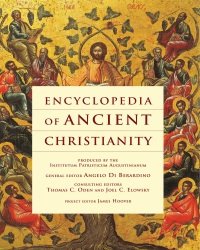
A. Di Berardino – Encyclopedia of Ancient Christianity
1.844 ₽
Автор: A. Di Berardino
Название книги: Encyclopedia of Ancient Christianity
Формат: PDF
Жанр: Философия и Религия
Страницы: 2940
Качество: Изначально компьютерное, E-book
2014 Midwest Publishing Association Award of Excellence (Scholarly/Reference) 2014 Readers' Choice Awards Honorable Mention The Encyclopedia of Ancient Christianity covers eight centuries of the Christian church and comprises 3,220 entries by a team of 266 scholars from 26 countries representing a variety of Christian traditions. It draws upon such fields as archaeology, art and architecture, biography, cultural studies, ecclesiology, geography, history, philosophy, and theology. This three-volume encyclopedia offers unparalleled, comprehensive coverage of the people, places and ideas of ancient Christianity, including:
cultural currents
events and movements
philosophy
iconography and architecture
archaeology
texts and translations
theological terms
doctrines
liturgy
spirituality
monasticism
Christian sects
heresies
controversies
councils
The encyclopedia's A-to-Z coverage extends from “Aaron (iconography)” to “Zosimus, pope” and chronologically from Christianity's origins to Bede (d. 735) in the West and John of Damascus (d. ca. 749) in the Greek East, with detailed emphasis on the first four centuries of Christian history. Its geographical range reaches across:
North Africa
Mauretania
Numidia
Africa Proconsularis Byzacena
Libya
Egypt
Nubia
Ethiopia
Asia
Adiabene
Armenia
Bithynia & Pontus
Georgia
Cappadocia
Lycia and Pamphylia
Phrygia
Syria
Mesopotamia
Arabia
Palestine
Persia
China
Europe
Gaul
Spain & Portugal
Italy
Germany
Britain and Ireland
Scotland
Pannonia
Dalmatia
Macedonia
Moesia
Thrace
Cyprus
Crete
This edition updates and expands on previous Italian and English-language editions with the addition of more than 500 new articles (added to the current Italian or English edition), including the following 30 articles exclusive to IVP's edition:
apostolic see
Capua
Carmen de synodo Ticinensi
China
cosmopolitanism
death
diakonia/diaconate
Dialogi de sancta Trinitate IV-V
doorkeeper (porter)
dynamis/energeia
eternity
forgiveness
freedom/free will
good
Hierotheus
incubatio
infinity/infinitude
libelli miraculorum
love
Mara bar Serapion (letter of)
oikeiosis
old age
presanctified
Serapeion (Serapeum)
subdeacon
Theosebia
Triumphus Christi heroicus
Tychon
unity
Virgo Parens
Extensive cross-referencing provides ease in exploring related articles, and helpful bibliographies, including primary sources (texts, critical editions, translations) and key secondary sources (books and journal articles), give access to the very latest in-depth scholarship in countless disciplines of study. IVP's new Encyclopedia of Ancient Christianity (2014) is translated from Nuovo dizionario patristico e di antichita cristiane (2006-2008), produced by the Institutum Patristicum Augustinianum, the world's foremost center for partristic studies, under the direction of Professor Angelo Di Berardino, and it greatly updates and expands the 1992 Encyclopedia of the Early Church (Oxford University Press/James Clarke).
A scholarly encyclopedia of Christian antiquity faces the daunting task of drawing together the results of research
on a vast field of study. The Dizionario patristico e di antichità cristiane (DPAC) was first published from
1983 to 1988 by Casa Editrice Marietti. Soon it became a prevailing resource for patristic scholars. It was evident
that it needed to be translated into English. So in 1992 the two-volume Encyclopedia of the Early Church (EEC)
was published by James Clarke & Co. in Great Britain and Oxford University Press in the United States, translated
by Adrian Walford with a foreword and bibliographic amendments by W.H.C. Frend.
The field of patristic studies has grown exponentially in the years since 1992, yet no comparable encyclopedia
has appeared in English since that time.
For more than twenty years the 1992 English edition from James Clarke/Oxford remained the standard of
the world of patristic studies. An ongoing process of revision by the original collaborators called forth the
Italian publication of the second edition of the Dizionario in Italian during the years 2006 to 2010—the
Nuovo dizionario patristico e di antichità cristiane (NDPAC); see the preface to the second Italian edition,
which follows, for indications of the additions and changes that were made.
This is the English translation of that expanded second edition of the Dizionario under the title Encyclopedia
of Ancient Christianity (EAC), published by InterVarsity Press. Both the Oxford and IVP editions have
been produced by the indefatigable Professor Di Berardino and his colleagues at the Institutum Patristicum
Augustinianum in Rome. To them a great debt is owed by all who engage in patristic studies now and in the
future. A new baseline of competence and information has been set. This new standard is characterized by
concise argument, breadth of international scholarship and richness of bibliography. This new edition has
been expanded by more than 35 percent, to 3,220 articles, written by 266 contributors from 26 countries.
Thirty new articles have been added since the Italian publication at the behest of Professor Di Berardino—
apostolic see, Capua, Carmen de synodo Ticinensi, China, cosmopolitanism, death, diakoniaâ•„/â•„diaconate,
Dialogi de sancta Trinitate IV-V, doorkeeper (porter), dynamis/energeia, eternity, forgiveness, freedom/free
will, good, Hierotheus, incubatio, infinity/infinitude, libelli miraculorum, love, Mara bar Serapion (letter of),
oikeiōsis, old age, presanctified, Serapeion (Serapeum), subdeacon, Theosebia, Triumphus Christi heroicus,
Tychon, unity and Virgo Parens—and the article on matristics has been updated.
Nothing like it exists in English. It covers key topics in early Christian studies with special attention to authors,
texts and contexts of the first through eighth centuries. Many articles are offered on figures and subjects not found
in previous patristic encyclopedias. This edition incorporates a far wider range of entries than its antecedents,
more fully embracing archaeological, philosophical, historical, geographic and theological arenas. Art historians,
linguistic experts, epigraphers and papyrologists are playing an increasing role in these findings. New insights into
Eastern European (Polish, Czech, Bulgarian and Hungarian) and Syriac traditions of patristic studies are better
represented than before. New entries have been added from Arabic, Coptic, Armenian and Gothic experts.
The expanded bibliographies alone are priceless for all who might venture into the study of the persons,
events and ideas of early Christian thought. Primary sources, texts and commentaries open up a vast theater of
reading on any of its subjects. W.H.C. Frend was right to say of the Encyclopedia of the Early Church in 1992:
“There is no work that can properly be compared with it.” This is a more extensive continuation of that work.
The time frame of the Encyclopedia encompasses the period from Clement of Rome to Bede and John of
Damascus—roughly AD 90 to 750, but with allowance for special cases such as Syria, Ethiopia, Mauretania
and Arabia.
The sheer mass of scholarly work on early Christianity is astounding. New studies with new methods
have been included. These contributors, along with our English translation editorial team of Joel Elowsky
and James Hoover, are offering an unrivaled resource in English for scholars around the world.
The purpose of an encyclopedia is to condense massive information about locations, figures, interpretations
and subjects into a suitably concise format commensurable with the importance of the subject. Its goal
is succinct summaries of complex data, offering an impartial, fact-based summation of diverse scholarship
along with sufficient bibliographies to guide readers further into this vast literature.
Several features of the Encyclopedia of Ancient Christianity (EAC) are worth noting at the outset. Extensive,
though not exhaustive, cross-referencing has been introduced to point readers to additional articles within
the EAC worth exploring in relation to various topics. Such references are indicated by asterisks (*) preceding
the approximate names of any additional articles to consult. So long as the referenced entry appears alphabetically
within the flow that readers should expect, the form may not be exact. Thus “*celibate” refers
readers to the article titled “celibacy of the clergy.” Where the appropriate entry would not be found alphabetically
in proximity to its expected place, additional information is supplied within parentheses, as in the
case of references to “deacon,” which take the following form “deacon (see *diakonia – diaconate).” Note that
the form (see * . . . ) always points to an article within the EAC. When “see” is in roman type, readers are
being directed to a standard outside reference work or to a work cited in the bibliography for the entry.
Readers are cautioned that not all cross-referencing is unambiguous; there are no fewer than seventeen
entries for “Eusebius” in the EAC, and while nearly all cross-references in this case are to Eusebius of
Caesarea in Palestine, readers may need to consult more than one entry to ascertain whether they have
identified the proper article. Context should make things clear. Generally, cross-referencing is supplied only
at the first mention of a related topic within an article or, in the case of long articles, at first mention within
each subsection. Common words that readers would undoubtedly expect to find within the EAC (bishop,
priest, pope) are usually not cross-referenced.
Facing the daunting task of reformatting the bibliographies and various elements of classical references
to conform to North American standards, we have decided to leave these items essentially as we found them
in the Italian edition. Thus readers are likely to find references in the form “Eusebius, HE V,16,5” where they
might expect “Eusebius, HE 5.16.5,” following the general European conventions that use commas where
North Americans are more inclined to use periods, and vice versa. This means on occasion, though rarely,
readers will find periods separating items in a series of page references. Readers should find no difficulty
locating sources once they accustom themselves to these conventions. The bibliographies likewise tend to
use italics for titles regardless of whether the titles indicate books, chapters within books, or journal articles.
We have also adjusted all instances of the feminine eadem and its abbreviation to Id. (the masculine abbreviation
for idem). We hope this provides no offense to women scholars, since we have done so in the interests
of treating all alike, of avoiding what is a highly uncommon abbreviation, and of precluding unintentional
mistakes in gender identification from mere initials.
Given the origins of the EAC, it will come as no surprise that, despite the multiple-languages sources
found within them, the bibliographies are nevertheless weighted toward secondary sources in Italian. No
systematic effort has been made to supplement them with additional bibliography in English, though this
should not pose an obstacle to further research given the wide range of sources provided. Readers will note
that frequently, though not universally, important reference works that are available in multiple languages
are so noted.
Despite the extensive list of bibliographical abbreviations, readers will still find abbreviations not listed
there. As the Italian edition notes, “Approximate abbreviations that can be easily understood are not included
in this list,” though we have added quite a few as an aid to readers. Occasionally, critical editions or
standard reference works are referred to simply by their editors. In referencing Cyprian’s letters, we have
sometimes inserted Hartel following the reference to indicate his numbering of the letters, which differs
substantially from the ANF numbering. Frequently, well-known works of ancient authors are referred to by
abbreviations either in Latin or in English without further explanation. We have followed the lead of the
Italian edition in this regard, allowing Latin to stand as is and translating Italian into English. Occasionally,
it has seemed preferable to use an unambiguous Latin title rather than a loose English title.
In the interests of space, we have frequently used abbreviations for common words (“c.” for either “century”
or “centuries”; “ca.” for “circa”; “esp.” for “especially”; “acc.” for “according”). We trust these will not
prove an obstacle to our readers.
It has been a joy to work together in providing readers with this marvelous resource. We hope you will
find much of value within it and be spurred to further research
Описание
A. Di Berardino – Encyclopedia of Ancient Christianity — фундаментальная энциклопедия, охватывающая весь период древнего христианства с I по VIII век. Издание содержит тысячи статей, посвящённых богословию, церковной истории, литургии, аскетизму, ключевым персоналиям, ересям, соборам и повседневной жизни ранних христиан.
Книга представляет собой перевод и адаптацию итальянского издания с дополнениями. Авторы — ведущие мировые специалисты по патристике — подробно разбирают развитие христианской мысли в контексте античной культуры, философии и римского права. Особое внимание уделено географии распространения христианства, монастырским традициям и влиянию на формирование европейской цивилизации.
- студентам и преподавателям богословия, истории Церкви и патристики
- исследователям античности и раннего Средневековья
- священнослужителям и всем, кто интересуется истоками христианского вероучения
- читателям, желающим получить точные академические сведения без идеологической окраски
Только зарегистрированные клиенты, купившие данный товар, могут публиковать отзывы.
Похожие


Другие книги раздела «Философия»
- J. van Huyssteen – Encyclopedia of Science and Religion
- Janet Broughton – A Companion to Descartes
- Jeff McMahan – The Ethics of Killing. Problems at the Margins of Life
- Joseph E. Brenner – Logic in Reality
- K. Haakonssen – The Cambridge History of 18-Century Philosophy
- Kwame Anthony Appiah – An Introduction to Contemporary Philosophy
- L. Gerson – The Cambridge History of Philosophy in Late Antiquity (2 Volumes)
- M. Lockwood – The Labyrinth of Time. Introducing the Universe
- Aziz Atiya – The Coptic Encyclopedia (8 Volume set)
- Berard Marthaler – New Catholic Encyclopedia (15 Volume set)
- David Noel Freedman – The Anchor Yale Bible Dictionary
- E. Dowling – Encyclopedia of Religious and Spiritual Development
- Jacob E. Safra – Britannica Encyclopedia of World Religions
- John Anthony McGuckin – The Encyclopedia of Eastern Orthodox Christianity
- K. Patton – Religion of the Gods. Ritual, Paradox, and Reflexivity
- L. Jones – Encyclopedia of Religion (14 Volume set, Second edition)
Все книги раздела «Философия» →
Смежные разделы: Бизнес-Книги · Биография · Боевики и Триллеры · Детективы · Детские книги · Школа · Дом и Семья · Здоровье · Искусство · Историческая проза · Классика · Компьютеры
Отзывы
Отзывов пока нет.