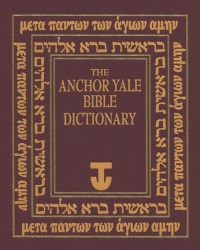
David Noel Freedman – The Anchor Yale Bible Dictionary
1.240 ₽
Автор: David Noel Freedman
Название книги: The Anchor Yale Bible Dictionary
Формат: PDF
Жанр: Философия
Страницы: 9907
Качество: Изначально компьютерное, E-book
This six-volume Bible dictionary contains more than 6000 entries from nearly a thousand contributors. Multicultural and interdisciplinary in scope it presents articles on all the major topics as well as pseudepigraphic and apocryphal texts, the historical Jesus, early Christianity's relations with other faiths, and much more
In view of Gary Herion‘s comprehensive Introduction to the Anchor Bible Dictionary, very little
needs to be added byway of preface, but a few words may be helpful. The project itself was initiated early
in the 1980s by conversations between Robert Heller, then head of the Religion Department at
Doubleday, and me. Because of the widespread acceptance and use of the Anchor Bible Critical
Commentaries, we felt that a companion work, the ABD, was an appropriate undertaking. As a
consequence, I prepared a master plan, which called for a set of fives: five volumes, five years, five
hundred contributors, and five million words. As such, it would have matched generally earlier major
works of the same kind: the justly regarded classic work of the turn of the century, The Hastings Dictionary of the Bible (in five volumes, 1898–1904), and the well-known Interpreter‘s Dictionary of the
Bible (also in five volumes, the first four appearing in 1962, with a fifth, supplemental volume in 1976).
Now, at the end of the first major stage of this enterprise (the submission of the manuscript), the ABD has
turned out to consist of six volumes, with nearly a thousand contributors, well over six million words,
with the completed manuscript submitted to the publisher in just six years. That it was done within this
period is a tribute to the last of the associate editors, Gary Herion, who delivered all six volumes in
manuscript form from the beginning of June to the latter part of August, 1990. While a project of such
magnitude is difficult to manage in its various aspects, the hardest part of all is to finish it and close it
down. Getting started certainly was not easy, but once this huge vehicle was well under way, it threatened
to become a runaway, moving faster and growing larger (like a snowball coursing down a mountainside)
and sweeping everything in its path. It is difficult to imagine how dangerous a prospect this can be, of
continuing and unlimited expansion, a never-ending process. It is not readily recognized that for each
topic assigned there are many more that could be assigned, and between every two entries there could
exist any number of others, all worthy of consideration. Even before the project has reached maximum
speed and efficiency, and manuscripts are pouring in in large numbers, it is necessary to call a halt, turn
off the power, and apply the brakes. The next most dramatic moment in the work comes with the decision
to call a halt and the declaration that the dictionary is done. Of course it isn‘t (and never will be) ―done‖
because the task of scholarship goes on, old entries need to be revised, and new entries need to be written;
but when the deadline arrives, the work is finished. It takes a person of character and courage to make
such a determination in the midst of the endless flow of words, but it is necessary. Not every assigned
article is received within the time limits, and not every one that is received is finally acceptable. But at
some point the declaration must be made, and the editors and the publisher must take what they have and
go on to the second major stage: producing the work of a whole generation of scholars in book form. Gary
Herion proved to be the right person in the right place at the right time. He came onboard after others had
started the project and moved it along. But he finished it, and for that a special accolade is in order. He
organized and coordinated the work force for this powerful push to the finish line, and he himself
contributed a major effort in negotiating with authors, bringing in the manuscripts, reading and editing the
latter. He set an example of conscientiousness and dedication that stirred the rest to emulation as well as
embarrassment: he came earlier and stayed later as time wore on and the deadlines approached. He was
the ideal coadjutor and chief of operations, and when the time came and the last whistle blew, he had
successfully completed what others had started.
I wish to add a personal word of gratitude to all those who had a hand in this undertaking, and whose
names are listed in Herion‘s Introduction. I want to mention in particular the administrative officers of the
University of Michigan, who provided substantial material assistance for the ABD, in particular the
several vice presidents for academic affairs who held the office during the life of the ABD project: Billy
Frye, James Duderstadt, Charles Vest, and Gilbert Whitaker. Each VPAA in turn renewed the
commitment and the support, the continuity being established and maintained by that most modest and
self-effacing of associate vice presidents, Robert Holbrook, who has been a faithful backer of this project
since its inception.
A final word of gratitude is owing to Astrid B. Beck, without whose constant and diligent oversight of
the Project and the Program on Studies in Religion, neither would have succeeded or even survived. She
maintained both at the highest levels of efficiency and equanimity during the most trying periods, when
the entire building was being torn apart and rebuilt, and when the work force threatened to overwhelm the
facilities, and the work load reached a crisis point. There is an unpayable debt owed by all of us.
DAVID NOEL FREEDMAN
Every generation needs its own Dictionary of the Bible. Within its pages one can expect to find
presented the essence of critical scholarship on subjects pertaining to the Bible, as those subjects are
understood by students of that generation. Thus while such encyclopedic reference works provide a
valuable service to their readers, in a larger sense they can never transcend the limits of their own
historical contexts. In time they inevitably become outdated, and after a generation or so they can hope to
achieve a sort of ―second shelf life‖ as a valuable period piece, witness to where the field of biblical
studies was at one point in its history.
It has been thirty years since the last major Bible dictionary appeared in America. The Biblical
Theology movement was in its heyday, and a certain ―consensus‖ on matters pertaining to the history and
literature of both testaments had been established. When reviewing English-language Bible dictionaries of
the time, one cannot help but notice the preponderance of word studies and of sweeping historical
reconstructions that were characteristic of the field at midcentury. One critic at the time noted this and
lamented that more attention was not being devoted to the critical issues of methods and assumptions.
Baldly stated, it seems that scholarship at that time was more interested in presenting ―the facts‖ than in
considering critically how we know them to be ―facts.‖The emphasis in biblical studies has changed
considerably since then. The mainstream American consensus that held in the 1950s and early ‘60s
unravelled during the 1970s. Sweeping historical reconstructions became increasingly rare as OT and NT
scholars alike began to engage in often fierce debates over methods and assumptions (e.g., about the role
and value of archaeology, and about the ―literary‖ nature of biblical historiography).And when syntheses
were attempted, one would very often find scholars moving beyond the venerable limits of the canon
itself: the vocation of ―biblical scholar‖ increasingly required one to be competent in dealing with a wide
range of later, extrabiblical texts attesting to the complex emergence of early Judaism and early
Christianity (or, as many would now insist, ―early Judaisms and early Christianities‖).
The Anchor Bible Dictionary is no less a product of its time. In some respects, the situation since the
1960s is now reversed: scholars now tend to be more preoccupied with considering how we know
something to be a ―fact‖ than in assembling those ―facts‖ into a meaningful whole. Thus the
overwhelming majority of major articles found in the following pages devotes a good deal of space to the
basic epistemological question: ―How do we know what we know about this topic?‖ One will be hard
pressed to find in these pages any sort of sweeping historical synthesis that presumes a scholarly
consensus. Scholarly consensus simply does not exist here at the end of the twentieth century.
Nevertheless in these six volumes there are still many new and refreshing insights one can discover
about biblical texts, about histories and personalities referred to therein, about religious ideas and themes
that find expression in its pages, about ancient Oriental and Hellenistic intellectual and cultural contexts
that almost invariably lie just beneath the surface of the text (if not on the surface itself), and about the
processes that helped to ensure the Bible‘s central place in nascent Judaism and Christianity. In short, the
ABD provides the scholarly world and the general public with an up-to-date and comprehensive treatment
of all biblical subjects and topics. Our goal has been to provide an eminently readable and yet
authoritative reference source for all readers of the Bible. To achieve this, we have assembled an
international host of scholars—including prominent archaeologists, Assyriologists, Egyptologists,
classicists, philosophers, and ancient historians—who have been selected on the basis of their expertise
and special contributions to biblical scholarship. They come with diverse professional and confessional
backgrounds, reflecting the growing pluralism and interdisciplinary interests of the field.
A review of ABD entries should quickly convince the interested student of the Bible that the ABD is
indeed an invaluable reference source and a powerful research tool. Yet the perceptive reader scanning
these pages and comparing its entries with those of other Bible dictionaries will also discover that there is
something to be learned here about the field of biblical studies itself. One may note, for example, the preponderance of new articles pertaining to the cultural history and social institutions that lie in the
background of ancient Israel and early Christianity; this is so because these days there is a relatively large
number of scholars with social science interests working in these areas. One will also note the large
number of articles dealing with archaeological sites and excavations; this is so because the last twentyfive
years have seen a veritable explosion of archaeological activity in the lands of the Bible. One will
also note specific entries treating pseudepigraphic and apocryphal texts, Nag Hammadi tractates, and
individual Dead Sea scrolls; this is so because the scope of scholarly interest has now extended beyond
the conventional limits of the canon. One will note that the so-called ―minor entries‖ on personal and
place names usually go beyond the one- or two-sentence recapitulations often found in other Bible
dictionaries; this is so because scholars today seem to have a keener interest in the often minute details
associated with genealogies and toponyms, and they appreciate how a careful reexamination of these
details can sometimes lead to fresh insights about the relationship between tradition and history.
Conversely one will not find as many minor or midlevel entries dealing with biblical lexical items; this is
so because we could not find many scholars interested in these subjects or able to push their presentations
beyond those found in other Bible dictionaries. What this means is that in some areas related particularly
to word studies the ABD simply does not replace such major English-language works as the IDB or the
still-incomplete TDOT. This also reveals something about the agenda and the priorities of biblical
scholarship in the 1970s and ‘80s.
One will also appreciate the extent to which biblical studies has become increasingly specialized and
even fragmented during the past thirty years. This first became apparent to us during the assignment phase
of the project, as more and more contributors expressed reservations about taking on assignments that did
not lie within the immediate bounds of their particular ―subject‖ or area of expertise. On the positive side,
this means that most ABDentries devote greater attention to crucial matters of data and methodology, so
that the reader usually gets an expert presentation of the basic issues associated with the study of this or
that topic. However, as noted above, the drawback is a certain reluctance to place a given topic within a
larger picture—to provide the sweeping and definitive synthesis that some readers desire and expect in a
dictionary of the Bible. When presented, syntheses in ABD entries tend to be developed more cautiously
than in earlier Bible dictionaries, and conclusions are frequently hedged with significant qualifications.
That is simply the way responsible critical biblical scholarship tends to be practiced today. One
ramification of this increased specialization is evident in our long list of contributors: those who would
lament all this as ―overspecialization‖ will no doubt delight in noting that in 1962 only 253 contributors
were needed to write more than 7,500 entries for the IDB, while thirty years later almost four times as
many were needed to write 6,200 entries for the ABD. This is an honest reflection of the nature of biblical
scholarship here in the final decades of the second millennium.
If it really will be another generation before the next major English-language dictionary of the Bible is
attempted, one senses that the ABD may in fact be one of the last of its kind. Somehow one suspects that
the next major English-language Bible dictionary may not be something one ―purchases‖ but something
to which one ―subscribes‖ (complete with annual updates and revisions); that—like money—its primary
medium will not be ink-on-paper but electronic impulses (complete with three-dimensional, interactive,
color graphics); that it will not be something you place on your shelf but that you load into your
computer. Despite all the exciting possibilities this presents, it is also a bit discomforting. Perhaps more
than anyone else, we who study the Bible should appreciate the power and the impact of the immutably
printed word that, for better or worse, reflects an age and a perspective that cannot easily be erased or
revised.
Описание
David Noel Freedman — The Anchor Yale Bible Dictionary представляет собой фундаментальный шеститомный справочник, который охватывает все ключевые аспекты библеистики, археологии, истории и культуры древнего Ближнего Востока. Это наиболее авторитетное современное академическое издание, объединившее работы свыше 600 ведущих мировых специалистов.
Словарь содержит более 6000 статей, посвящённых библейским книгам, персонажам, географическим названиям, археологическим объектам, историческим событиям, религиозным практикам и лингвистическим вопросам. Особое внимание уделяется актуальным научным данным, включая результаты раскопок, анализ древних текстов и современные методы исследования.
- Исследователям и преподавателям библеистики, теологии и древней истории
- Студентам духовных и гуманитарных вузов, изучающим Ветхий и Новый Завет
- Священнослужителям и всем, кто занимается глубоким изучением Библии
- Специалистам в области археологии и истории Древнего Востока
Только зарегистрированные клиенты, купившие данный товар, могут публиковать отзывы.
Похожие


Другие книги раздела «Философия»
- C. Hooker – Philosophy of Complex Systems (2011)
- Протоиерей Сергей Булгаков – Собрание сочинений (2016)
- Паскаль Буайе – Объясняя религию. Природа религиозного мышления (2017)
- И. Фокин – Philosophus Teutonicus. Якоб Бёме
- Люйши Чуньцю – Весны и осени господина Люя
- Марк Аврелий Антонин, Эпиктет – Размышления
- Ч. Кирвель – Социальная философия
- Ольга Власова – Антипсихиатрия. Социальная теория и социальная практика
- Гуннар Скирбекк – История философии
- Нагата Хироси – История философской мысли Японии
- Роджер Бэкон – Избранное
- Андре Конт-Спонвиль – Философский словарь
- Елена Князева – Эволюционная эпистемология
- Николай Бердяев – Сочинения
- Michael A. Peters – Encyclopedia of Educational Philosophy and Theory
- В. Поликарпов – Философские проблемы сознания
Все книги раздела «Философия» →
Смежные разделы: Бизнес-Книги · Биография · Боевики и Триллеры · Детективы · Детские книги · Школа · Дом и Семья · Здоровье · Искусство · Историческая проза · Классика · Компьютеры
Рекомендуем также
- S. Paul – Clinical Cases in Skin Cancer Surgery and Treatment (2016)
- Y. Sakai – Laparoscopic Surgery for Colorectal Cancer (2016)
- V. Stearns – Novel Biomarkers in the Continuum of Breast Cancer (2016)
- A. Mathur – Nanotechnology in Cancer (2017)
- P. Rennert – Novel Immunotherapeutic Approaches to the Treatment of Cancer
- M. Baranska – Optical Spectroscopy and Computational Methods in Biology and Medicine (2014)
- A. Bondanza – Tumor Immunology (2016)
- H. Seligmann – DNA Replication. Current Advances (2016)
Отзывы
Отзывов пока нет.