
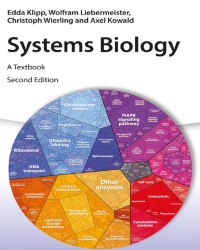
E. Klipp – Systems Biology (2016)
983 ₽
Автор: E. Klipp
Название книги: Systems Biology (2016)
Формат: PDF
Жанр: Биологические науки
Страницы: 507
Качество: Изначально компьютерное, E-book
This advanced textbook is tailored for an introductory course in Systems Biology and is well-suited for biologists as well as engineers and computer scientists.
It comes with student-friendly reading lists and a companion website featuring a short exam prep version of the book and educational modeling programs. The text is written in an easily accessible style and includes numerous worked examples and study questions in each chapter. For this edition, a section on medical systems biology has been included.
Systems biology is the scientific discipline that studies
the systemic properties and dynamic interactions in a
biological object, be it a cell, an organism, a virus, or an
infected host, in a qualitative and quantitative manner
and by combining experimental studies with mathematical
modeling. Scientists can describe the inner processes
of stars a thousand light years away with great accuracy.
But how a tiny cell under our microscope grows and
divides remains puzzling in many ways. We see kids
growing, people aging, plants blooming, and microbes
degrading their remains. We use yeast for brewery and
bakery, and doctors prescribe drugs to cure diseases. But
do we understand how processes of life work?
Starting in the nineteenth century, such processes
have no longer been explained by referring to special
“life forces,” but by laws of physics and chemistry. By
studying the structure and dynamics of living systems in
finer and finer details, researchers from different disciplines
have revealed how life processes arise from the
structure and functional organization of cells, how tens
of thousands of biochemical components interact in
orchestrated ways, and how these systems are regulated
by genetic information and continuously adapted
through mutations and selection. With this conceptual
shift, new questions became central in biology: How
does an organism’s phenotype emerge from the genotype,
as encoded in the organism’s DNA, and how is it
shaped by environmental factors? Initially, such questions
were approached by statistics, for example, by
studying what mutations are associated with specific
inheritable diseases. But the task, now, is to understand
the mechanistic details.
We can easily understand the effects of gene disruptions
when gene products have simple, specific functions.
However, most gene mutations have only weak or
quantitative effects on physiology, and many genetic diseases
are multifactorial. Tracing the effects of multiple
mutations, of mutations affecting gene regulation, or of drugs requires a deep, quantitative, and dynamical
understanding of cell physiology. In recent years, highthroughput
experiments, time series experiments, and
imaging techniques with high resolution have provided
us with a detailed picture of the cellular machinery. We
can observe how physical structures are built, maintained,
and reproduced, how the metabolic state is
changing, and how signaling and regulation systems
allow cells to adapt to their environment. However, to
understand how all these systems act together – and
how cells can work as complex, robust systems – cataloging
and understanding single-cell components is not
enough. Instead, we need to capture the global dynamics
between these components. This is where mathematical
models come into play.
Mathematical modeling has a long, though relatively
marginal, tradition in biology, and has influenced the
field in many ways. Models can be used to test hypotheses
and to yield quantitative predictions or reveal gaps
or inconsistencies in previous arguments, thus helping
us to improve our understanding of biochemical processes.
Inspired by the ideas of cybernetics in the sixties
and seventies, dynamical systems theory and control theory
have been increasingly applied to biochemical pathways.
Thanks to powerful experimental techniques in
genomics and proteomics, a wealth of biological data
has accumulated and computational models of cells are
now within reach. Systems biology, the discipline
devoted to developing such models, uses biochemical
networks as a main concept. It studies biological systems
by investigating the network components and their
interactions with the help of experimental high-throughput
techniques and dedicated small-scale investigations
and by integrating these data into networks and dynamical
simulation models.
Like many new fields of research, systems biology
started out with great expectations. High-throughput
data and computational models were hoped to provide answers to basic yet difficult biological questions: Why
do we age? What processes control cell proliferation,
and how? How do neurodegenerative disorders or diseases
such as cancer develop? How can we engineer
microbes more efficiently to produce valuable chemicals,
fuels, or specific drugs? Only few of these goals have
been achieved until now, and most of these questions
remain on our agenda. Nevertheless, systems biology has
greatly contributed to our understanding of cells and is
increasingly becoming a standard part of biological
research. It has fostered the formulation of new concepts
and methods, such as statistical network analysis, the
analysis of the robustness and fragility of dynamical systems,
and the analysis of molecular noise. Even more
importantly, it has enabled experimental biologists to
realize that some scientific ideas cannot be easily
expressed by words only. Inspired by electrical engineering,
biologists now communicate the structure of biochemical
systems by network graphics, which can then
be translated into dynamical models.
This book gives an overview of systems biology as a
rapidly developing field and provides readers with established
and emerging tools and methods. You will learn
how to formulate mathematical models of biological
processes, how to analyze them, how to use experimental
data and other types of knowledge to make models
more precise, and how to interpret their simulation
results. Based on our own experiences in teaching
undergraduate and graduate students, the book is
designed as an introductory course for students of biology,
biophysics, and bioinformatics. It is as well useful
for senior scholars who approach systems biology for the
first time or seek more information about specific concepts
and techniques. In the first chapters, we introduce
stoichiometric and kinetic models, the main theoretical
frameworks for metabolism and signaling pathways. We
continue with methods for model construction (including
model fitting, data handling, and model reduction)
and related formalisms (spatial, discrete, and stochastic
models). Then, we move on to experimental highthroughput
techniques and to cellular networks. The
analysis of regulation networks leads us to more general
perspectives on cell physiology, including modularity,
robustness, and optimality. The main part of the book ends with a chapter on case studies. Addressing readers
with different scientific backgrounds, we have added a
reference section summarizing some basic knowledge of
cell biology and mathematics, followed by a survey of popular
biological databases and software tools. Further material
is available on an accompanying Web site (http://
www.wiley-vch.de/home/systemsbiology), which also contains
solutions to the exercises presented in the book.
For the second edition of this book, we have updated
and expanded the text to reflect advances in the field,
and have reorganized the chapters to improve readability.
Many of the changes reflect current developments in
systems biology. On the one hand, the development of
software tools is a very active area, where many new
tools are developed, while others drop into oblivion. In
the meantime, SBML has become an established
exchange format for computational models in systems
biology. We also notice that systems biology as a whole
has become a mainstream discipline: High-throughput
measurements have become an integral part of cell biology,
computational models are used in research and
teaching, and collaborations between experimentalists
and theoreticians are increasingly common. Today, systems
biology is perceived as what it is: the endeavor to
understand complex processes in living organisms. Not
more, but also not less!
We thank our friends and colleagues who helped us
write this book. We are especially grateful to Mariapaola
Gritti, Bernd Binder, Andreas Hoppe, Dagmar Waltemath,
Elad Noor, Avi Flamholz, Terence Hwa, Ron
Milo, Jonathan Karr, Ulrich Liebermeister, David Jesinghaus,
Martina Fröhlich, and Severin Ehret for reading
and commenting on the text. We thank the Max Planck
Society for support and encouragement. We are grateful
to the European Commission for funding via different
European projects (UniCellSys, SysteMTb and FinSysB
to EK, HeCaToS 602156), the German Ministry for Education
and Research, BMBF (ViroSign, OncoPath, Sys-
ToxChip to EK), and the German Research Foundation
(GRK 1772 to EK, Ll 1676/2-1 to WL).
The book is dedicated to our teacher Prof. Dr. Reinhart
Heinrich (1946–2006) whose work on metabolic
control theory in the 1970s paved the way to systems
biology and who greatly inspired our minds
Описание
E. Klipp – Systems Biology (2016) — это современное введение в одну из самых динамично развивающихся областей науки на стыке биологии, математики и информатики. Книга объясняет, как изучать живые системы не как набор отдельных компонентов, а как целостные сети взаимодействий, где изменения в одном элементе влияют на всё поведение клетки, ткани или организма.
Автор подробно разбирает ключевые концепции: реконструкцию биологических сетей, математическое моделирование метаболизма, сигнальных путей и регуляции генов, а также методы анализа больших данных и симуляции динамики систем. Издание сочетает теоретические основы с практическими примерами и инструментами, которые уже используются в исследованиях.
- студентам и аспирантам биологических, биоинженерных и биоинформатических специальностей
- исследователям, переходящим от классической молекулярной биологии к системному подходу
- специалистам в области вычислительной биологии и биоинформатики
- всем, кто хочет понимать современные методы анализа сложных биологических процессов
Только зарегистрированные клиенты, купившие данный товар, могут публиковать отзывы.
Похожие


Другие книги раздела «Биологические науки»
- P. Ghosh – Introduction to Protein Mass Spectrometry (2016)
- J. Peterson – Calculus for Cognitive Scientists (2016)
- M. Leake – Chromosome Architecture (2016)
- MIT Critical Data – Secondary Analysis of Electronic Health Records (2016)
- P. Chatterjee – Bacterial Artificial Chromosomes (2011)
- S. Ranjan – Nanoscience in Food and Agriculture (5 Volume set)
- C. Kole – Plant Nanotechnology (2016)
- Y. Yamaguchi – Immunotherapy of Cancer (2016)
- Н. Парамонова – Гематология детского возраста (2014)
- С. Зиматкин – Гистология, Цитология и Эмбриология
- M. Mishra – Epigenetic Advancements in Cancer (2016)
- A. Mathur – Nanotechnology in Cancer (2017)
- D. Langenau – Cancer and Zebrafish (2016)
- E. Song – The Long and Short Noncoding RNAs in Cancer Biology (2016)
- G. Thouand – Bioluminescence. Fundamentals and Applications in Biotechnology (3 Volume set, 2016)
- H. Liu – Cancer Stem Cells (2016)
Все книги раздела «Биологические науки» →
Смежные разделы: Медицина на испанском языке · Медицина на немецком языке · Медицина на французском языке · Анестезиология и Реаниматология · Акушерство и Гинекология · Ветеринария · Гастроэнтерология и Гепатология · Дерматология и косметология · Диетология и нутрициология · Иммунология и Аллергология · Кардиология · Лапароскопия и Эндоскопия
Рекомендуем также
- John Westfall – Celestial Shadows. Eclipses, Transits, and Occultations (2015)
- Jeffery Burley – Encyclopedia of Forest Sciences
- Rob Kitchin – International Encyclopedia of Human Geography
- А. Корольченко – Пожаровзрывоопасность веществ и материалов и средства их тушения (Второе издание, 2 Тома)
- F. Bruinsma – Railway Development. Impacts on Urban Dynamics (2008)
- H. Stadtler – Supply Chain Management and Advanced Planning (5th edition)
- A. Janahmadov – Synergetics and Fractals in Tribology (2016)
- Anna M. Fan – Toxicology and Risk Assessment (2015)

Отзывы
Отзывов пока нет.