
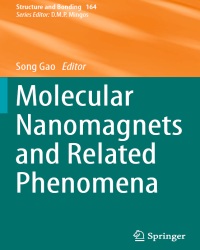
S. Gao – Molecular Nanomagnets and Related Phenomena
1.445 ₽
Автор: S. Gao
Название книги: Molecular Nanomagnets and Related Phenomena
Формат: PDF
Жанр: Нанотехнологии
Страницы: 468
Качество: Изначально компьютерное, E-book
The series Structure and Bonding publishes critical reviews on topics of research concerned with chemical structure and bonding. The scope of the series spans the entire Periodic Table and addresses structure and bonding issues associated with all of the elements. It also focuses attention on new and developing areas of modern structural and theoretical chemistry such as nanostructures, molecular electronics, designed molecular solids, surfaces, metal clusters and supramolecular structures. Physical and spectroscopic techniques used to determine, examine and model structures fall within the purview of Structure and Bonding to the extent that the focus is on the scientific results obtained and not on specialist information concerning the techniques themselves. Issues associated with the development of bonding models and generalizations that illuminate the reactivity pathways and rates of chemical processes are also relevant. The individual volumes in the series are thematic. The goal of each volume is to give the reader, whether at a university or in industry, a comprehensive overview of an area where new insights are emerging that are of interest to a larger scientific audience. Thus each review within the volume critically surveys one aspect of that topic and places it within the context of the volume as a whole. The most significant developments of the last 5 to 10 years should be presented using selected examples to illustrate the principles discussed. A description of the physical basis of the experimental techniques that have been used to provide the primary data may also be appropriate, if it has not been covered in detail elsewhere. The coverage need not be exhaustive in data, but should rather be conceptual, concentrating on the new principles being developed that will allow the reader, who is not a specialist in the area covered, to understand the data presented.
The discovery of single-molecule magnets (SMMs) at the beginning of the 1990s
opened a new interdisciplinary field in between chemistry, physics, materials, and
nanoscience. The first SMM Mn12 cluster is a nanoscale molecule showing slow
magnetic relaxation and quantum tunneling of magnetization. Some molecular
nanowires with similar behaviors were found about 10 years later and named as
single-chain magnets (SCMs). In the following decade, a few single-ion magnets
(SIMs) were reported; they can be considered as a new family of molecular nanomagnets
(MNs).
In 2006, volume 122 of Structure and Bonding had been devoted to “Single-
Molecule Magnets and Related Phenomena,” edited by Richard Winpenny. This is
a continued volume and extended to more wide and comprehensive topics in the
rapid growth field. Some authors of last volume also have their contributions to this
volume. This volume covers various molecular nanomagnets, from materials to
magnetism to device and from basis to method to application.
This volume consists of nine chapters: the first five chapters mainly focus on the
different molecular nanomagnets, their synthesis, structures, intrinsic magnetic
properties, theoretical and experimental methods; the followed four chapters mainly
focus on related phenomena and potential applications.
The first chapter of this volume by Milios and Winpenny mainly focuses on
the development of cluster-based SMMs since 2005 and summarizes astonishing
number of beautiful new cluster-based SMMs, from 3d to 4d/5d, to 4f-elements.
The clusters reported herein are categorized and commented in terms of their metal
content from the synthetic chemist’s point of view.
From 2003, SMMs have been extended from clusters to some mononuclear
lanthanide coordination compounds or organometallics. In the second chapter
Jiang, Wang, and Gao review four series of well-investigated lanthanide singleion
magnets, theoretical and experimental investigation methods, especially the
advanced methods of the angle-resolved magnetometry measurement on lanthanide
ions. Transition metal based SIMs are not included. In the third chapter, the static and dynamic magnetic properties of single-chain
magnets and related systems are reviewed by Coulon, Pianet, Urdampilleta, and
Clee´rac based on a theoretical point of view. Authors particularly focus on the
so-called Ising limit, from simple regular chain of ferromagnetically coupled spins,
to more complicated structures including chains of antiferromagnetically coupled
magnetic sites. The section “from SCM to 3D ordered systems” provides a new
insight into the single chain magnets.
The understanding of mechanisms of magnetic anisotropy in molecular nanomagnets
became a task of primary importance in the last decade. In the fourth
chapter, Chibotaru discusses the physical reasons for magnetic anisotropy and the
mechanisms of its appearance in mononuclear and polynuclear metal complexes.
Differences in the manifestation of magnetic anisotropy between complexes with
weak and strong spin-orbit coupling are emphasized.
Following the theoretical chapter, four physicists Baker, Blundell, Domingo,
and Stephen Hill present a fairly comprehensive review of some of the primary
spectroscopic methods that have contributed to the current understanding of molecular
nanomagnets. These include: electron paramagnetic resonance (EPR); optical
spectroscopy, including magnetic and X-ray magnetic circular dichroism
(MCD/XMCD); inelastic neutron scattering (INS); and muon spin rotation
(m+SR). Each section provides a background of the physics of the techniques before
launching into some well-selected examples.
In the sixth chapter, Cornia and Mannini present a critical overview of the latest
achievements in the deposition of SMMs as monolayers or submonolayers on
native or prefunctionalized surfaces. Special emphasis is placed on the selection
and design of molecular structures that withstand solution- or vapor-phase processing
and maintain their magnetic functionality on a surface.
In the seventh chapter, Bogani reviews the experimental state of the art of
molecular spintronics using molecular magnet. After a brief introduction to the
fundamental concepts in the field, all possible approaches to fabricate molecular
spintronic devices have been summarized. He also provides a brief discussion of the
future directions and the considerable challenges that remain unexplored in the
field.
Another potential application of molecular nanomagnets is quantum computation.
Ghirri, Troiani, and Affronte introduce basic concepts, stressing analogies
between the physics and the chemistry of molecular nanomagnets and the science of
computing. They review main achievements, present challenges, and focus on two
emerging topics: quantum simulators and hybrid systems made by resonant cavities
and molecular nanomagnets.
Last chapter by Luis and Evangelisti review history, materials, and underlying
physics that form a background common to magnetic refrigeration and spin–
lattice relaxation. To illustrate how these subjects are profoundly interrelated
with each other, they describe studies performed on two gadolinium-based single
molecule magnets and their promising applications as low temperature magnetic
refrigerants. Last but not least, I am greatly indebted to all authors who have contributed to
these important and exciting topics and I hope that the readers will find this volume
useful, stimulating, and inspirational to their research. I also greatly appreciate the
help of June Tang, Chemistry Editor of Springer, in organizing this volume.
Описание
S. Gao – Molecular Nanomagnets and Related Phenomena — это специализированное научное издание, посвященное быстро развивающейся области молекулярного магнетизма и наноразмерных магнитных систем. Книга объединяет обзоры ведущих исследователей и освещает ключевые достижения в синтезе, физике и применении молекулярных наномагнитов.
Автор подробно рассматривает спин-кроссовер, магнитные свойства одно-молекулярных магнитов (SMM), квантовые эффекты, релаксацию спина, а также перспективы использования таких материалов в молекулярной спинтронике, квантовых компьютерах и высокоплотной магнитной памяти. Издание отражает современное состояние исследований на стыке химии, физики и материаловедения.
- Исследователям и аспирантам, работающим в области молекулярной нанотехнологии и магнетизма
- Специалистам по спинтронике и квантовым технологиям
- Химикам, синтезирующим координационные соединения и кластеры
- Студентам старших курсов и преподавателям, изучающим современные проблемы физики наноматериалов
Только зарегистрированные клиенты, купившие данный товар, могут публиковать отзывы.
Похожие




Другие книги раздела «Нанотехнологии»
- A. Grumezescu – Nutrient Delivery. Nanotechnology in the Agri-Food Industry (2016)
- A. Tiwari – Advanced 2D Materials (2016)
- A. Zhang – Nanowires (2016)
- B. Xing – Engineered Nanoparticles and the Environment (2016)
- C. Kumar – X-ray and Neutron Techniques for Nanomaterials Characterization
- C. Nicolini – Nanobiotechnology in Energy, Environment and Electronics (2015)
- C. Weinberger – Multiscale Materials Modeling for Nanomechanics (2016)
- F. Nasirpouri – Electrodeposition of Nanostructured Materials (2017)
- J. Karger – Diffusion in Nanoporous Materials (2012)
- J. Sone – Intelligent Nanosystems for Energy Information and Biological Technologies (2016)
- M. Aliofkhazraei – Handbook of Mechanical Nanostructuring (2015)
- M. Prechtl – Nanocatalysis in Ionic Liquids (2017)
- M. Werner – The Nano-Micro Interface (2015)
- S. Fakirov – Nano-Size Polymers (2016)
- S. Thomas – Rheology and Processing of Polymer Nanocomposites (2016)
- W. Lee – Microtechnology for Cell Manipulation and Sorting (2017)
Все книги раздела «Нанотехнологии» →
Смежные разделы: Авиация и космонавтика · Астрономия · Геология и Геодезия · Железнодорожное дело · Журналистика · Математика · Машиностроение · Научно-популярная литература · Физика · Химия · Экология · Энергетика
Рекомендуем также
- W. Zhang – Measurement Technology for Micro-Nanometer Devices (2016)
- Yu Yao – Robust Control (2016)
- T. Gasser – Basiswissen Urologie (6 Auflage, 2015, Немецкий язык)
- D. Ubelaker – The Global Practice of Forensic Science (2015)
- G. Christ – Handbook of Oncology Social Work (2015)
- J. Wu – Variational Methods in Molecular Modeling (2017)
- M. Rai – Nanotechnology for Bioenergy and Biofuel Production (2017)
- W. Hustrulid – Open Pit Mine Planning Design (2013)

Отзывы
Отзывов пока нет.