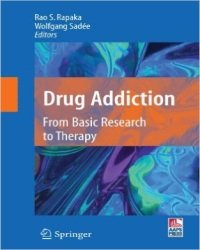
R. Rapaka – Drug Addiction. From Basic Research to Therapy
6.850 ₽
Автор: R. Rapaka
Название книги: Drug Addiction. From Basic Research to Therapy
Формат: PDF
Жанр: наркотическая зависимость
Страницы: 786
Качество: Изначально компьютерное, E-book
This book provides a comprehensive overview of physiological, biochemical, and genetic pathways underlying drug addiction, and resultant efforts to develop novel treatment strategies dealing with drug addiction and other CNS disorders where the neurophysiological processes overlap, such as treatment of pain. The volume focuses on the translation of fundamental addiction research to a variety of treatments and brings together scientists with wide ranging expertise.
This book affords a comprehensive overview of current research on drug addiction
and related disciplines, with topical reviews written by eminent scientists in the field.
It was inspired by a joint AAPS–NIDA symposium “Frontiers in Science: Drug
Addiction – From Basic Research to Therapies”, held in September 2004, at the NIH
campus. Subsequently, we have invited leading scientists to contribute chapters on a
broad range of topics, covering basic research (e.g. mechanisms of action of drugs of
abuse, development of receptor-specific ligands, animal models), discovery and
development of therapies, and other clinical applications. As neuronal circuits
involved in drug addiction also impinge upon many other vital functions of the brain
and peripheral tissues, we have broadened the scope to include pathophysiologies
related to drug abuse/addiction. For example, the complex actions of opioids on pain,
addiction liability, and other adverse effects have triggered an intensive search for
non-addictive opioid pain medications and for non-opioid analgesics directed against
novel targets. Other directions include treatment of stimulant addiction and toxicity,
new therapies for gastrointestinal dysfunction, inflammation, cognitive and neurodegenerative
disorders, and immunological diseases.
This book is divided into several portions, each addressing issues of importance
in drug addiction or in scientific areas that have naturally evolved as research targets
for addiction researchers:
1. General topics
2. Transporters and stimulants and hallucinogens
3. Drug design: nicotine, opioids, and related ligands
4. Opioids: general
5. Cannabinoids
The first section starts out with a detailed analysis of a principal addiction pathway
involving DARPP32, a key regulator of dopamine signaling, presented by
Greengard and colleagues. This is followed by drug discovery from natural sources
(Kinghorn), antibodies, endogenous peptides, and small RNAs as drug candidates,
and computational analysis of G protein coupled receptors (Reggio). The scope of
basic topics further includes pharmacogenetics (Rutter), and addresses the role of
chemokines, nicotinic receptors, and PDZ domains as protein–protein interaction
modules.
The second section addresses issues related to neurotransmitter transporters and
their role in mediating the effects of stimulants and hallucinogens. This focuses
on monoamine synaptic reuptake transporters and cocaine, among other stimulants.
A series of chapters further discuss the interaction of stimulants and hallucinogens
with various receptors and their mechanisms of action.
The third section “Drug design: nicotine, opioids, and related ligands” critically
assesses the molecular biology, physiology, and pharmacology of receptors and
other targets for drugs of abuse. Focusing on drug design, several chapters address
the basic tools for drug discovery such as crystallography and chemistry, with applications
to opioid and nicotinic receptors. This leads to Sect. 4 with opioid ligands
and their interaction with target receptors as the focus. Relevant issues include
molecular modes of target interactions, opioid receptor regulation and tolerance, the
relevance of receptor oligomerization, CNS drug delivery, homology modeling, and
the serendipitous discovery of cell-permeable, mitochondrial-targeted peptide antioxidants
– an example of a distinct application arising from addiction research.
The last section deals with cannabinoids, an area of tremendous recent growth
because of the role cannabinoids play in multiple physiological systems, including
those involved in pain modulation.
These diverse disciplines and technologies all converge on a more detailed
understanding of addiction and the promise for developing improved treatment
strategies for a spectrum of neurological disorders. This volume uniquely brings
together seemingly disparate, but nevertheless complementary critical reviews that
together paint a rather comprehensive picture of current efforts in drug addiction
and its treatment. It also shows how one discipline reaches into many other areas,
with the interplay among them yielding the promise for significant advances in
understanding and treating drug addiction and related disorders.
Описание
Книга R. Rapaka – Drug Addiction. From Basic Research to Therapy объединяет современные данные фундаментальных исследований и клинических подходов к проблеме наркомании. Авторы разбирают механизмы формирования зависимости на уровне мозга, генетики и нейрохимии, а также рассматривают актуальные стратегии лечения и реабилитации.
Издание охватывает широкий спектр тем: от молекулярных основ действия психоактивных веществ до разработки новых фармакологических препаратов и немедикаментозных методов терапии. Особое внимание уделено переходу научных открытий в реальную медицинскую практику.
- специалистам в области наркологии и психиатрии
- нейробиологам и фармакологам, изучающим механизмы зависимости
- студентам и аспирантам медицинских и биологических специальностей
- исследователям, работающим над созданием новых методов терапии
Только зарегистрированные клиенты, купившие данный товар, могут публиковать отзывы.
Похожие


Другие книги раздела «Химия»
Смежные разделы: Авиация и космонавтика · Астрономия · Геология и Геодезия · Железнодорожное дело · Журналистика · Математика · Машиностроение · Нанотехнологии · Научно-популярная литература · Физика · Экология · Энергетика
Рекомендуем также
- О. Швецова – Технология изготовления изделий по индивидуальным заказам
- R. Patel – Green Biocatalysis (2016)
- T. Jezierski – Canine Olfaction Science and Law (2016)
- M. Colecchia – Pathology of Testicular and Penile Neoplasms (2016)
- Н. Куликов – Водоснабжение (2016)
- C. Salgado – Aesthetic and Functional Surgery of the Genitalia
- A. Khan – Precision Molecular Pathology of Breast Cancer (2015)
- J. Rowley – Chromosomal Translocations and Genome Rearrangements in Cancer (2015)
Отзывы
Отзывов пока нет.